Written by gary@nbkaison.com
Commercial Ice Machine Leak Testing Before Shipment
Commercial ice machine leak testing should follow a documented sequence from pressure control through joint checks, evacuation, charging, performance testing, and final release. Each stage answers a different question. Pressure holding evaluates the sealed circuit, a detector helps locate leakage, evacuation removes air and moisture, and an ice-making run confirms operation under defined conditions. Buyers should request the model, refrigerant, test boundary, applied pressure, holding time, acceptance criterion, result, and release authorization for their order. A single pressure value cannot describe every configuration, because circuit design, approved components, refrigerant, cooling method, and destination requirements can change the applicable test conditions.
What Commercial Ice Machine Leak Testing Must Prove
A useful leak test starts with the correct system boundary.
Refrigerant tightness differs from water leakage
Refrigerant tubing and the water circuit serve separate functions. A dry evaporator can still have a refrigeration leak, while a sealed refrigerant circuit says nothing about a loose water inlet or drain connection.
The distinction matters.
A buyer therefore needs separate evidence for the sealed refrigeration circuit and the water path, even when both systems are assembled inside one compact cabinet before shipment at the factory.
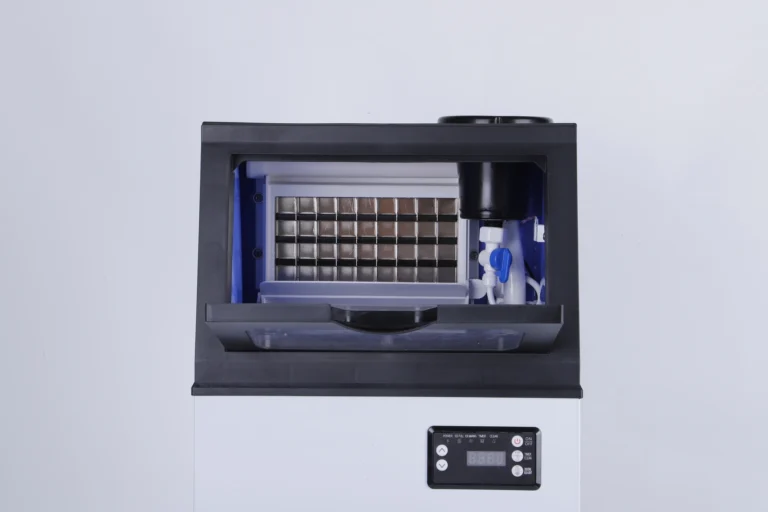
For a built-in bin ice machine, the inspector may see the cabinet, pump, evaporator, condenser, and storage section together, yet each fluid path still needs its own acceptance method and record.
The boundary follows the ordered configuration
The tested boundary must match the machine that will ship. A separate bin ice machine may include field connections or a different condensing arrangement, so the factory record should identify exactly which assembled circuit was under pressure.
Voltage, refrigerant, condenser type, and approved component selections also belong with the model identity. Without that configuration context, two records bearing the same commercial model name may describe different refrigeration circuits and cannot support the same release decision.
Where Refrigeration Leaks Can Begin
Leak checks should follow the physical route of the circuit.
Brazed joints and service connections
Every joint introduces an interface that deserves controlled inspection. The practical route begins at compressor connections, continues through condenser and filter-drier joints, reaches the metering device and evaporator, then returns through the suction line.
Following the circuit in a fixed order helps inspectors cover compressor connections, condenser joints, the filter-drier, metering device, evaporator tubing, service points, and the complete suction return without losing track of access points.
Small details count.
On a cube ice machine, a compact cabinet can place several joints close to panels, insulation, wiring, and water components, making orderly access and clear identification important before the enclosure is completed.
Tubing supports and vibration contact points
Leaks do not originate only at visible braze fillets. Unsupported tubing, tight bends, contact with a sharp panel edge, or excessive movement near the compressor can create stress that develops after initial assembly.
The condenser arrangement changes the inspection route. An air-cooled ice machine adds fan and airflow clearances, while a water-cooled ice machine adds condenser-water connections that remain distinct from the refrigerant boundary.
Combine visual inspection with pressure and location checks
A smooth-looking joint confirms visible workmanship. Pressure behavior and a suitable locating method then evaluate the sealed circuit under the approved test conditions.
Use the methods together.
A pressure hold checks the complete sealed boundary over time, while localized checking identifies a connection that needs attention when the circuit response falls outside the approved acceptance condition.
How KAISON Applies Leak Control During Production
Leak control comes before evacuation, charging, and final machine testing.
Before evacuation begins, the production team confirms the approved pressure, holding time, circuit boundary, test medium, acceptance criterion, and order identification for the exact machine configuration being built on the line.
Brazing, checking, and nitrogen pressure holding
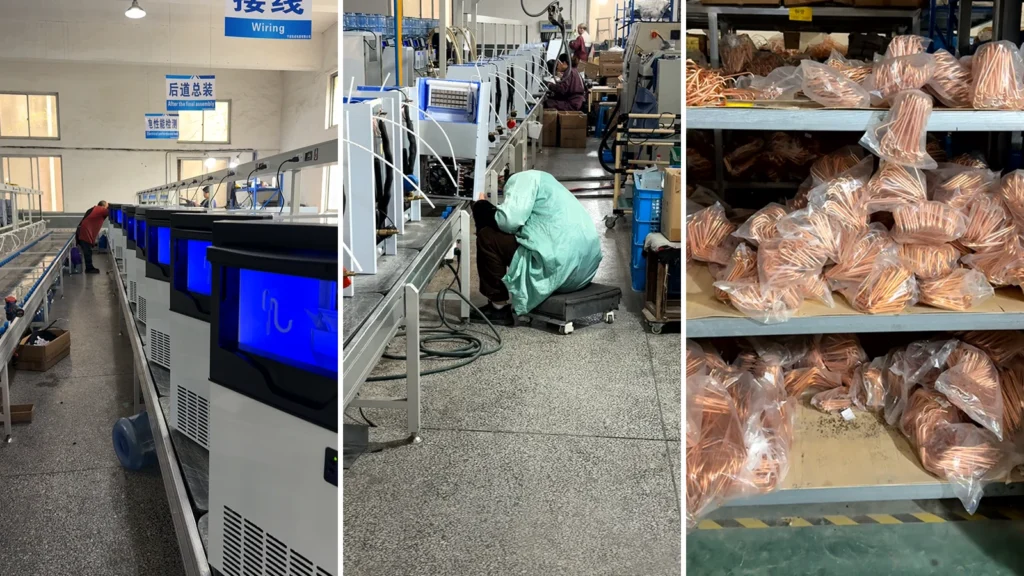
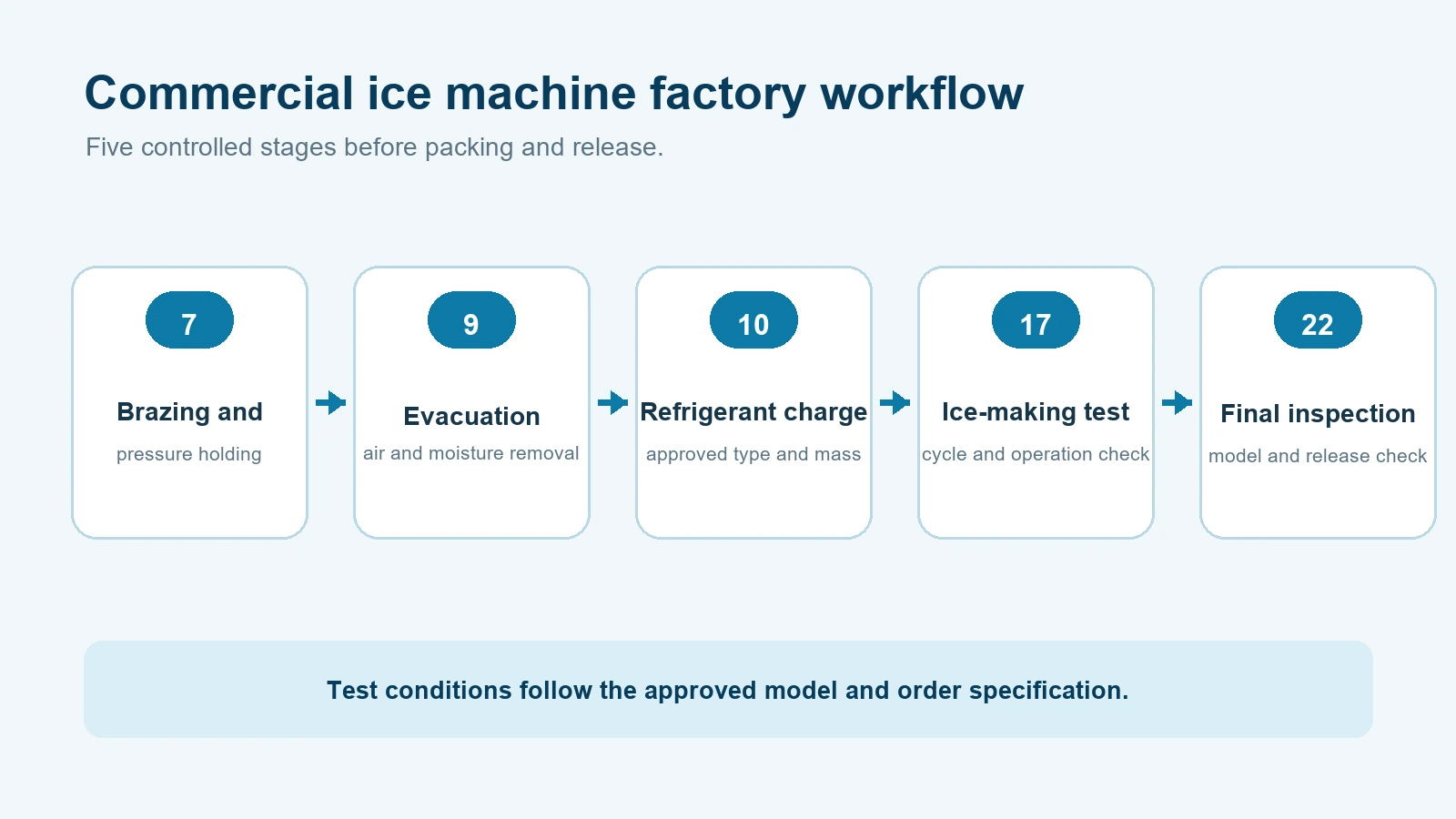
KAISON places brazing, leak checking, nitrogen charging, and pressure holding at step 7 of the production flow. One approved project configuration uses 1.2 MPa, equal to 12.0 bar or 174.0 psi.
Use this value when the model drawing, refrigerant circuit, component limits, and order specification call for it. Other commercial ice maker configurations receive their own approved pressure setting.
Pressure requirements follow the approved circuit
KC/ZBJ 003-2024 requires refrigerant piping to withstand 1.5 times working pressure for 30 minutes without leakage. Because the requirement is based on working pressure, it scales the check to the approved circuit.
The approval basis stays clear.
The production team selects the applicable pressure and holding time from the approved order documents before the circuit moves to evacuation.
Joint criteria support consistent inspection
The finished-product inspection requirement sets a maximum refrigerant leakage rate of 0.5 g per year for each brazed joint. The method uses a leak detector and records the result against the order configuration.
The criterion is precise.
Converted for reference, 0.5 g per year equals 1.37 mg per day or 0.01764 oz per year. The completed inspection entry connects the criterion with the shipped configuration.
| Factory stage | Control objective | Order-specific requirement | Buyer document |
|---|---|---|---|
| Brazing and leak control | Seal refrigerant joints before evacuation | Approved nitrogen pressure and circuit boundary | Production inspection entry |
| Pressure holding | Check circuit tightness over a defined time | 1.5 times working pressure for 30 minutes when KC/ZBJ 003-2024 applies | Pressure, time, temperature, and result fields |
| Joint leak check | Check brazed joints against the acceptance rate | Maximum 0.5 g/year per joint when this criterion applies | Leak-check result linked to the order |
| Evacuation | Remove air and moisture after pressure control | Vacuum target and duration from the approved work instruction | Evacuation entry |
| Refrigerant charging | Add the specified refrigerant mass | Refrigerant type and charge from the order specification | Charging entry |
| Ice-making test | Confirm cycle operation after charging | Stated test conditions and result | Performance-test entry |
| Final inspection | Match the machine and documents before packing | Model, nameplate, serial or batch reference | Final release entry |
Set Pressure, Time, and Temperature for the Ordered Model
The ordered machine configuration determines every recorded test condition.
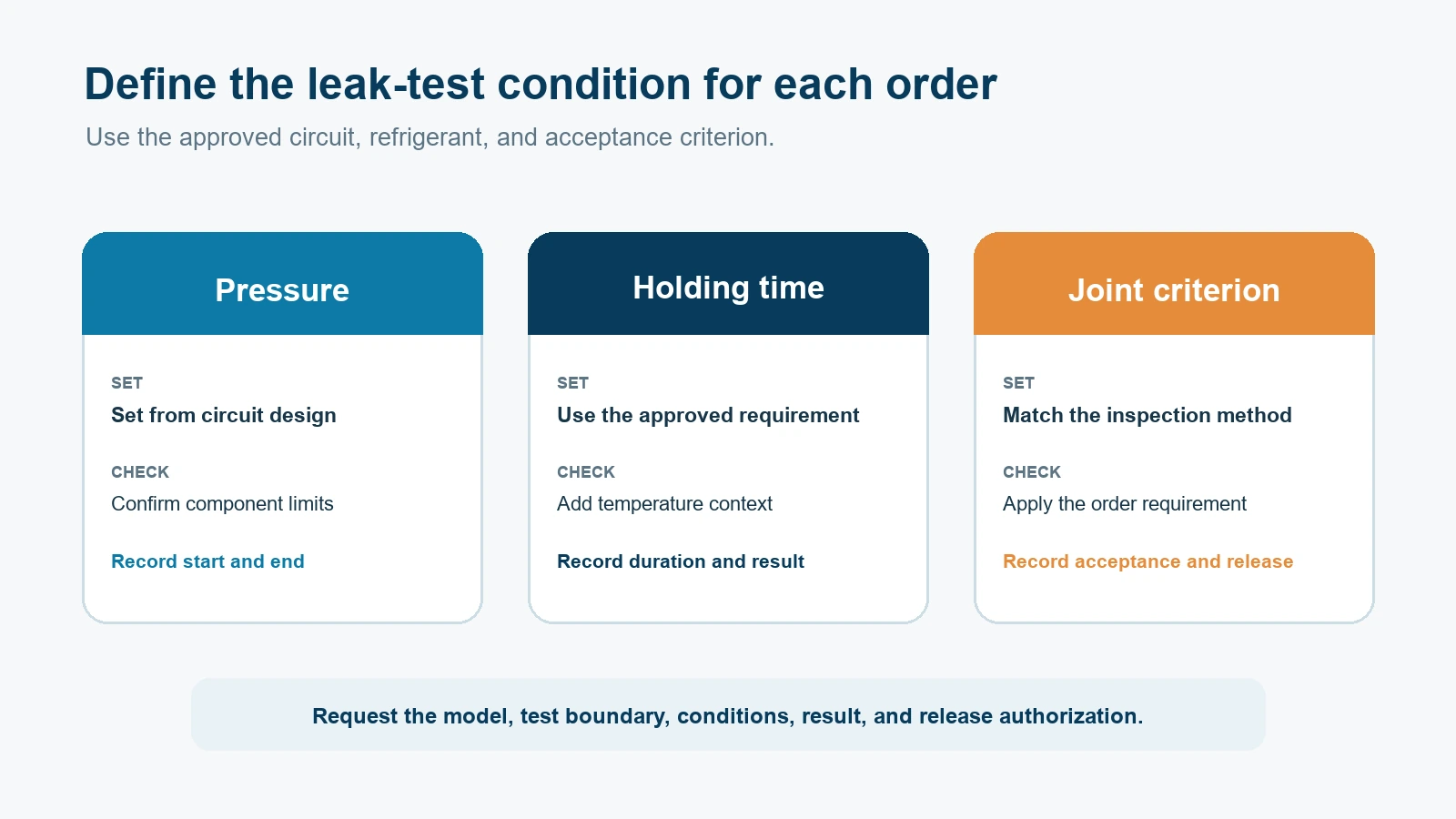
Recording temperature beside the starting and ending pressure helps engineering reviewers distinguish normal gas-pressure movement from a circuit response that falls outside the approved acceptance rule for that production order during testing.
Pressure must stay within approved component limits
Engineering sets the pressure from the circuit design and component ratings. The selected value must remain within the permitted limits of the compressor, condenser, evaporator, valves, and tubing.
Pressure is only one field.
A complete entry identifies the test medium, start and end conditions, holding duration, circuit boundary, model, and acceptance rule, giving the buyer a clear basis for shipment approval.
Temperature context explains pressure movement
Gas pressure moves when the circuit temperature changes. Recording ambient or circuit temperature lets the reviewer interpret pressure movement against the specified acceptance rule.
This is basic physics.
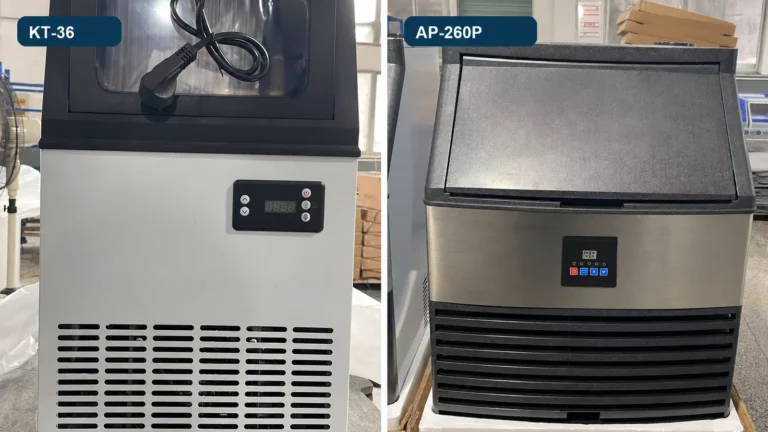
Temperature context supports the pressure reading. The approved acceptance rule determines whether a specific KT-36 configuration meets its release requirement.
Use one approved condition for each order
Engineering and production teams select the condition for the ordered design pressure, refrigerant, cooling arrangement, destination approval, and authorized components.
One KAISON project uses 1.2 MPa. Orders governed by KC/ZBJ 003-2024 use 1.5 times working pressure, and the production entry shows which approval basis applies.
What Follows a Refrigeration Circuit Check
Later production stages prepare the circuit and confirm machine operation.
Keeping evacuation, refrigerant charging, operational testing, and final inspection in separate production entries lets overseas buyers trace the machine from prepared circuit to packing release for the exact ordered configuration.
Evacuation removes air and moisture
Evacuation removes air and moisture from the prepared refrigerant circuit. It follows assembly and pressure control, giving the circuit the required preparation state before refrigerant charging.
Each stage has its own record.
For a flake ice machine or snowflake ice machine, separate entries let the buyer review pressure control and dehydration as two defined production stages.
Refrigerant charging follows the approved configuration
Charging begins after the circuit has reached the required preparation state. The charge type and mass should match the order specification, nameplate, component approval, and destination requirements for the exact model being produced.
The machine then moves forward.
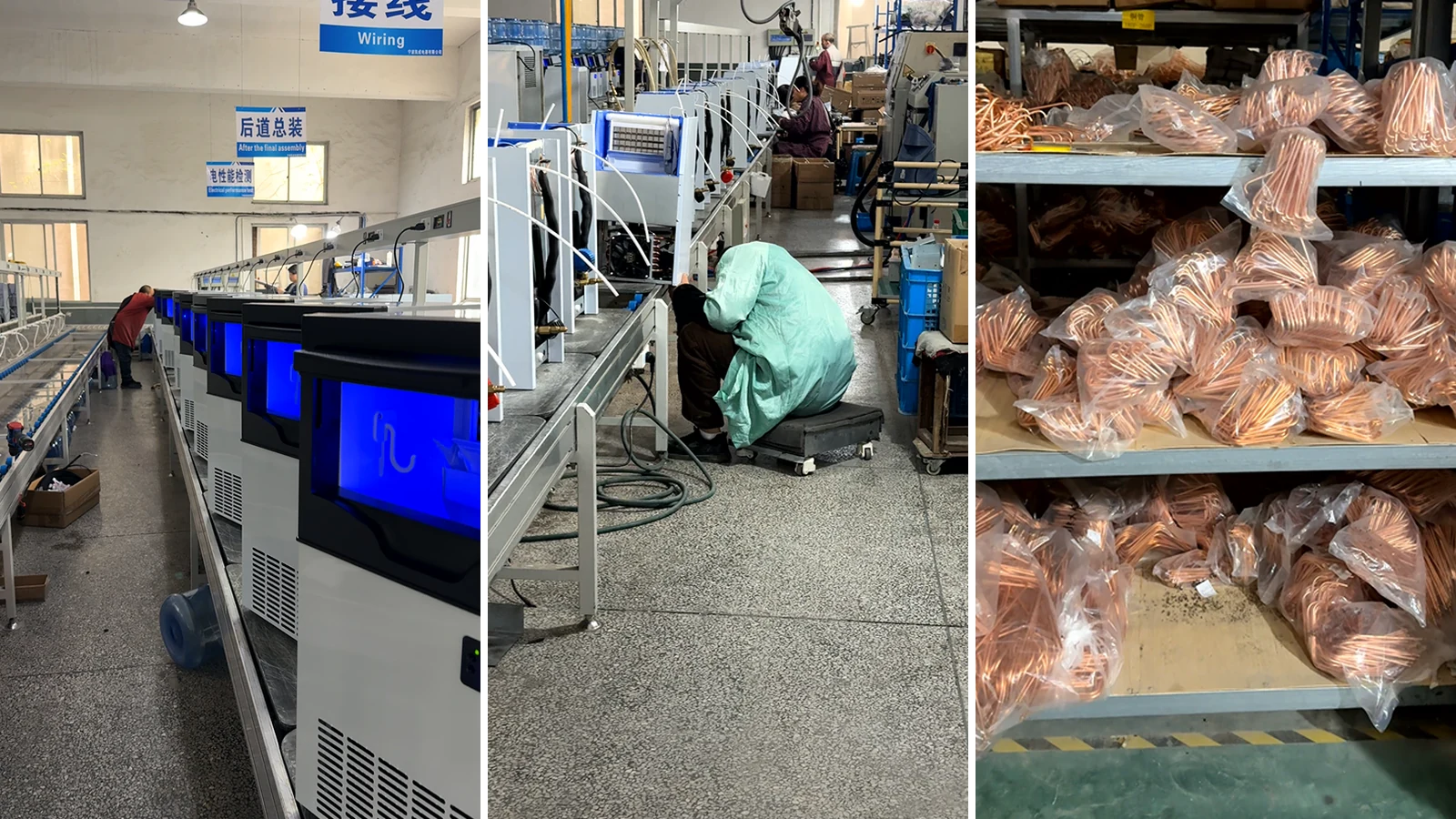
The factory supports this stage with 4 charging machines and 16 vacuum pumps. Approved work instructions control the refrigerant and evacuation values used for each order.
Performance testing and final inspection close the sequence
An ice-making run checks whether the assembled system operates under stated test conditions. Output, cycling, electrical behavior, water operation, and visible ice formation can reveal functional issues after charging and electrical assembly.
The production flow places ice-making performance at step 17 and final inspection at step 22. These stages complement circuit control, while quality-control information shows the wider factory inspection structure.
What Overseas Buyers Should Request
Procurement teams need records that map directly to the order.
The completed shipment package should connect the purchase order, model, serial or batch reference, refrigerant, cooling method, test condition, result, and release authorization in one reviewable chain for the buyer.
Identify the model, circuit, and configuration
Start with the purchase order, production model, serial or batch reference, voltage, frequency, refrigerant, cooling method, and condensing arrangement. These fields connect the test statement to the physical machine that will arrive.
Specificity prevents confusion.
For example, an AP-260P product configuration and an AP-300P product configuration should each be reviewed against their own approved documents, even when both produce commercial cube ice.
Request test conditions and acceptance fields
The inspection entry should state the test medium, controlled pressure, holding time, relevant temperature, circuit boundary, locating method, acceptance criterion, result, date, and release authorization. These fields give purchasing, inspection, and engineering teams one clear reference.
Ask for the complete test entry.
A gauge image shows one moment. The completed entry adds the circuit boundary, elapsed duration, acceptance limit, model information, and relationship to the machines listed on the packing documents.
Use type-test reports for market-access review
Third-party safety reports support compliance review for their stated samples, standards, dates, and model families. Production inspection entries then connect shipment approval to the machines listed on the order.
CVC issued reports KSAS012026-0003 and KSAS012026-0004 on February 10, 2026, with Pass results for their listed model families. The certification overview provides a route for discussing destination requirements.
Add Leak-Test Evidence to the RFQ
Define the required inspection documents before production starts.
Put measurable fields into the specification
An RFQ should connect the requested product range with the inspection documents expected before dispatch. State the ordered configuration first, then list the record fields and acceptance basis required by the buyer's quality plan.
Keep it practical.
KAISON's OEM and ODM service can align technical documents with a defined project, while the factory profile gives sourcing teams background for supplier qualification and production discussions.
Decide whether witness inspection is needed
Witness inspection can help when the order has a new refrigerant, a market-specific approval, a custom condensing arrangement, or a buyer quality plan that requires direct observation before dispatch.
The scope should be agreed early.
Send the model list, destination, electrical supply, refrigerant requirement, cooling method, required inspection fields, and timing through the contact page to request a configuration-specific quotation and quality-document plan.
- One approved project configuration uses a nitrogen holding pressure of 1.2 MPa, equal to 12.0 bar or 174.0 psi.
- KC/ZBJ 003-2024 specifies 1.5 times working pressure for 30 minutes without leakage for refrigerant piping.
- The finished-product inspection requirement sets a maximum refrigerant leakage criterion of 0.5 g/year for each brazed joint.
- CVC reports KSAS012026-0003 and KSAS012026-0004 support type-safety review for their listed model families.
- Evacuation, refrigerant charging, ice-making performance testing, and final inspection follow separate control purposes.
What is the difference between a refrigerant leak test and a water leak test?
A refrigerant leak test examines the sealed tubing and components that contain refrigerant, including compressor connections, condenser joints, the filter-drier, metering device, evaporator, and return line. A water leak test covers the inlet, pump, distribution components, reservoir, and drain path. Purchase specifications should name and record both checks separately when the buyer needs approval for the cooling circuit and the water-handling assembly.
Is a pressure-hold test enough for a commercial ice machine?
A pressure hold records how the pressurized refrigeration boundary behaves during a defined period. Localized checking identifies connections that need attention, while evacuation, correct charging, and operational testing complete their own production stages. A useful release package connects the pressure basis with the model, refrigerant, circuit boundary, time, temperature context, acceptance rule, result, and authorization associated with the machines on the order.
Why should test pressure stay within approved component limits?
The refrigeration circuit contains components with defined pressure ratings and approved operating conditions. Applying a value copied from an unrelated machine can overstress tubing, valves, an evaporator, or another component without proving suitability for the current design. The test basis should therefore come from approved engineering documents for the ordered configuration. Buyers can ask the supplier to identify whether the value is a fixed project setting or a multiple of working pressure.
Can a vacuum test replace positive-pressure leak checking?
Vacuum behavior and positive-pressure behavior answer different production questions. Evacuation removes air and moisture before refrigerant charging, while a controlled positive-pressure stage evaluates the sealed circuit under the specified test condition. Moisture release, temperature, hoses, valves, and the service setup can affect a vacuum reading. Separate entries for evacuation, pressure control, and localized checking keep the shipment documents clear and the approval basis consistent.
Which refrigeration joints deserve attention during inspection?
Inspection planning normally follows the entire sealed circuit, including compressor stubs, condenser connections, filter-drier joints, metering-device connections, evaporator tubing, service points, and the suction return. Supports, bends, and locations where tubing approaches panels also deserve visual attention because vibration or contact can create stress. The exact boundary should come from the ordered circuit drawing, especially when self-contained and field-connected configurations place different sections inside the factory-tested assembly.
Does an ice-making test prove that the refrigerant circuit is leak-free?
An ice-making test shows that the machine can operate and produce ice under the conditions used during the run. Circuit checking adds the specified pressure condition, joint criterion, and result for the sealed refrigeration path. Buyers should request both entries. Together they show how the unit performed and how the refrigerant boundary was evaluated against its acceptance criterion before shipment.
What information belongs in a buyer's leak-test record request?
The request should identify the purchase order, model, serial or batch reference, electrical supply, refrigerant, cooling method, and condensing arrangement. It should also name the test medium, pressure basis, holding time, relevant temperature, circuit boundary, locating method, acceptance criterion, result, date, and release authorization. Defining these fields in the RFQ gives purchasing, inspection, and engineering teams one consistent shipment record.
How should buyers use third-party safety reports with shipment records?
A third-party safety report supports compliance review for the samples, standards, model family, dates, and scope named in that report. The shipment inspection entry connects a production order to its machines, test conditions, acceptance criteria, results, and release authorization. Buyers can use both documents together: the safety report for market-access review and the production entry for the configuration and shipment listed on the purchase order.