Written by gary@nbkaison.com
Commercial Ice Machine Compressors Used by KAISON
Commercial ice machine compressors must match the machine model, power supply, refrigerant, condenser arrangement, and destination market. One compressor model cannot cover every order safely or efficiently. A compact 110V/60Hz cube machine needs a different electrical configuration from a 220V/50Hz modular flake machine, even when both produce commercial ice. Buyers should therefore request the compressor manufacturer and exact model together with voltage, frequency, refrigerant, charge, and cooling method. The final quotation and approved specification sheet should identify that complete configuration. Daily ice output, whole-machine input power, compressor input, and compressor cooling capacity are separate figures and should never be compared as if they were the same rating.
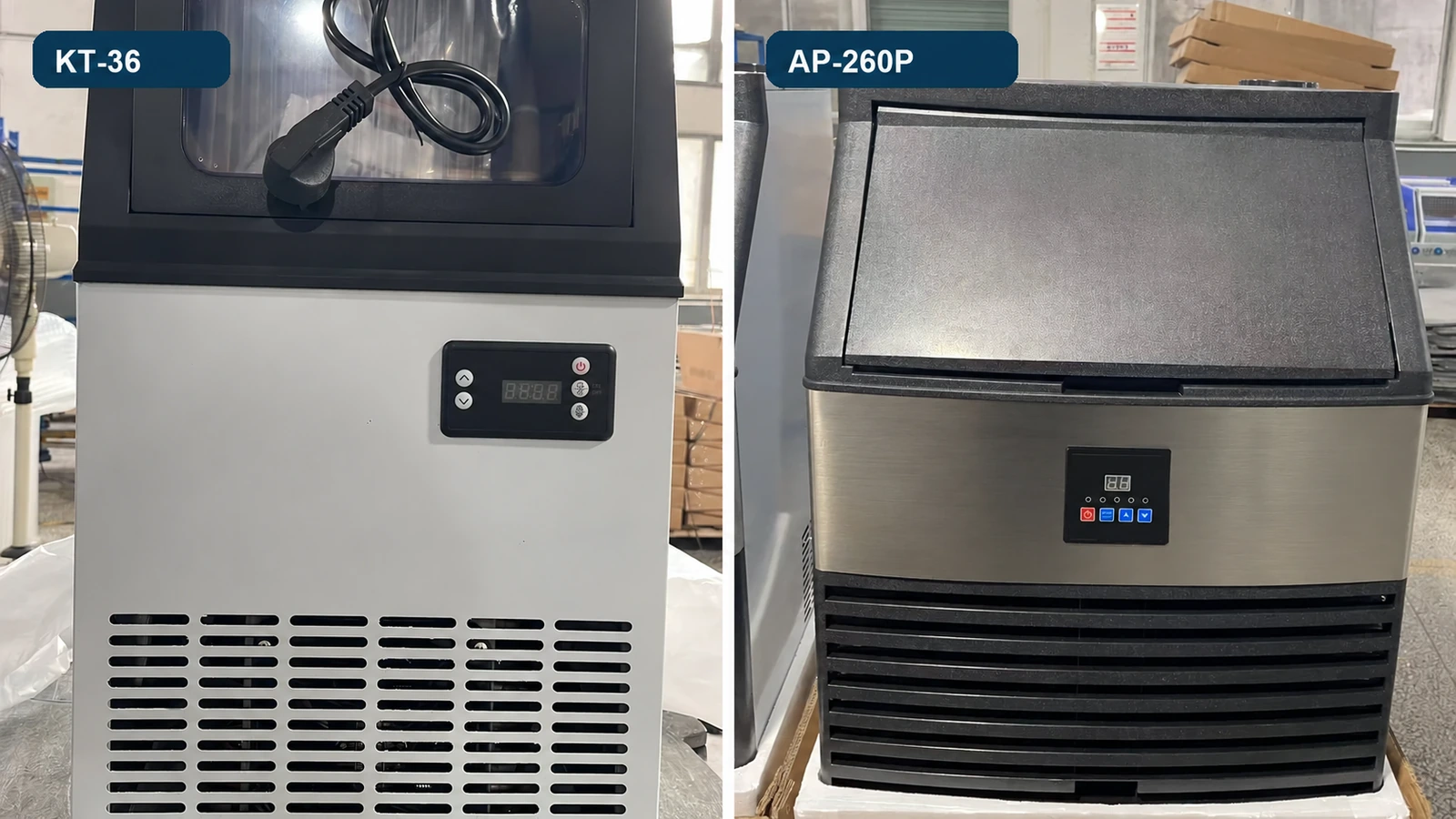
Commercial Ice Machine Compressors Change With the Configuration
The compressor follows the complete refrigeration design, not capacity alone.
Why one ice machine model can have several compressors
Voltage matters.
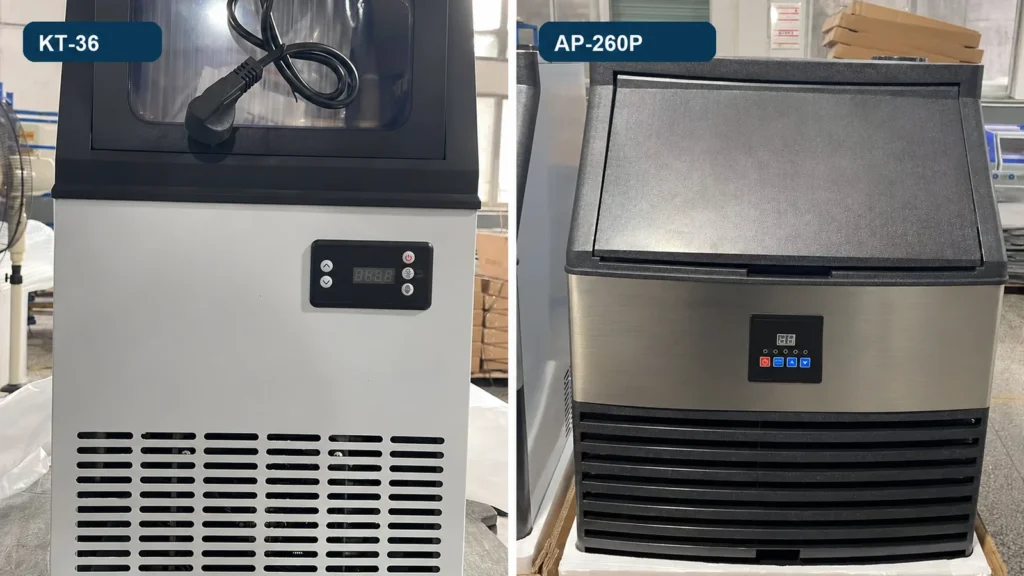
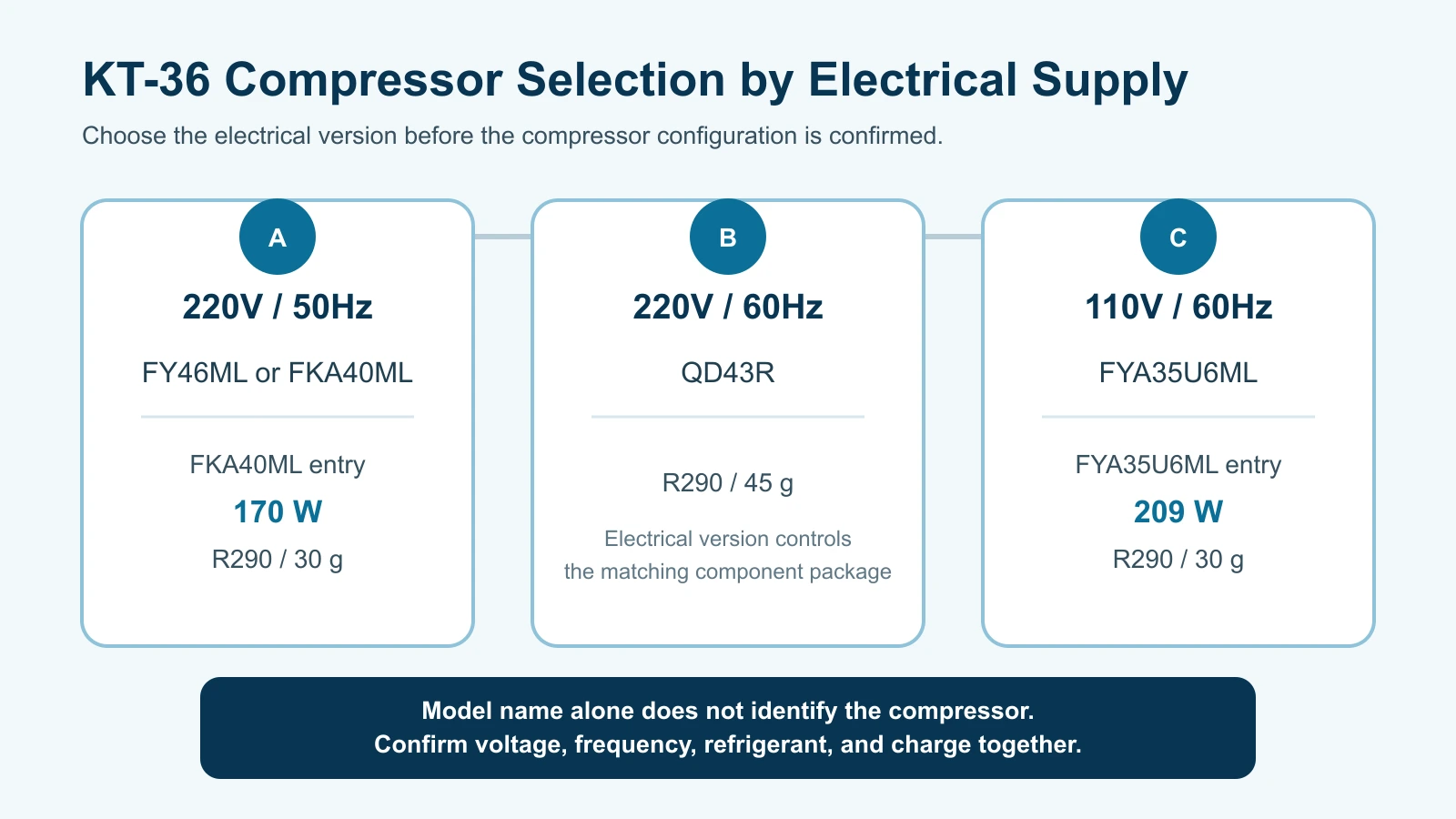
KAISON offers the KT-36 commercial cube ice machine with FY46ML or FKA40ML at 220V/50Hz, QD43R at 220V/60Hz, and FYA35U6ML at 110V/60Hz.
Each alternative has its own refrigerant charge and electrical entry, so buyers need the complete configuration for sourcing, order approval, and after-sales planning. The 220V/50Hz FKA40ML entry lists 170 W and 30 g of R290. The 110V/60Hz FYA35U6ML entry lists 209 W and 30 g. The 220V/60Hz QD43R entry lists a 45 g R290 charge.
The model name still matters. Yet the suffix, supply frequency, starting components, refrigerant charge, and condenser must stay together in the order specification. A substitution that preserves only nominal ice output can change wiring, protection, heat rejection, and certification coverage.
What a buyer should require on the quotation
Ask for one complete configuration line.
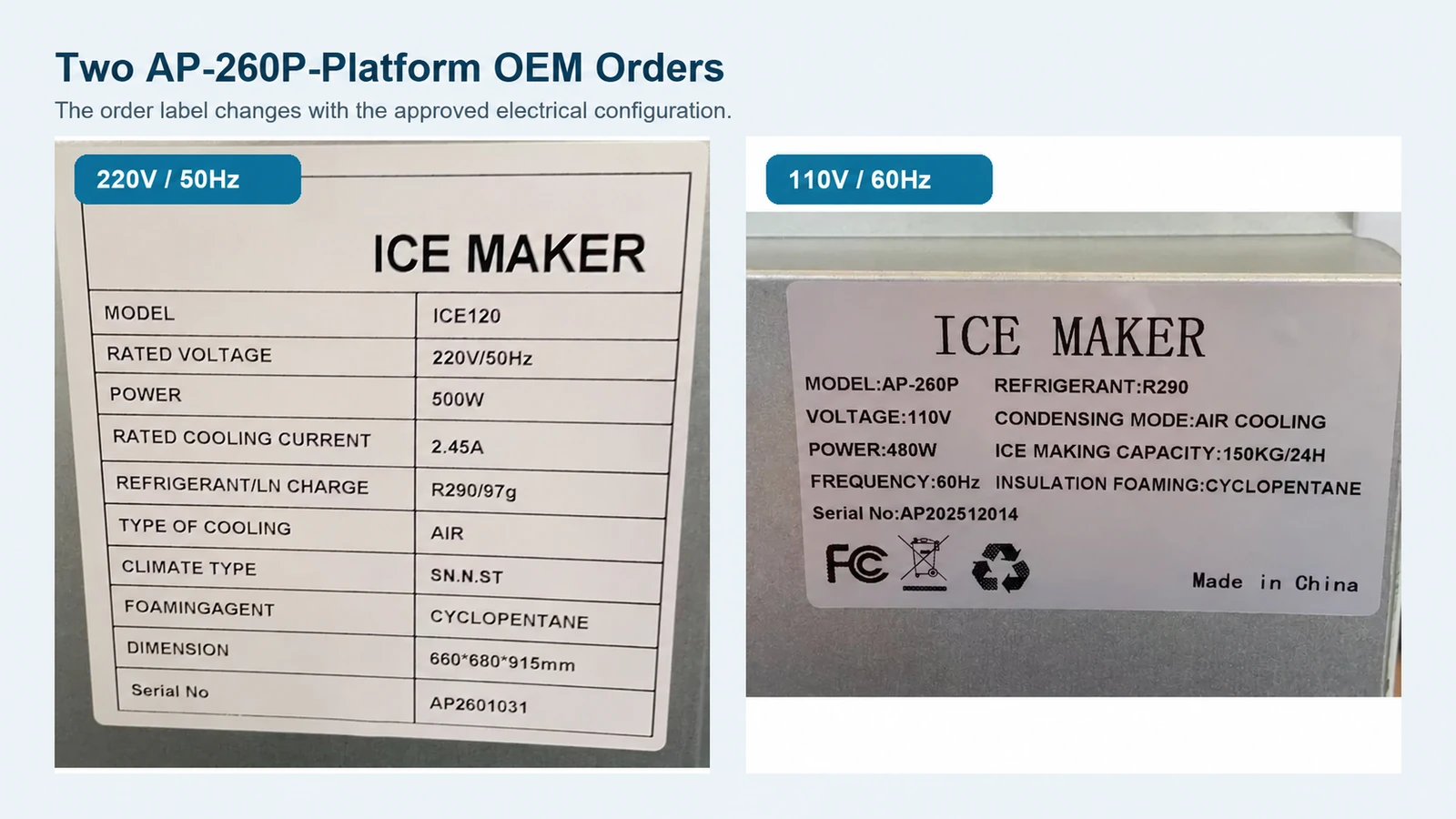
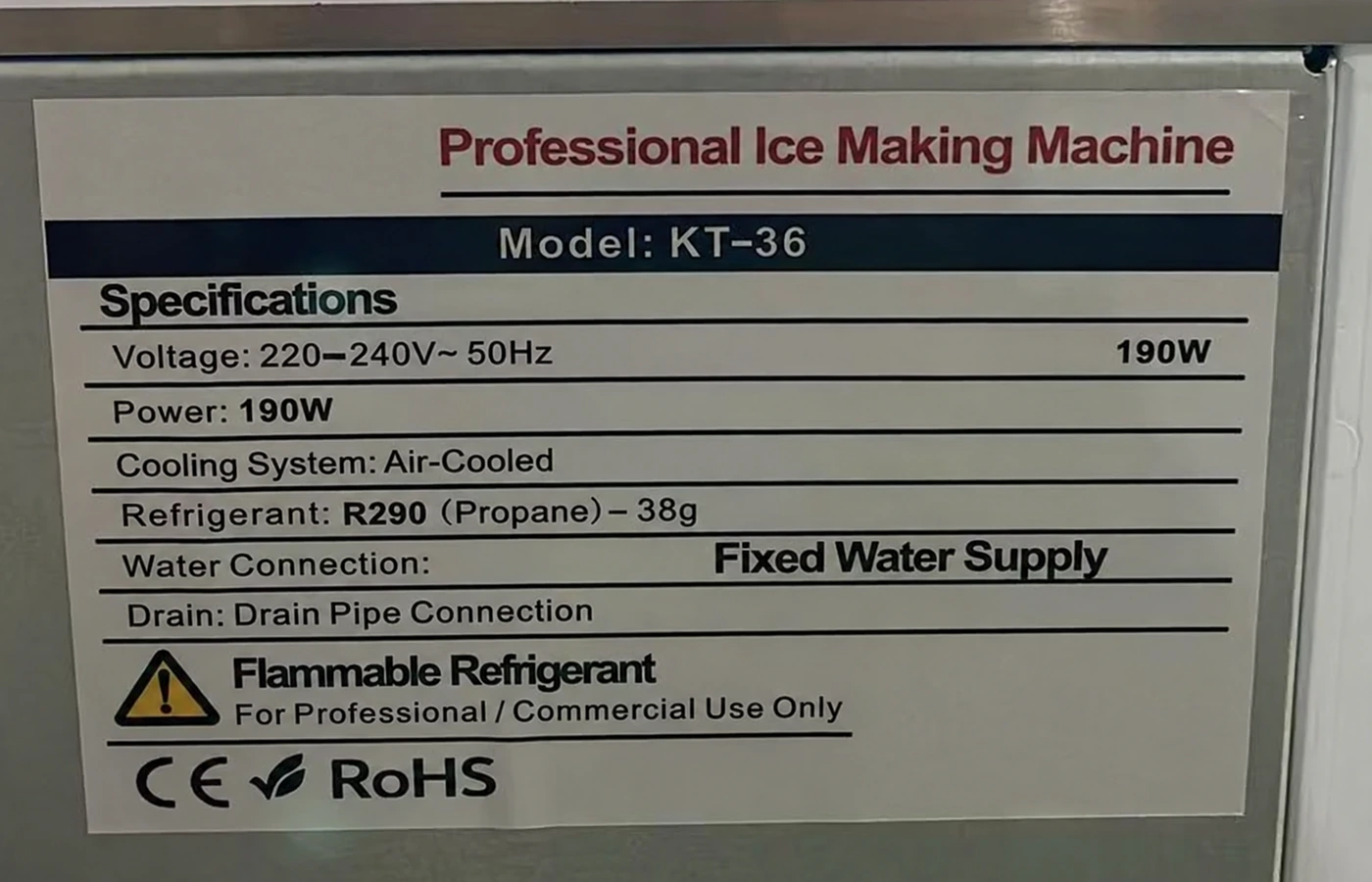
That line should state the ice machine model, compressor manufacturer, compressor model, refrigerant, charge, voltage, frequency, phase, cooling method, and any approved alternative before production begins and purchasing releases the order. The same information should appear on the approved order document and match the finished unit's nameplates.
For an OEM or ODM ice machine, add the destination country and plug standard. If the project requires a named compressor brand, write that requirement into the approved specification instead of relying on a general product-family description.
Compressor Options Across the KAISON Product Range
Several compressor families serve different machines across the product range.
Compact and built-in cube ice machines
Small cube machines mainly use hermetic R290 compressor configurations.
The KN-40 can use Wanbao FY46 or Anuodan QD43R. KS-50 options include FKA50ML and Anuodan QD55. Other pairings include FKD66ML for KX-65, FTY80 for KX-78 and KM-90, and FTK95ML for AP-180P and AP-260P.
These are model-specific entries.
The cube ice machine range includes 110V/60Hz and 220V/60Hz alternatives alongside 220V/50Hz versions. Buyers should confirm the model, electrical supply, refrigerant, charge, and compressor on one specification line.
Split cube machines and higher loads
Larger systems introduce different compressor and condenser combinations.
AP-300P options include DSG167UV at 220V/50Hz with R22, plus DSD113SV, VSG167UV, FND140U6, or NUT140NR for other refrigerants and electrical versions. Air-cooled and water-cooled builds also use different charge entries.
For specified AP split models ordered with a named compressor requirement from the buyer, KAISON can supply a Tecumseh unit instead of the standard Highly compressor at added cost under an approved quotation. The quotation should state that choice for pricing and service-parts planning.
Buyers comparing a separate-bin ice machine should therefore request the exact build, not only the daily ice figure. The AP-300P product page can introduce the platform, while the order specification controls the compressor actually supplied.
Snowflake and flake ice machines
Ice type changes the refrigeration load and the selected compressor.
KL-60 uses FKD66ML with R290, 220V/50Hz input, 337 W whole-machine power, and a 70 g charge. KL-220 uses SG167UV with R22, 780 W whole-machine power, and water cooling.
The larger KL-650 uses TH532MV with R22, 220V/50Hz, a 900 g charge, and 1,903 W whole-machine power. Whole-machine input does not convert directly into compressor cooling capacity.
For flake ice, KP-300/F uses WHP07300RUV with R22, a 1,350 g charge, 1,470 W whole-machine power, and air cooling. Buyers can compare the snowflake ice machine range with the flake ice machine range before requesting a model-specific compressor schedule.
| Ice machine | Compressor configuration | Refrigerant and charge | Electrical or cooling configuration |
|---|---|---|---|
| KT-36 | FKA40ML | R290, 30 g | 220V/50Hz; 170 W entry |
| KT-36 | FYA35U6ML | R290, 30 g | 110V/60Hz; 209 W entry |
| AP-260P | FTK95ML | R290, 71 g or 73 g | 220V/50Hz; 433 W entry |
| AP-300P | DSG167UV | R22, 270 g water-cooled or 450 g air-cooled | 220V/50Hz; 649 W or 818 W entry |
| KL-60 | FKD66ML | R290, 70 g | 220V/50Hz; air-cooled |
| KL-650 | TH532MV | R22, 900 g | 220V/50Hz; water-cooled |
| KP-300/F | WHP07300RUV | R22, 1,350 g | Air-cooled; 1,470 W machine entry |
Compressor Power Is Not the Machine's Ice Output Rating
Four specifications describe different parts of the refrigeration system.
Separate compressor input from whole-machine input
Do not compare unlike numbers.
Whole-machine power can include the compressor, fan motors, pumps, controls, lighting, and harvest components. Compressor input covers the compressor at a stated operating condition. Cooling capacity measures heat removal, while daily ice output measures mass produced under a defined test condition.
AHRI Standard 540 defines compressor power input and requires published compressor performance to be tied to rating conditions and an operating envelope before buyers compare models from different suppliers or data sheets. That is why a compressor data-sheet value should not be presented as the daily output of a commercial ice maker.
The KP-300/F specification gives 1,470 W as whole-machine input. Do not assign that figure to the WHP07300RUV compressor alone because fans, pumps, controls, and other electrical loads also draw power.
Compare performance at named conditions
Every useful comparison needs its operating condition.
Compressor capacity changes with suction condition, discharge condition, refrigerant, frequency, and supply voltage. A buyer should compare manufacturer data only when the refrigerant and rating condition match the proposed ice machine configuration.
The same rule applies to ice production. Daily output belongs with ambient-air and inlet-water temperatures, while electrical data belongs with voltage and frequency; mixing those references can make two valid specifications appear contradictory.
Refrigerant, Voltage, and Condenser Design Drive Selection
Three engineering choices narrow the acceptable compressor list quickly.
Refrigerant and charge belong to the approved system
Refrigerant compatibility is mandatory.
Available configurations use R290, R22, or R404A according to the model and destination-market version. Oil compatibility, motor design, displacement, safety controls, tubing, and charge all depend on that system choice.
A buyer should never request a refrigerant change as a label edit. The compressor, metering device, condenser, evaporator, controls, and compliance file may need review when a flammable refrigerant changes construction or charge controls for the destination market and standard in service.
Match the certification information to the quoted model and electrical version. Report 8621.SH.2108.0154.2 lists Wanbao FTA45L and FTY80L for its 220V/50Hz R290 product family; the quotation identifies the compressor selected for the order.
Frequency and market voltage change the component package
Frequency changes more than the plug.
The KT-36 entries demonstrate the point: 220V/50Hz, 220V/60Hz, and 110V/60Hz versions carry different compressor choices and sometimes different charges. Starting devices, protection, wire sizing, and certification evidence must follow the selected electrical version.
For procurement, write the destination voltage, frequency, and phase in the RFQ. A vague request for an export model invites avoidable revisions after drawings, labels, plugs, or component approvals have already been prepared.
Air cooling and water cooling affect the match
Condenser selection changes heat rejection and refrigerant-side conditions.
An air-cooled ice machine uses fan-driven airflow across a condenser. A water-cooled ice machine rejects heat through water flow, which changes the condensing arrangement and may change refrigerant charge or component selection.
The AP-300P uses 270 g for a water-cooled R22 version and 450 g for an air-cooled version under its 220V/50Hz configuration. Keep those charge values with the named AP-300P build.
Match Certification Reports to the Ordered Configuration
Each report lists specific models, electrical data, and components.
Use the report that matches the quoted configuration
Start with the electrical version.
Before shipment, compare the quoted voltage, frequency, refrigerant, compressor model, unit nameplate, and applicable certificate so the ordered machine matches the buyer's approved electrical and service configuration for the destination market.
KAISON's 2021 CE report 8621.SH.2108.0154.2 lists KS-50 at 220V/50Hz with R290 and names Wanbao FTA45L and FTY80L in its component list. Use the final quotation to identify which compressor is fitted to the purchased model.
The 2021 FCC report 8621.SH.2108.0149 covers a 110V/60Hz R290 configuration and lists Wanbao FT45U6ML with Dongper LZ43XU1 as an alternative. Match that electrical version to the quotation and unit nameplate.
60Hz reports list specific compressor alternatives
Two report sets identify useful 60Hz configuration examples.
Safety report KSAS012026-0003 and EMC report KSAM012025-0017 list AP-260P configurations using Wanbao FND100XML and FKD46X6ML at 220V to 240V, 60Hz. These compressor alternatives belong to the electrical version covered by the reports.
Safety report KSAS012026-0004 and EMC report KSAM012025-0019 list KL-650 with Highly PTH420UX-C9KU and PSG184SX-H7CU at 220V to 240V, 60Hz. Match the required report, electrical version, and final compressor entry before shipment.
During pre-shipment quality inspection, the unit nameplate, compressor nameplate, refrigerant label, and functional test should match the approved specification. Buyers can request this evidence when component traceability is part of acceptance.
Put the Compressor Requirement Into the RFQ
A precise RFQ prevents substitutions from becoming late-stage disputes.
Information the buyer should send
Start with the intended installation.
Provide the target model or daily ice demand, ice type, ambient design condition, inlet-water condition, cooling method, destination country, voltage, frequency, and phase. State whether the compressor brand is mandatory, preferred, or open to an approved equivalent.
For a compact installation, link the request to the built-in-bin machine range. For model-level review, reference a page such as the KL-60 snowflake machine or KP-300 flake machine.
Documents to approve before production
Approve the configuration before the production release.
The buyer should receive a quotation or specification sheet that identifies the exact compressor, refrigerant and charge, electrical supply, cooling method, machine input, and relevant report scope for the ordered market version. For OEM work, retain the approved revision with the artwork, nameplate data, and spare-parts list.
Check one more detail.
The unit nameplate and compressor nameplate should match the approved build when the order reaches inspection, while any agreed alternative should be recorded through a revised document before assembly proceeds. Send the complete requirement through the commercial ice machine inquiry form so engineering can return a model-specific configuration.
- A KT-36 configuration can use different compressors for 220V/50Hz, 220V/60Hz, and 110V/60Hz versions.
- Report 8621.SH.2108.0154.2 lists FTA45L and FTY80L for a 220V/50Hz R290 product family.
- Reports KSAS012026-0004 and KSAM012025-0019 list PTH420UX-C9KU and PSG184SX-H7CU for 220V to 240V, 60Hz KL-650 configurations.
- Whole-machine input, compressor input, cooling capacity, and daily ice output are different measurements.
- The final quotation should identify compressor manufacturer, exact model, refrigerant, charge, voltage, frequency, phase, and condenser type.
Frequently Asked Questions About Commercial Ice Machine Compressors
These answers cover the configuration questions buyers ask before ordering.
What compressor brand does KAISON use in commercial ice machines?
KAISON uses more than one compressor manufacturer across its commercial ice machine range. Available configurations include Wanbao, Anuodan, and Highly, while specified split models can be ordered with a Tecumseh option. The supplied brand depends on the machine model, voltage, frequency, refrigerant, cooling method, and approved order version. Request the manufacturer and exact compressor model in the quotation because a family-level brand statement does not identify the component fitted to one order.
Which compressor is used in the KT-36 ice machine?
KT-36 configurations include FY46ML or FKA40ML for 220V/50Hz, QD43R for 220V/60Hz, and FYA35U6ML for 110V/60Hz. The FKA40ML version lists 170 W and 30 g of R290, while the FYA35U6ML version lists 209 W and 30 g. Confirm the required electrical version and final compressor on the quotation because the KT-36 model name alone does not select one of these builds.
Can I specify a compressor brand for an OEM order?
Yes. A compressor brand requirement can be included in an OEM specification, subject to engineering compatibility, certification scope, availability, and commercial approval. State whether the brand is mandatory or whether an approved equivalent is acceptable. The final document should also name the exact compressor model, refrigerant, voltage, frequency, phase, and cooling method. Brand-only approval leaves important technical details unresolved and can create a mismatch between the buyer's service plan and the machine delivered.
Does a higher compressor wattage mean more daily ice output?
No direct conversion is valid. Compressor input power, compressor cooling capacity, whole-machine input, and kilograms of ice per 24 hours measure different quantities. Cooling capacity also changes with refrigerant and rating conditions. Daily ice output depends on the complete machine and its stated ambient-air and inlet-water test conditions. Compare two models only after identifying which wattage is shown, what components it includes, and which operating conditions apply to both figures.
Why does voltage or frequency change the compressor model?
The compressor motor, starting components, protection, and performance envelope must suit the electrical supply. A 110V/60Hz version can therefore use a different compressor from a 220V/50Hz machine with the same cabinet and ice grid. KT-36 has separate compressor options for three electrical supplies. Provide country, voltage, frequency, and phase before quotation so engineering can select a compatible configuration and check the applicable compliance documents.
Are air-cooled and water-cooled versions fitted identically?
They should not be assumed identical. The condenser changes how the system rejects heat, and the refrigerant charge or compressor match can differ with the approved design. AP-300P uses 270 g of R22 for a water-cooled configuration and 450 g for an air-cooled 220V/50Hz configuration. Treat those values as model-specific. The quotation should identify the cooling method and exact refrigeration package together.
How should certification reports be used when selecting a compressor?
Use the report that matches the quoted model, voltage, frequency, and refrigerant. A component list may include compressor alternatives for several related machines, so the final quotation should still name the model selected for the order. Report 8621.SH.2108.0154.2, for example, lists two Wanbao compressor models for its 220V/50Hz R290 product family. Match the report number, final specification, and unit nameplate before shipment.
What should I send to receive an exact compressor configuration?
Send the ice type, required daily output, installation temperatures, cooling method, destination country, voltage, frequency, phase, and preferred machine model. Add any mandatory compressor brand, refrigerant, certification, plug, or spare-parts requirement. Engineering can then return a quotation or specification sheet with the proposed compressor manufacturer and model. Approve that revision before production, and request matching machine and compressor nameplate evidence if component traceability matters to acceptance or after-sales service.