Written by gary@nbkaison.com
Air Cooled vs Water Cooled Ice Machines: Which Fits Your Site?
Air cooled vs water cooled ice machines should be selected by the installation site's peak temperature, available heat-rejection path, utility rates, and plumbing. Air cooling is usually the simpler choice for a ventilated, temperature-controlled room because the condenser needs no separate cooling-water circuit. Water cooling suits hot, enclosed rooms when a permitted drain, tower, or recirculating loop can carry condenser heat away. Compare both options on the same required ice output and stated test conditions. Then verify airflow clearance, condenser-water requirements, voltage, certification scope, and local restrictions for the shortlisted model before ordering.
Choosing Air Cooled vs Water Cooled Ice Machines for Your Site
Begin with the conditions around the installed machine.
Compare catalog capacity at the stated rating conditions, then record the summer temperature at the equipment corner, available ventilation, water route, and required output during the busiest shift before selecting a condenser.
Choose air cooling for ventilated, temperature-controlled rooms
In a self-contained indoor model, the fan draws room air across the condenser coil and discharges the resulting warm air back into the room. A remote air-cooled condenser rejects that heat at its separate installation location.
The installation still needs potable water for making ice, a drain, and the specified electrical supply. It does not need a separate condenser-water line.
Air cooling suits many ventilated restaurant ice maker projects and other conditioned indoor sites. Where water and sewer tariffs are high, an air-cooled model also avoids a separate condenser-water charge, provided the room ventilation can remove the condenser heat throughout the busiest shift. Keep the specified intake and discharge paths open.
Consider water cooling for hot or enclosed rooms
A water-cooled condenser transfers refrigeration heat to a separate water circuit.
Depending on the site design, warmed condenser water flows to a permitted drain, cooling tower, or recirculating loop. Room temperature has less direct influence on condenser heat rejection, although water temperature and flow still matter.
Evaluate the water-cooled ice machine range for an enclosed cook line, tropical plant room, or production site that needs reliable output through the hottest shift. Confirm first that the proposed water arrangement is permitted and affordable.
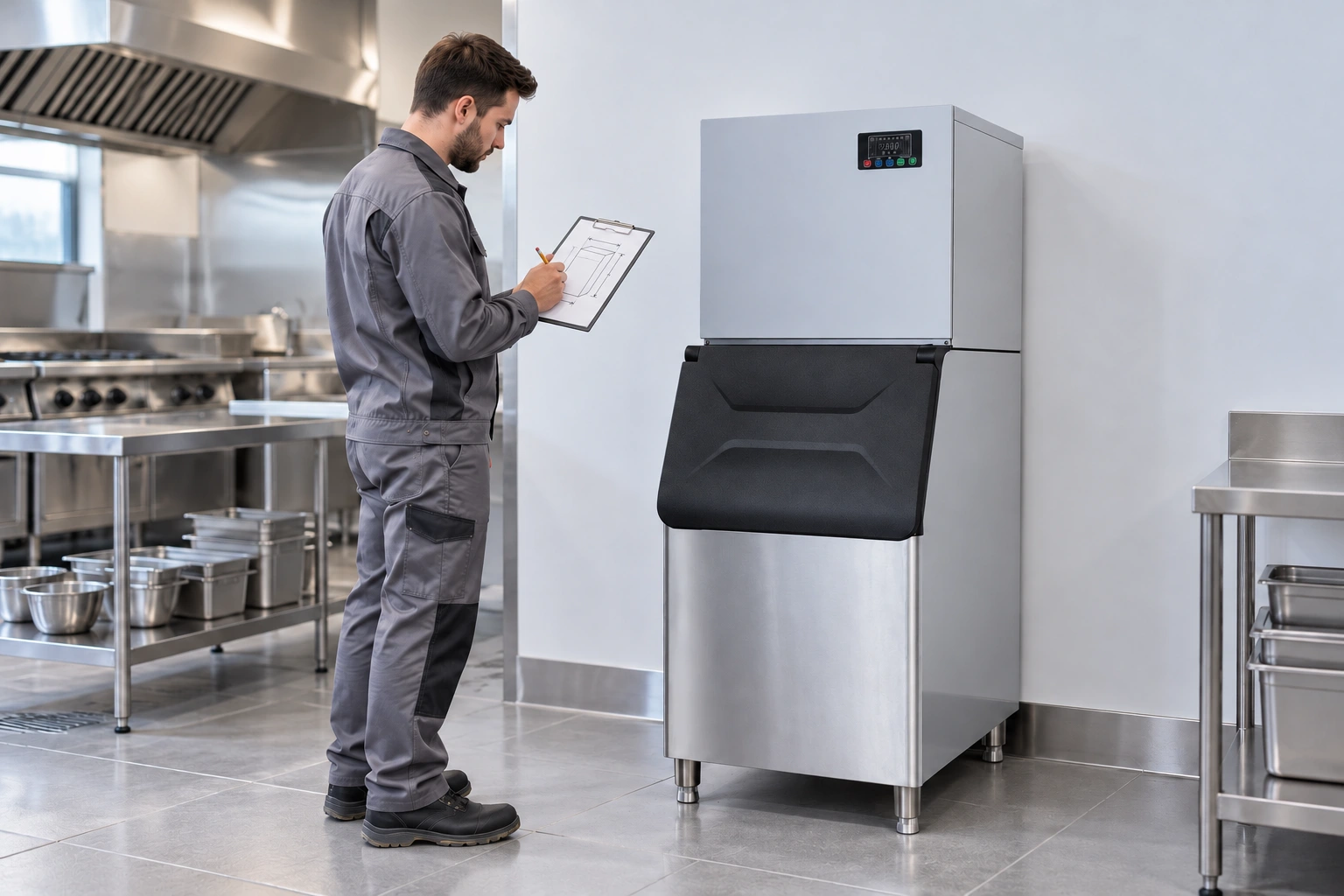
How Each Condenser Rejects Heat
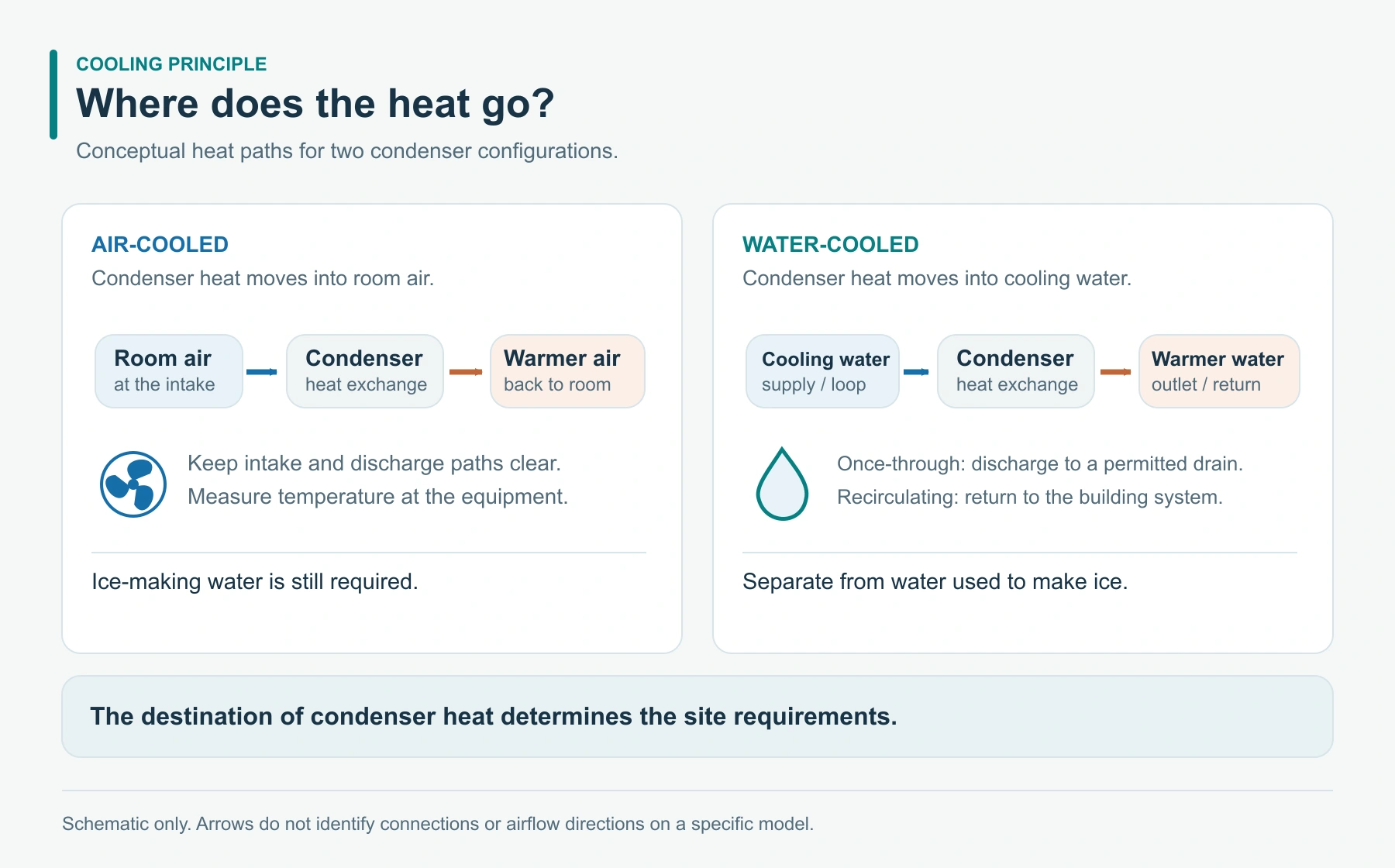
Both systems use the same basic refrigeration cycle. The site requirements change at the condenser, where air carries heat to the surrounding space and water transfers heat to a separate circuit before the refrigerant begins another freezing cycle.
Air carries condenser heat to the surrounding space
The fan, condenser coil, intake grille, and discharge opening must form one unobstructed airflow path.
Grease, dust, blocked panels, or recirculated exhaust air raise the condensing temperature and can reduce production. A dining-room thermometer may miss the problem if the machine sits beside hot equipment.
KAISON's air-cooled ice machine guidance states that ratings assume 21°C ambient, reports a 20 to 30 percent output drop at 32°C, and warns of little useful production near 38°C. Confirm the selected model against its technical sheet.
Water carries condenser heat through a separate circuit
A water-cooled condenser needs a dedicated supply and a return or drain path. This circuit is separate from the potable water used to make ice. A once-through setup discharges warmed water, while a tower or closed loop recirculates heat-transfer water through other building equipment.
Before selecting a water-cooled model, obtain its required flow, inlet pressure, connections, operating water temperature, and water-quality limits. Where once-through cooling is restricted, a compliant loop may change both the equipment scope and project cost.
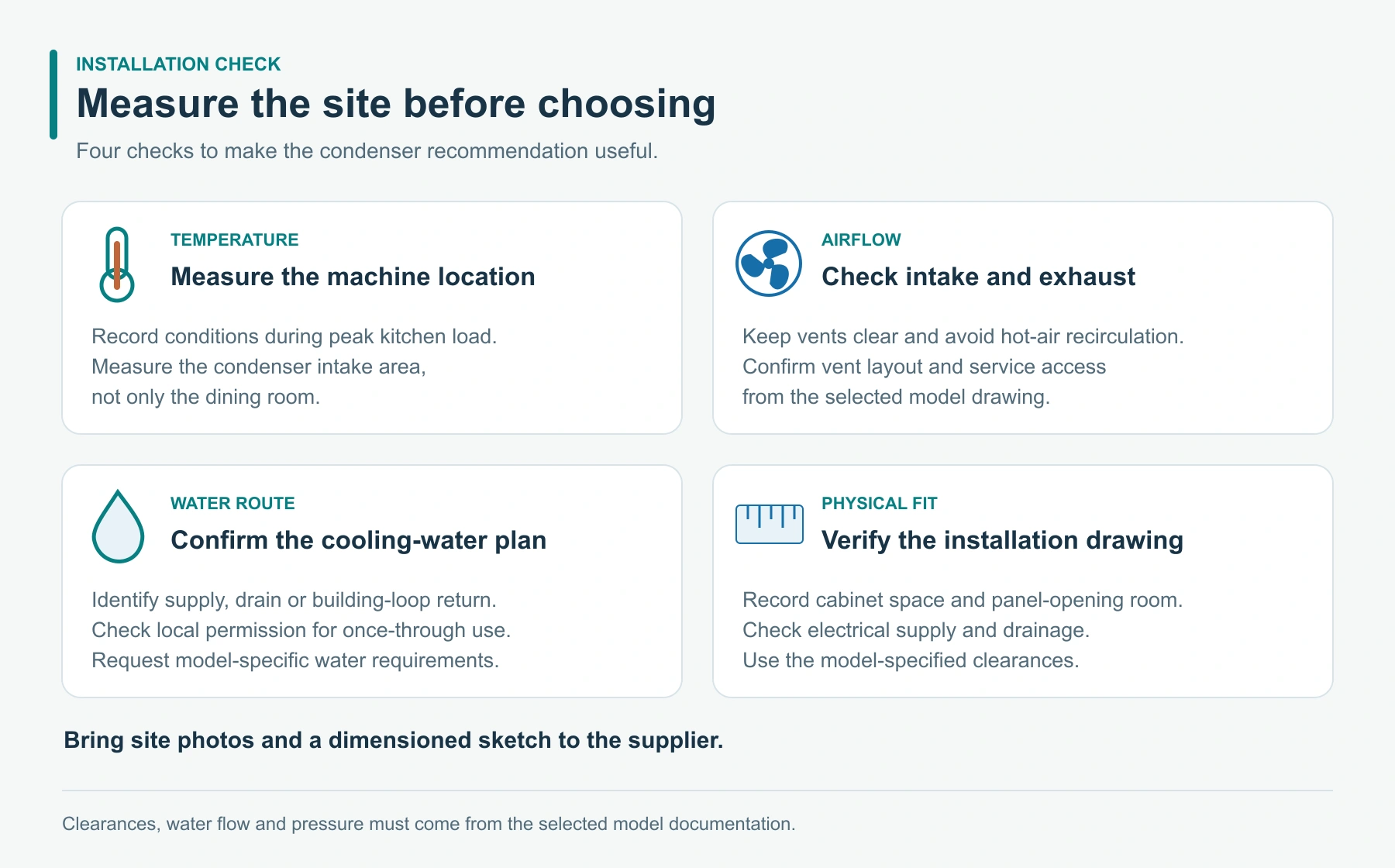
Check Site Requirements Before Comparing Prices
The lowest machine price may not produce the lowest installed cost. An apparently cheaper unit can require expensive rework if its condenser cannot reject heat, its service panels cannot open, or its water route conflicts with the building design after the order is placed.
Measure the equipment area at peak load
Record the temperature at the condenser air intake. Measure during the hottest season or highest kitchen load, with nearby cooking and ventilation equipment operating. Also note whether warm exhaust can return to the intake.
A hotel ice machine in a conditioned service room operates under different conditions from one installed beside laundry equipment. The same distinction applies between a quiet cafe ice machine station and an enclosed production corner.
Check airflow clearance and service access
Use the selected model's drawing. Air-cooled equipment needs its stated intake, discharge, and service clearances; side-venting cabinets need open space around their grilles. Front-breathing equipment may suit a designed undercounter opening when that feature is confirmed in the model documentation.
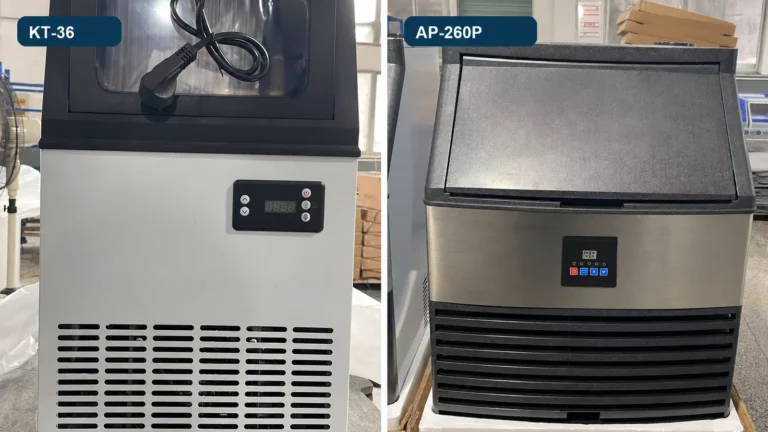
The current product catalog lists air cooling across built-in bin machines, separate-bin machines, and countertop ice makers. Confirm flush-installation suitability from the model drawing and vent position rather than the cabinet type alone.
Confirm the condenser-water route and local rules
For water cooling, show the proposed supply, shutoff, return or drain, filtration, and service access on the site plan. Ask the local authority or project engineer whether once-through condenser water is allowed. Do this before approving equipment.
| Verifiable item | Air-cooled configuration | Water-cooled configuration |
|---|---|---|
| Heat-rejection medium | Room air through a fan and condenser coil | Water through the condenser circuit |
| Site connections | Ice-making water, drain, and power | Ice-making water, drain, power, plus condenser-water supply and return or drain |
| Ambient reference in KAISON category guidance | Ratings assume 21°C; typical output loss is 20 to 30 percent at 32°C | Guidance positions water cooling for stable output in hot rooms |
| Clearance evidence | Model drawing must state intake, discharge, and service space | Model drawing must state plumbing and service access |
| ENERGY STAR Version 3.0 eligibility | Air-cooled batch and continuous commercial ice makers may qualify | Water-cooled models are ineligible under this program version |
| Local approval | Ventilation and equipment requirements | Once-through use or loop design must be checked locally |
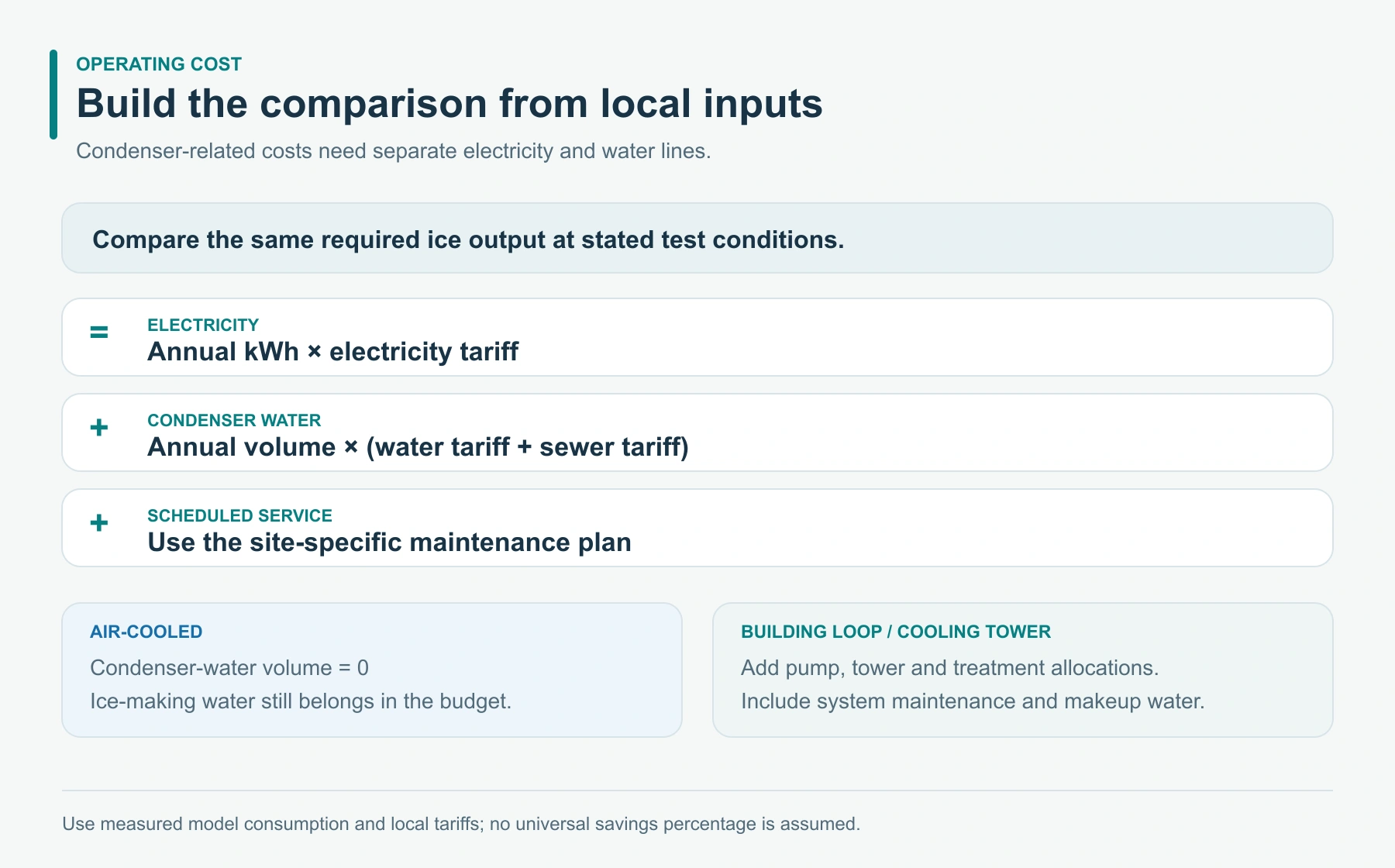
Calculate Operating Cost With Local Inputs
Operating cost changes with the model, utility rates, and site.
Compare annual production, measured electricity and condenser-water consumption, local utility and sewer tariffs, water-treatment needs, and the building's heat-rejection arrangement for every operating month before choosing the lower-cost option for the site.
Calculate electricity and condenser-water costs separately
Use this annual worksheet: electricity consumption multiplied by the electricity tariff, plus condenser-water volume multiplied by combined water and sewer tariffs, plus scheduled service cost. Use zero condenser-water volume only for an air-cooled model.
The United States ENERGY STAR Version 3.0 commercial ice maker criteria cover air-cooled batch and continuous machines. Depending on equipment type and harvest rate, the criteria cap potable water at 15, 20, or 25 gallons per 100 pounds of ice. Water-cooled ice makers are not eligible under that version.
Those thresholds apply to potable water used by eligible air-cooled machines. A complete cost comparison also needs condenser-water consumption for the water-cooled alternative and comparable operating data for both exact models.
Price once-through water and building loops separately
A building loop changes the calculation because condenser water circulates instead of being discharged after one pass. Include pump, tower, treatment, and maintenance allocations supplied by the facility engineer. Use the site's operating records instead of a generic water cost.
Confirm local approval first. If once-through cooling is restricted, exclude that arrangement before comparing equipment costs. A site with an existing loop still needs an allocation for pumping, treatment, tower operation, and maintenance.
Choose a Model That Offers the Required Cooling Method
Choose the required ice type and output first.
Confirm that the exact model is available with the condenser configuration the site needs, because compact countertop or undercounter models are commonly air-cooled, while higher-output cube, snowflake, and flake machines may offer both versions.
Compare output and cooling options on the same model
KAISON lists the following models with both air-cooled and water-cooled configurations. Use the catalog specifications to identify suitable output and electrical options, then request utility data for the selected condenser version.
| Model | Ice type | Listed capacity | Listed input | Electrical supply | Condenser options |
|---|---|---|---|---|---|
| AP-300P | Cube | 200 kg/24h | 800 W | 220V/50Hz or 220/110V/60Hz | Air-cooled or water-cooled |
| AP-350P | Cube | 250 kg/24h | 855 W | 220V/50Hz or 220/110V/60Hz | Air-cooled or water-cooled |
| AP-800P | Cube | 400 kg/24h | 1,210 W | 220V/50Hz or 220/110V/60Hz | Air-cooled or water-cooled |
| KP-1T | Flake | 1,000 kg/24h | 4.1 kW | Three-phase 380V/50Hz | Air-cooled or water-cooled |
Treat the listed input as a model specification. Compare condenser versions using option-specific utility data. Before ordering, ask the supplier to confirm rating conditions, bin capacity, cabinet dimensions, condenser connections, and expected performance at the measured site temperature.
If the required ice type is still open, compare the broader cube ice machine range with the flake ice machine range before choosing a model family.
Verify documents for the exact order configuration
Confirm certification coverage for the exact model, voltage, condenser option, and destination. The certification page lists ISO 9001:2015, ISO 14001:2015, ISO 45001:2018, CE testing to EN 60335, FCC Part 15B, RoHS, and project-based ETL or CB support.
Before paying a deposit, request the certificates and reports that apply to the selected model, voltage, condenser option, and destination country. Keep those documents with the approved quotation so the ordered configuration and compliance scope remain clear.
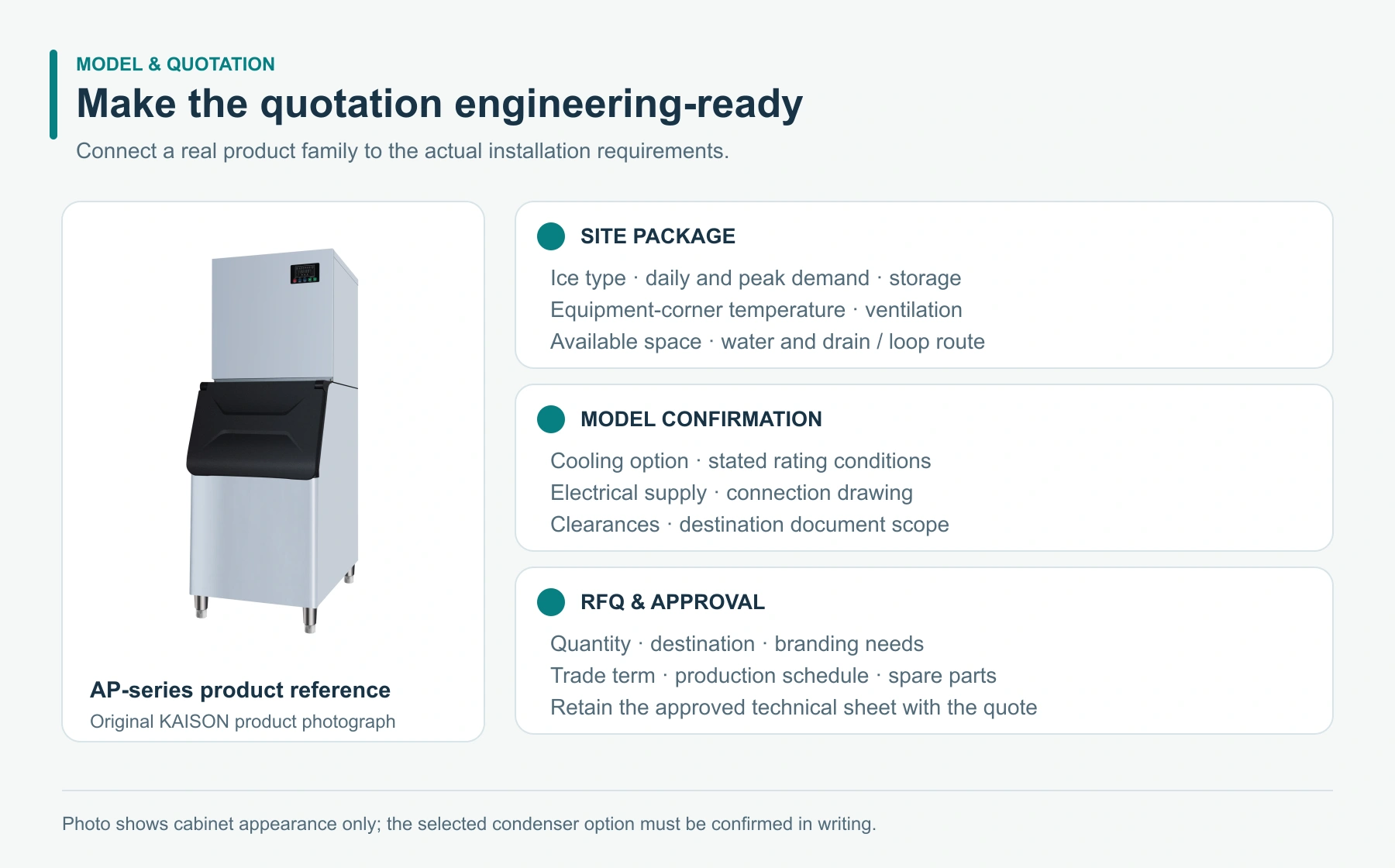
Send the Site Details Needed for an Accurate Quote
Send complete site details with every quotation request. Provide the information needed to confirm heat rejection, production demand, utilities, installation space, destination documents, and the condenser configuration required for the hottest expected operating conditions before the order is placed.
Send measured site conditions and ice demand
Include ice type, required kilograms per 24 hours, peak-hour demand, storage plan, equipment-corner summer temperature, room ventilation, clearances, water source, drainage, and any tower or loop. Attach a simple site photo and dimensioned sketch.
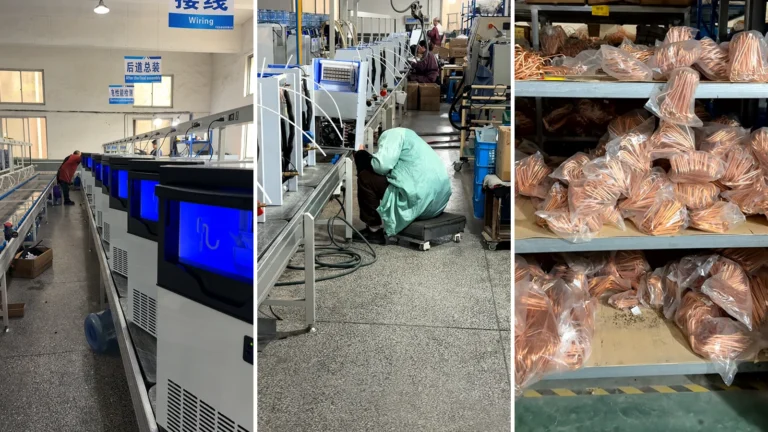
The factory's quality-control process includes leakage, electrical-safety, and ice-making performance checks before shipment. Ask the factory to state the test conditions behind the quoted output and include them with the approved model specification.
Include destination and order requirements
Add order quantity, destination, voltage, frequency, plug or hardwire requirement, branding, packaging, and required certificates. Importers that need custom branding or packaging can use the OEM and ODM process after the technical configuration is accepted.
Submit these details through the contact and quotation page. Request one consolidated reply covering condenser type, model code, rating condition, water and drain requirements, clearance drawing, electrical data, document scope, production schedule, trade term, and recommended spare parts.
Final Checks Before Choosing a Condenser
Complete these six checks before placing the order.
Confirm each item against the site drawing, official program rules, product specification, and final quotation so the cooling method, utilities, output, and document scope match the ordered machine at delivery.
- ENERGY STAR Version 3.0 covers eligible air-cooled batch and continuous commercial ice makers; it excludes water-cooled ice makers from certification under that program version.
- ENERGY STAR Version 3.0 sets potable-water limits of 15, 20, or 25 gallons per 100 pounds for eligible equipment types; these figures do not include condenser-water use.
- A supplier rating based on 21°C ambient cannot predict summer output until the actual equipment-corner temperature and condenser airflow are known.
- A listed 200 kg/24h capacity and 800 W input remain model specifications; they do not substitute for option-specific utility data and stated test conditions.
- Once-through condenser water needs local approval and a tariff calculation, while a tower or recirculating loop needs a facility-engineering cost allocation.
- The RFQ should include ice type, daily and peak demand, ambient temperature, clearances, water route, drainage, voltage, destination, quantity, and certification needs.
Frequently Asked Questions
Use these answers for an initial comparison before requesting a quote. Confirm model-specific connections, clearances, electrical data, and local permissions in the installation documents and quotation.
Do water-cooled ice machines always use less electricity?
Operating cost depends on the exact models and the site. Compare measured energy consumption at stated conditions, then add the applicable water, sewer, pump, tower, treatment, and service costs. ENERGY STAR Version 3.0 covers eligible air-cooled commercial ice makers and excludes water-cooled models. Determine total operating cost separately, using the same required ice output for both options and accounting for any production loss in a hot room.
Do air-cooled ice machines use water?
The term air-cooled refers to the condenser. The machine still uses potable water to make ice and may use water during harvest or cleaning according to its design. Because the condenser rejects heat through air, it requires no separate condenser-water circuit. Check the product data for potable water use, inlet pressure, drain arrangement, and cleaning requirements before planning the installation.
Which condenser is better for a hot commercial kitchen?
Water cooling is often the stronger option when the equipment area remains hot, ventilation is limited, and steady production is required through peak service. Air cooling can still work if the selected model's rating and clearance requirements are satisfied at the measured temperature. KAISON's category guidance reports a typical 20 to 30 percent output drop at 32°C from its 21°C rating baseline. Verify the exact model sheet and confirm that the proposed condenser-water route is permitted.
Is a water-cooled ice machine quieter?
Removing a condenser fan can reduce one important noise source, yet total sound also comes from the compressor, water movement, harvest, pumps, and nearby building equipment. Ask for a declared sound measurement with its distance and operating condition if noise affects a bar, hotel floor, clinic, or open kitchen. A remote or building-loop component may move sound elsewhere instead of eliminating it. Compare sound data for the complete installations.
How much airflow clearance does an air-cooled machine need?
Use the clearance shown in the selected model’s installation drawing. The required intake, discharge, and service space depends on the model and vent layout. Check the drawing before cabinetry, walls, or neighboring equipment are fixed. A front-breathing undercounter design may support a fitted opening, while a side-venting cabinet needs open space around its grille. Record actual dimensions and preserve panel access so cleaning and service can occur without removing surrounding equipment.
Does a cooling tower eliminate water use?
A tower or recirculating loop reduces the once-through discharge pattern, but the complete system may still need makeup water, treatment, pumping energy, bleed-off, and maintenance. Facility engineers should allocate those costs to the ice-machine project using site records. The machine supplier must provide required condenser-water flow, pressure, temperature, and connection data for the selected model. Include the existing loop’s operating costs in the project calculation.
Which cooling method needs more maintenance?
Maintenance tasks differ, so frequency should come from the model manual and local conditions. Air-cooled condensers need unobstructed fins and airflow; grease or dust can increase cleaning demand. Water-cooled systems add water valves, lines, filters, scale control, and possible tower or loop responsibilities. Both machines still require food-zone cleaning, sanitation, water treatment, drain inspection, and refrigeration service. Compare the complete maintenance plan and access requirements instead of choosing from one component alone.
What should I send for an accurate factory quotation?
Describe the ice shape, daily volume, busiest-hour draw, required storage, and hottest temperature at the machine. Add ventilation condition, cabinet space, water source, waste or loop route, electrical supply, destination, order quantity, and document needs. Include site photos and a dimensioned sketch when possible. The factory team can then match a condenser option and model family, state the rating conditions, provide connection and clearance drawings, and identify the document package that applies to the destination.