Written by gary@nbkaison.com
How to Choose a Commercial Ice Maker
How to choose a commercial ice maker starts with measured demand, the required ice form, and the machine’s output under your real operating conditions. Record peak-day ice use, the longest busy period, available storage, ambient and inlet-water temperatures, electrical supply, water, drainage, and service access before comparing models. Treat advertised daily production as a test-condition figure until the supplier identifies the relevant conditions and configuration. Then compare condenser type, machine layout, operating cost, documentation, maintenance access, and after-sales scope on the same basis. The best choice is the unit that can recover through your busiest service window and can be installed, cleaned, and supported at your site.
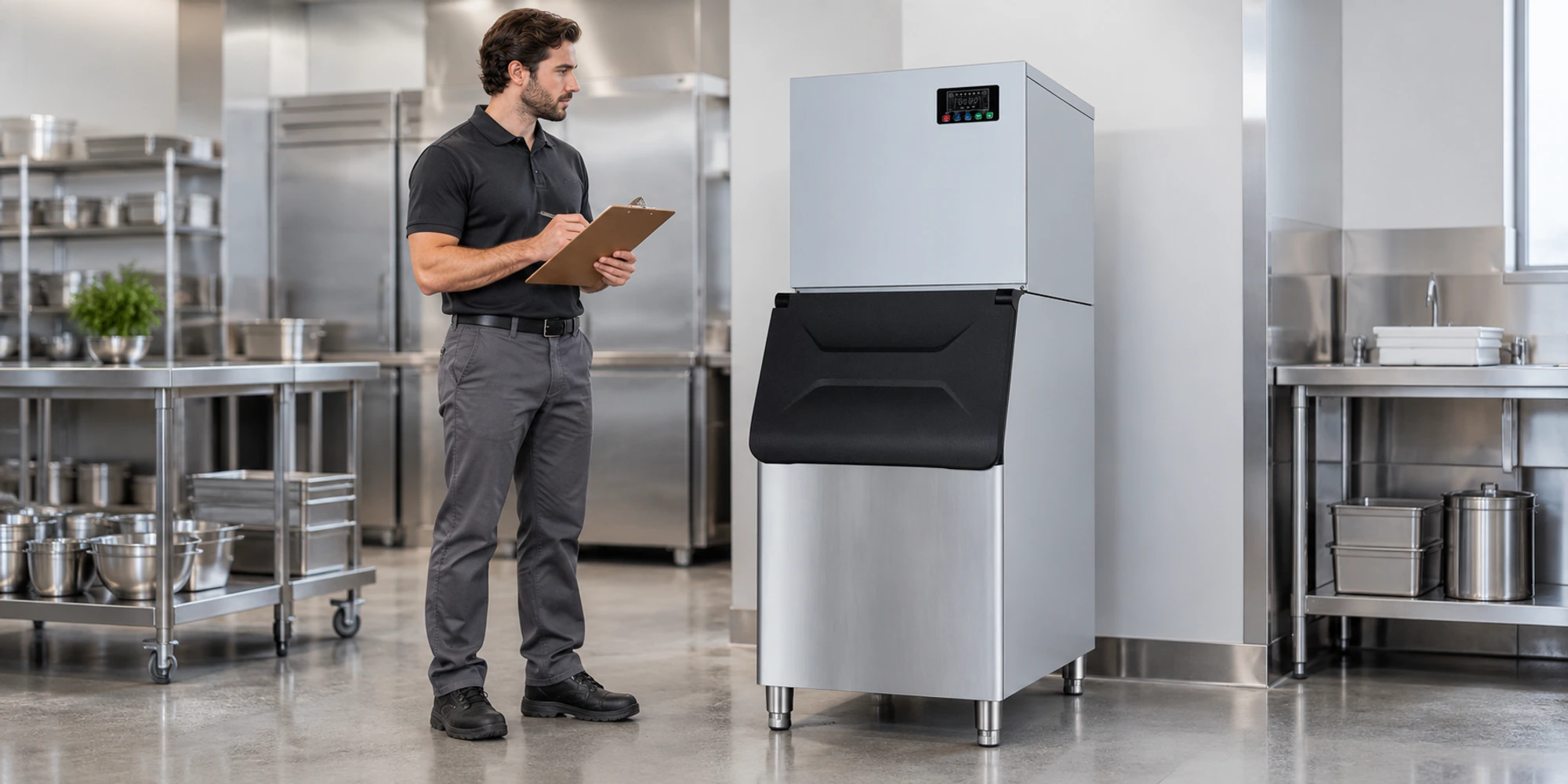
How to Choose a Commercial Ice Maker by Real Demand
Start with measured demand during the busiest service period.
Review several representative weeks and record ice taken from the bin by hour, including beverage service, food display, preparation, delivery packing, and any other process that shares the supply. Separate normal use from the busiest observed day. Measure first.
Calculate production and storage separately
Apply a simple purchasing rule. Required documented output must cover measured peak-day use plus the recovery stock your operation decides to hold, at conditions close to the planned site. Storage must cover the largest drawdown between production cycles and replenishment. A larger bin cannot compensate for a machine that consistently makes ice too slowly.
A practical capacity request should state peak-day consumption, operating hours, expected air and inlet-water temperatures, desired recovery stock, and the production evidence required from each shortlisted supplier for the proposed configuration.
| Input | Buyer-supplied value | How it affects selection |
|---|---|---|
| Peak-day ice use | kg per busiest day | Sets the production target |
| Highest continuous draw | kg during stated hours | Tests recovery needs |
| Required reserve | kg chosen by the operator | Sets usable storage needs |
| Ambient and inlet-water temperature | degrees C | Changes cycle time and output |
| Operating schedule | hours per day | Defines available recovery time |
Use measured conditions when available
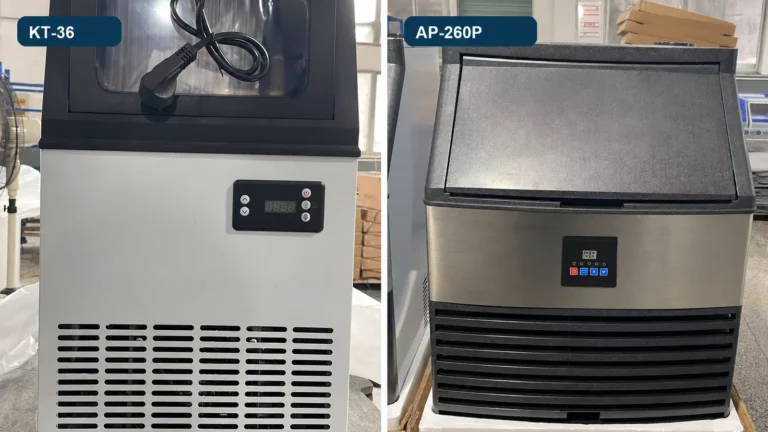
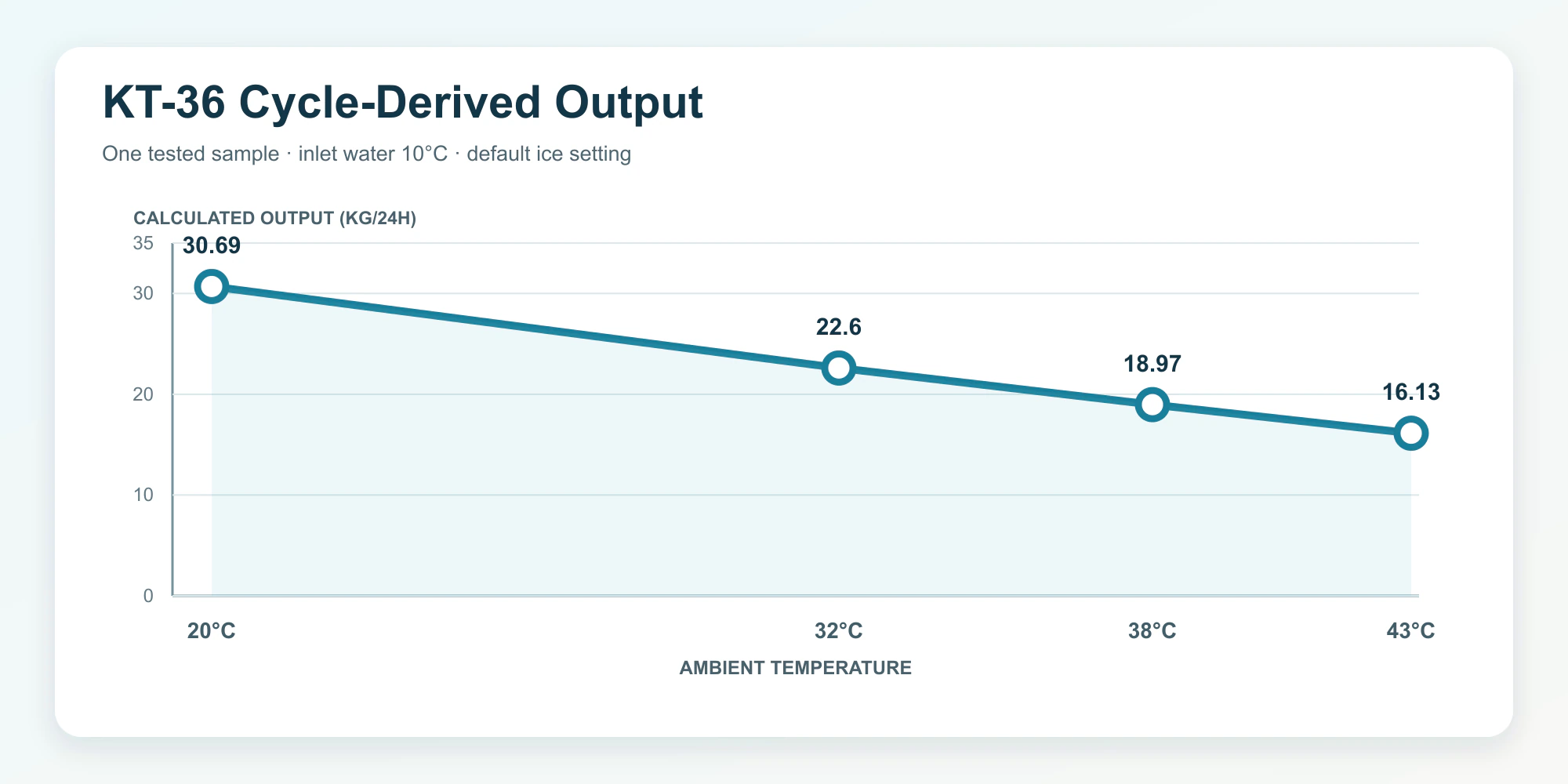
A KAISON test dated September 18, 2023 evaluated one KT-36 with an FKA40ML compressor, 220V/50Hz supply, 203.8W stated power, default ice thickness, and 10 degrees C inlet water. The figures below are calculated from the recorded cycle time and batch weight at each ambient temperature.
| Ambient temperature | Inlet water | Complete cycle | Batch ice weight | Calculated output |
|---|---|---|---|---|
| 20 degrees C | 10 degrees C | 15.25 min | 325 g | 30.69 kg/24h |
| 32 degrees C | 10 degrees C | 18.75 min | 295 g | 22.6 kg/24h |
| 38 degrees C | 10 degrees C | 20.5 min | 270 g | 18.97 kg/24h |
| 43 degrees C | 10 degrees C | 23.66 min | 265 g | 16.13 kg/24h |
The result explains why a buyer should request output at a stated condition instead of reading the model name as a capacity guarantee. Use the same discipline when reviewing the complete product range or a specific page such as the AP-25BT cube ice machine.
Match Ice Type and Machine Configuration to the Operation
Choose ice form and machine layout around the operation.
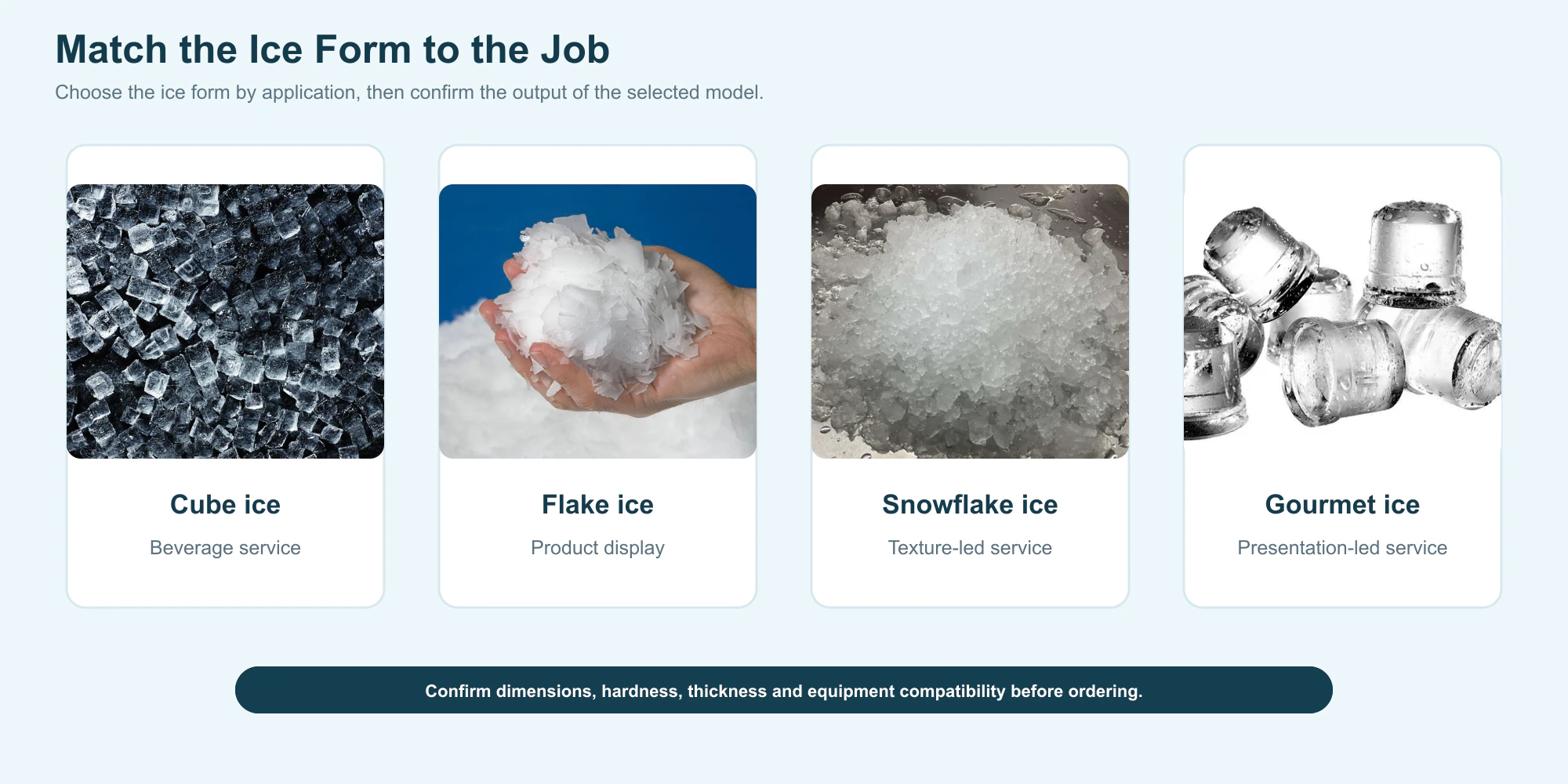
Ice shape affects presentation, contact area, handling, melt behavior, and downstream equipment. Start with the application, then compare cube ice machines, snowflake ice machines, flake ice machines, and gourmet ice machines as separate equipment families.
Select the ice by its job
Use cubes when a defined drink presentation and predictable portioning are priorities. Consider flake ice when broad product contact and shaping around displayed goods matter. Evaluate snowflake or granular formats when the texture itself serves the menu or display. Confirm cube dimensions, hardness, clarity, thickness adjustment, and compatibility with dispensers or packaging before approval.
When two formats meet the same demand, compare how each one serves the product, fits the service routine, handles storage, and supports cleaning before choosing a machine family for purchase.
Choose an integrated or separate-bin layout
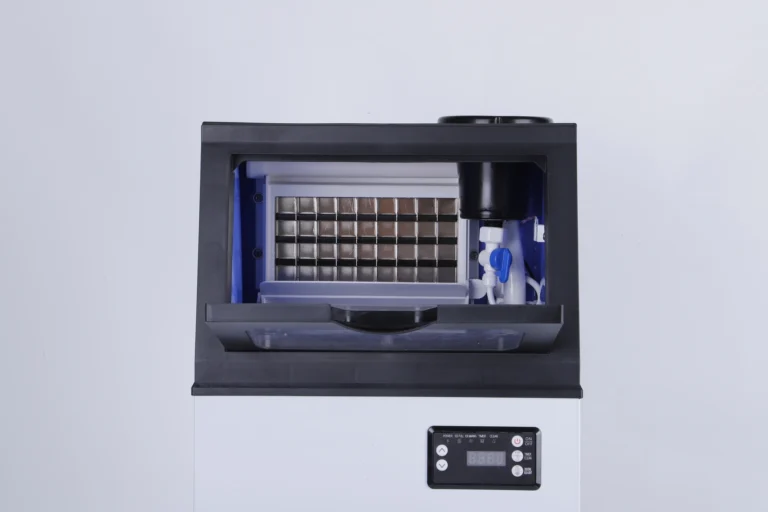
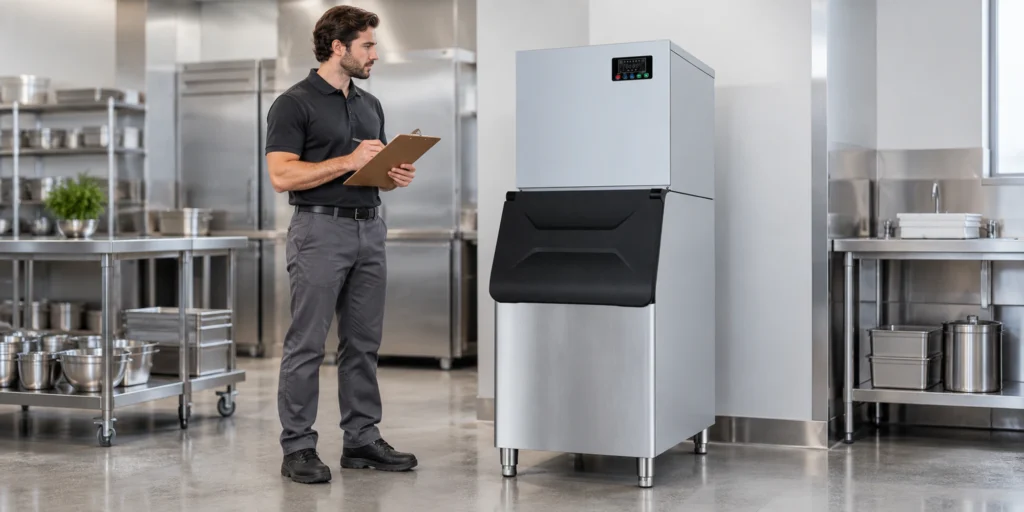
Built-in-bin machines combine production and storage in one cabinet and suit sites with simpler demand and limited space. Separate-bin machines let buyers pair a head with a larger storage bin and can support higher throughput or different harvesting patterns.
The KN-40 product page and KM-78 product page show how these layouts appear in the current range. Confirm every product-page capacity against the order datasheet, voltage, compressor, condenser, and stated test condition.
Verify Site Conditions Before Shortlisting Equipment
Installation facts can eliminate unsuitable machines before any quote.
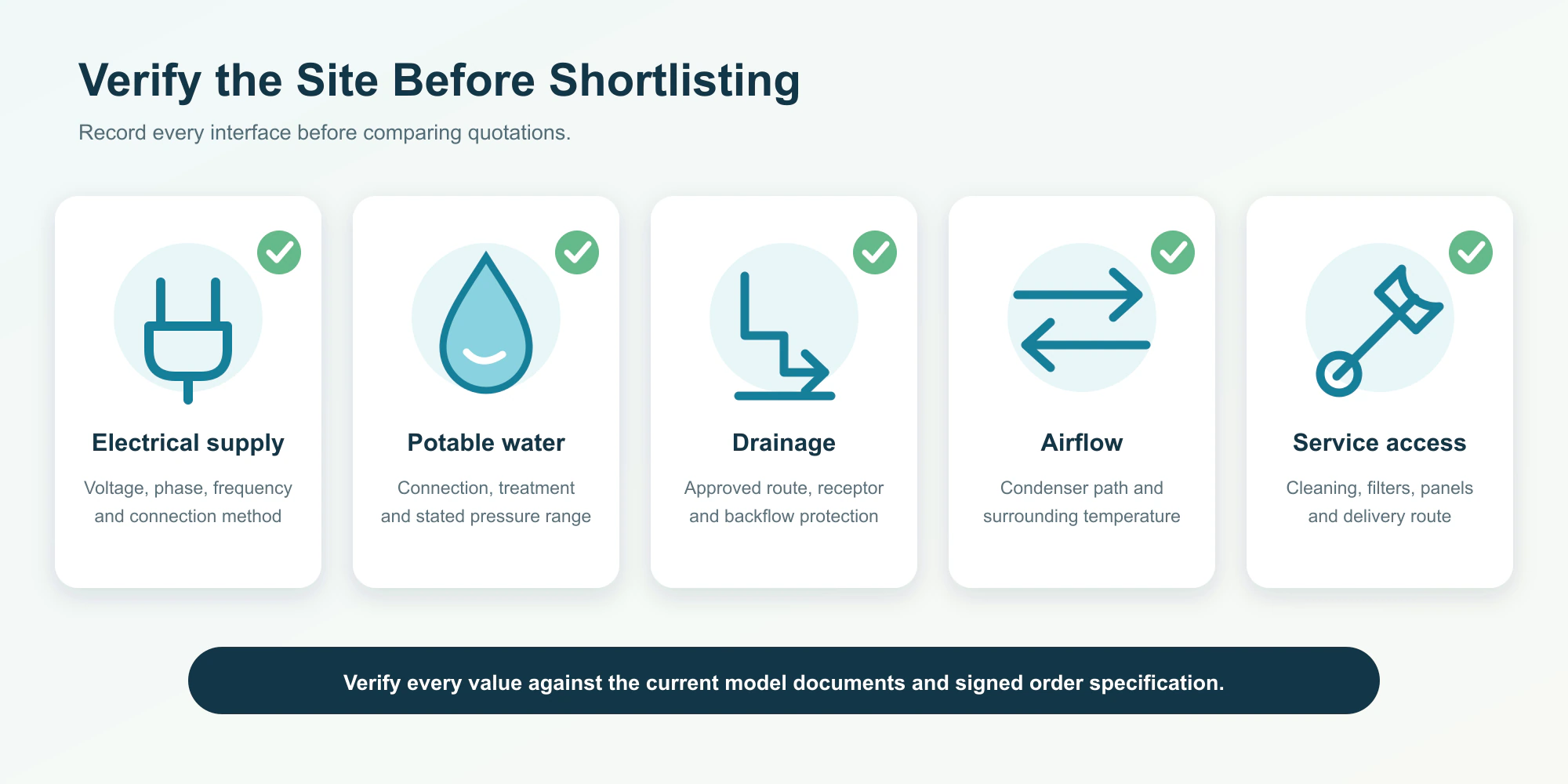
Confirm every interface. Your site worksheet should record the nameplate supply, phase, frequency, plug or hardwire requirement, potable-water connection, pressure range, drain method, clearance, ambient limits, floor load, and service access in advance.
Compare condenser options at the actual site
An air-cooled ice machine needs clean airflow and rejects condenser heat into its surrounding space when the condenser is indoors. A water-cooled ice machine needs an approved condenser-water supply and discharge arrangement. Ask whether the quoted machine is self-contained, split, or remote-condensing because its heat path and installation scope change.
Confirm the model-specific installation sheet
A KAISON flow-type installation manual specifies 0.1 to 0.5 MPa water pressure, gravity drainage, more than 15 cm of clearance, ambient temperatures from 10 to 38 degrees C, and inlet water from 5 to 30 degrees C. Apply these limits only to the models and document revision covered by that manual.
Installation requirements vary by model and revision. Use the current manual and the specifications confirmed in your signed order when planning the site. Before delivery, have qualified trades verify the potable-water connection and treatment needs, drain routing, backflow protection, and ventilation. They should also confirm service clearances, electrical protection, and compliance with local codes.
Review compact options in the countertop ice maker category and compare them with the broader applications overview. Use these pages to shortlist equipment families, then approve the site against the selected model’s installation documents.
Compare Technical Claims on Equal Test Conditions
Compare production claims only after normalizing their operating conditions.
Conditions change output. A credible comparison records the tested sample, condenser type, voltage and frequency, air temperature, inlet-water temperature, ice setting, cycle definition, measured batch weight, and calculation method beside every result shown.
Distinguish ratings, cycle calculations, and field records
A rated figure may come from a defined laboratory procedure. A cycle calculation extrapolates a measured harvest over 24 hours. A field record reflects a real installation with its own demand, maintenance, ventilation, and water quality. Keep these evidence types separate and request the underlying conditions for each.
Check whether documents match the offered model
A safety report should identify the tested sample and any covered model family. Report KSAS012026-0003, issued February 10, 2026, tested AP-260P samples against IEC 60335-1 and IEC 60335-2-89 and listed related models based on documented construction similarities. The report defines a specific safety-evidence scope; it does not show that every configuration has identical performance.
Review the supplier’s quality-control process and certification library, then request the full report relevant to the destination market. Verify the applicant, manufacturer, model, voltage, frequency, refrigerant, report number, issue date, standard edition, laboratory, result, and any sample-only limitation.
Evaluate Lifetime Cost and Supplier Evidence Together
Lifetime cost begins with the exact installed configuration.
Use local rates. For each shortlisted configuration, calculate purchase price, freight, installation, treatment equipment, planned filters, cleaning labor, electricity, water, expected service parts, downtime exposure, and disposal over the same evaluation period.
Build a transparent operating-cost worksheet
Use measured consumption where the supplier has it. A practical formula is annual electricity cost equals measured kWh multiplied by the local tariff, while annual water cost equals measured cubic meters multiplied by the local water and discharge rates. Keep maintenance, filters, cleaning labor, spare parts, and service travel as separate lines so assumptions remain visible.
Evaluate the manufacturer behind the specification
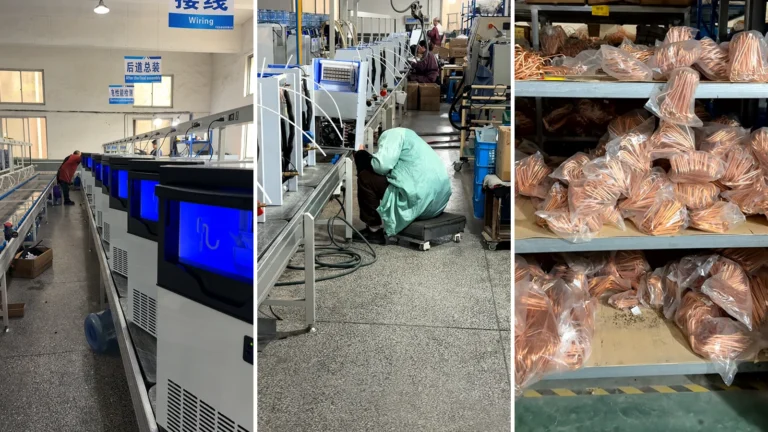
When sourcing from KAISON, compare the quoted specification with production evidence, component traceability, inspection records, spare-parts availability, and the written support plan. The OEM and ODM service page explains available customization routes. Require the quotation to identify any change that affects certification, performance testing, manuals, packaging, minimum order quantity, or lead time.
Do not accept vague equivalence. Request a nameplate image, current datasheet, wiring information, installation drawing, cleaning instructions, parts list, warranty terms, and the exact certificate or report that covers the offered build.

Build the Final RFQ and Approval Path
A structured RFQ keeps every supplier answer directly comparable.
Use one RFQ structure for every supplier. Include the use case, ice form, peak demand, operating schedule, site temperatures, utilities, preferred condenser, required documents, destination, order quantity, branding needs, and acceptance checks.
Require written answers before ordering
Ask the supplier to return one completed schedule instead of sending unrelated brochures. Include an acceptance plan covering model and nameplate verification, packaging condition, accessory count, water and electrical connection review, startup, cycle observation, ice quality, bin-control operation, drainage, alarms, and document handover.
Use the contact page to submit the completed brief. Attach photographs of the proposed location and utility points when possible, then request a marked installation drawing and final specification for the exact voltage, frequency, condenser, refrigerant, and branding configuration.
- Size production from measured peak-day use and output documented at the expected air and inlet-water temperatures.
- Keep production, storage, and peak draw as three separate purchasing fields.
- IEC 60335-2-89 addresses safety for commercial refrigerating appliances with incorporated or remote refrigerant condensing units or compressors.
- Report KSAS012026-0003 is a commissioned safety report with a named tested sample, covered models, standards, and issue date.
- Put utilities, installation limits, test conditions, warranty scope, spare parts, and acceptance checks in the RFQ.
Frequently Asked Questions
How much ice-making capacity does my business need?
Base capacity on measured peak-day ice use under expected conditions. Add the reserve your operation deliberately wants for recovery, then ask suppliers to document output near your expected air and inlet-water temperatures. Do not size from average daily use alone because an acceptable daily total can still fail during a concentrated service rush. Record the largest continuous draw and the hours available for recovery. Keep the bin calculation separate. The final capacity decision should show the demand record, desired reserve, operating schedule, and supplier evidence used.
Is storage-bin capacity the same as daily ice production?
Storage and production describe different functions inside the ice system. Production states how much ice the machine can make under defined conditions, while storage states how much finished ice the bin can hold before its control stops production. A large bin can cover a short demand surge if it was filled beforehand. It cannot repair an ongoing production shortage. Check usable storage, bin compatibility, ice-level controls, sanitation access, and the timing of demand. Match both values to the operating schedule.
Should I choose an air-cooled or water-cooled ice maker?
Choose the condenser after documenting ventilation, room heat, water availability, discharge rules, utilities, and local operating costs. Air-cooled equipment avoids condenser-water consumption but needs clean airflow and may add heat where an indoor condenser operates. Water-cooled equipment can suit sites where its water circuit and discharge are permitted and correctly sized. The right answer depends on the exact configuration and location. Ask for condenser requirements, heat-rejection information, water data, clearances, and the current installation drawing before approval.
What is the difference between a built-in-bin and separate-bin machine?
A built-in-bin machine combines the ice-making section and storage in one cabinet. This layout can simplify planning for modest demand and compact sites. A separate-bin system pairs an ice-making head with a compatible bin, giving more flexibility for storage size, production class, and service layout. A KAISON quotation should confirm bin compatibility and control operation in writing. Also check overall height, door or lid clearance, floor loading, drainage, cleaning access, and delivery route dimensions. Select the layout that matches the demand pattern and available service space.
Which commercial ice type should I choose?
Choose ice according to the product or process it serves. Cubes suit many beverage programs where portioning, appearance, and a defined shape matter. Flake ice can wrap around displayed products and increase contact area. Snowflake or granular ice may support menu items or presentations that rely on texture. Gourmet forms can prioritize visual presentation. Test the proposed ice with the actual drink, display, packaging, or downstream equipment. Confirm dimensions, thickness control, hardness, melt behavior, scoopability, and dispenser compatibility before ordering.
Does a hot kitchen reduce commercial ice-maker output?
Higher ambient or inlet-water temperatures can lengthen the cycle and reduce calculated output. One KT-36 sample recorded this pattern with 10 degrees C inlet water and ambient conditions from 20 through 43 degrees C. Use the selected model’s own data when planning another installation. Ask for performance at your expected condition, confirm ventilation and condenser cleanliness, and keep heat-producing equipment away from required airflow. Site design and maintenance affect the result.
What utilities should I confirm before ordering?
Confirm voltage, phase, frequency, connection method, circuit requirements, grounding, potable-water connection, pressure range, treatment, drain type, discharge route, and any condenser-water circuit. Verify every value against the selected model’s current nameplate and installation manual. Include ambient and inlet-water limits, ventilation clearances, service access, floor strength, and the delivery path. Local electricians, plumbers, food-safety personnel, and code officials should resolve jurisdiction-specific requirements. Do this before shipment because utility changes can alter cost, timing, and machine suitability.
What documents should I request from a commercial ice-maker supplier?
Request the current datasheet, nameplate image, installation drawing, user and cleaning manuals, wiring information, parts list, warranty terms, inspection record, and reports required for the destination market. Ask each shortlisted supplier to map every document to the exact model, voltage, frequency, refrigerant, compressor, condenser, and destination-market configuration stated in the final quotation before you approve the order. Check report numbers, dates, standard editions, laboratories, tested samples, covered models, and limitations. Keep the approved set with the purchase order so receiving and commissioning teams can verify the delivered machine.