Written by gary@nbkaison.com
Commercial Ice Machine Installation Requirements: A Site Preparation Guide
Commercial ice machine installation requirements must match the delivered AP-300P, its supplied instructions, and approved site services before power is connected. Confirm the assembled footprint, ventilation, drinking water, drainage, and electrical supply together. An available socket and tap alone do not establish readiness. Record the cooling configuration and controller version before inspecting the delivery route. Plan separately for the ice head and storage bin. Treat published specifications and the dated AP-300P laboratory results within their stated scope. Qualified trades must approve plumbing and electrical work. Commissioning then verifies filling, drainage, ice harvest, and automatic stopping before the machine enters foodservice use.
Commercial Ice Machine Installation Requirements at a Glance
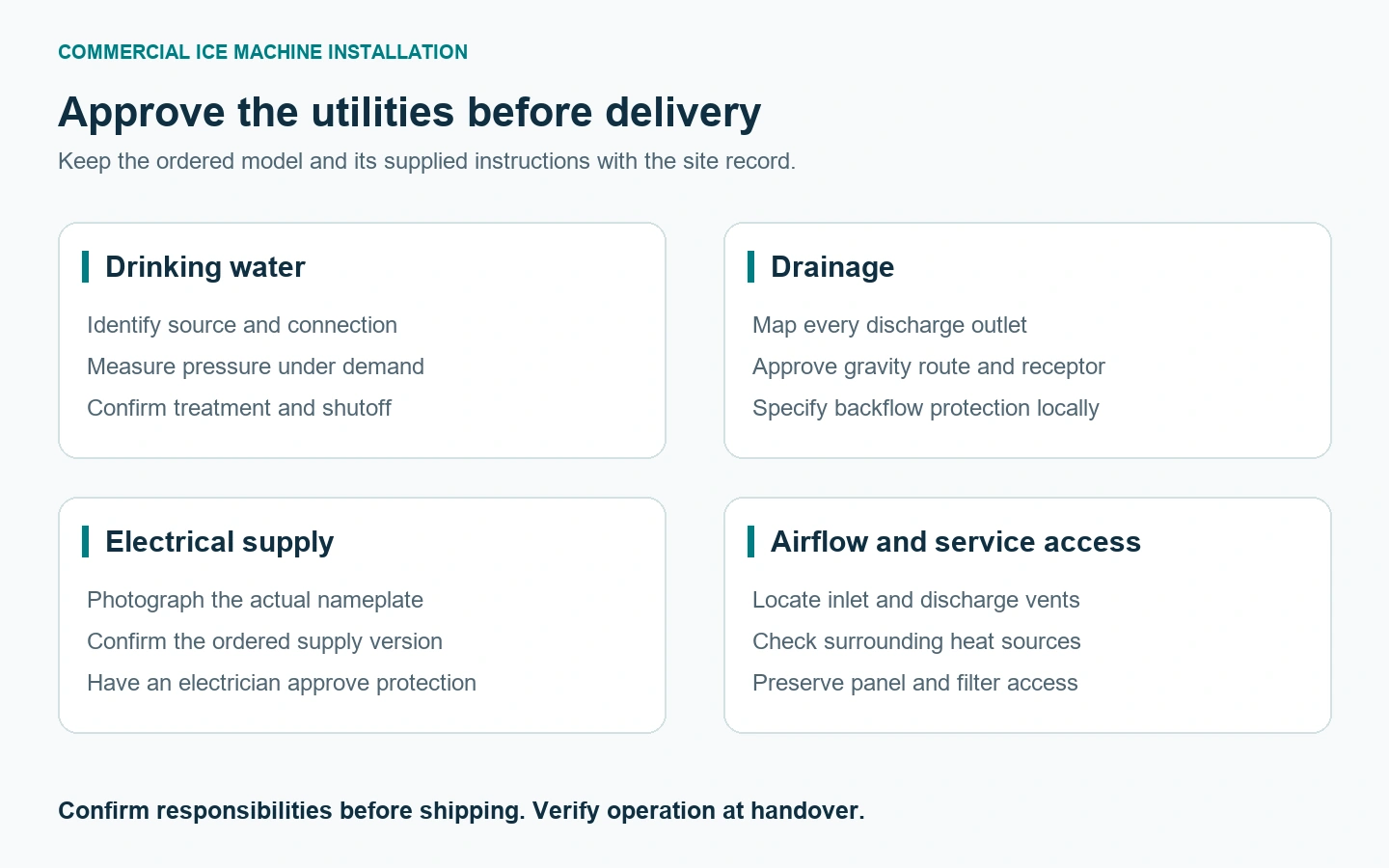
Approve each utility before scheduling delivery and connecting the machine.
Start with the site survey. Before delivery, the buyer should confirm the room layout with the installer so utility approval and written supplier confirmation refer to the same ordered configuration and the matching installation instruction revision.
A commercial ice maker belongs in a working layout that supports ice collection and cleaning. For restaurant ice makers, check access during service. Review bar service, banquet peaks, and staff routes when preparing hotel ice machines.
Apply the same utility survey to a cafe ice machine installation.
| Requirement | Record before delivery | Responsible person |
|---|---|---|
| Machine identity | Ordered model, cooling configuration, controller photograph, supplied manual | Buyer and supplier |
| Space | Cabinet dimensions, vents, removable panels, door travel, delivery openings | Facility manager and installer |
| Drinking water | Source, measured pressure, connection, selected treatment | Plumber and facility manager |
| Drainage | Outlet elevations, route, approved receptor and backflow protection | Plumber |
| Electricity | Nameplate supply, grounding, circuit protection, connection method | Electrician |
| Commissioning | Leak checks, drain flow, harvest, full-bin response and handover record | Installer and operator |
Confirm the AP-300P Configuration and Delivery Route
Identify the actual machine before using catalogue dimensions for planning.
Plan for the Ice Head and Storage Bin
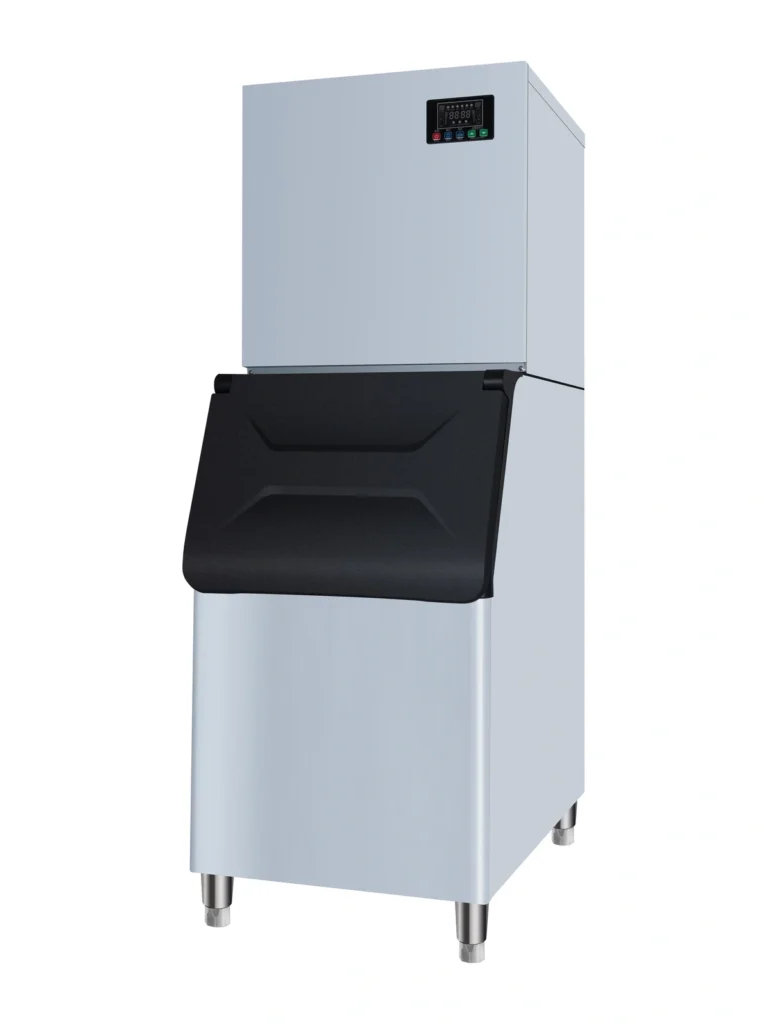
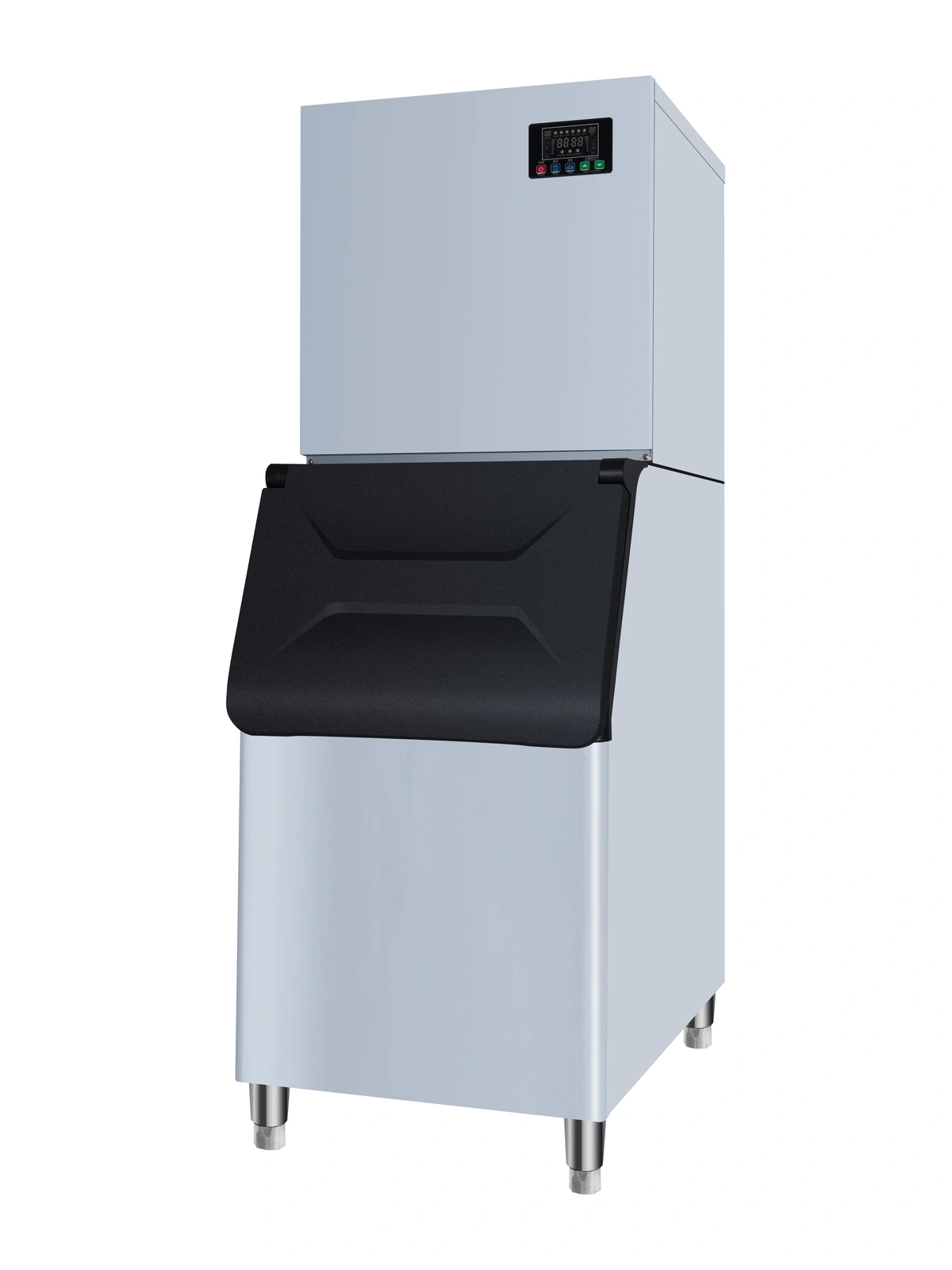
KAISON's AP-300P product document lists an assembled size of 560 x 830 x 1570 mm, a 140 kg storage bin, and a 73 kg net weight. It lists an 80 kg gross weight.
Measure the route separately. Review the AP-300P cube ice machine before surveying access.
Ask the receiving team to photograph the delivery route before dispatch so the installer can check its narrowest doorway and any obstacles that prevent the packed cabinet from reaching the intended location.
The document lists two packages. The mainframe carton is 625 x 645 x 635 mm, while the storage-bin carton is 880 x 640 x 990 mm.
These figures do not include ventilation, connection space, service access, or door travel.
Separate Published Specifications From the Delivered Version
Use the nameplate to identify the supplied electrical version. Different documents can describe different production conditions or machine revisions. Obtain the matching technical sheet before treating catalogue output as a site guarantee.
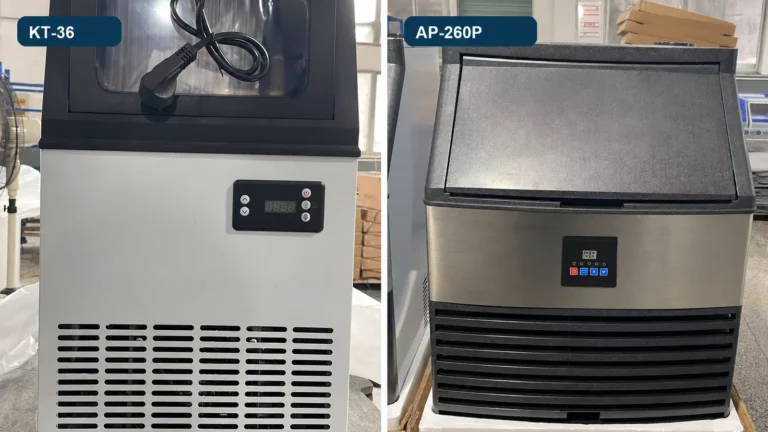
Compare cube ice machine configurations by their installed arrangement. A separate-bin ice machine adds ice-head placement, bin alignment, and assembly checks to the survey.
Preserve Airflow and Service Access
Ventilation and panel access must survive the final furniture layout.
Check the Vents and Nearby Heat Sources
Keep the vents clear. Check the proposed location while surrounding equipment is operating, because an oven, a dishwasher, or a confined recess can expose the condenser to conditions that an empty room survey will miss.
The AP-300P product sheet does not state a ventilation clearance. Obtain the order-specific installation drawing before setting furniture dimensions, and mark every intake, outlet, removable panel, and cleaning access zone.
An air-cooled ice machine needs an unobstructed cooling path. Allow technicians to remove service panels and reach the filter without dismantling surrounding equipment.
Review Water Cooling as a Separate Configuration
A water-cooled ice machine requires the specified condenser-water connections as well as ice-making water. Identify each port from its installation drawing. Approve the water consumption and discharge arrangement before selecting that configuration.
Prepare Drinking Water and Accessible Treatment
Match the supply arrangement to the installed inlet and accessories.
Confirm Pressure and Connection Details
Measure pressure at the connection. The available split-machine instructions list 0.1 to 0.5 MPa, but obtain confirmation that this manual revision accompanies the delivered AP-300P before adjusting the supply.
For plumbing and electrical connection planning, KAISON's AP-300P parameter drawing identifies the water inlet, drain, power input, condenser-water inlet, and condenser-water outlet.
Inspect the delivered fitting before ordering adapters. A translated pipe label cannot establish thread compatibility.
Where several appliances share the incoming pipe, ask the plumber to observe the pressure during simultaneous use and confirm that the selected treatment equipment permits the required supply under those actual operating conditions.
Distinguish Filtration From Potable Water
Start with drinking water. A sediment cartridge does not establish microbiological safety or remove every dissolved contaminant. The manufacturer's split-machine instructions explicitly describe their supplied filter as suitable for machine testing.
Choose treatment from the local water analysis and the cartridge manufacturer's stated capabilities. Preserve replacement access, and follow the instructions supplied with the selected AP-300P configuration.
Plan Drainage Before the Machine Arrives
Drainage must carry discharge away without returning it to equipment.
Confirm the Route and Receptor
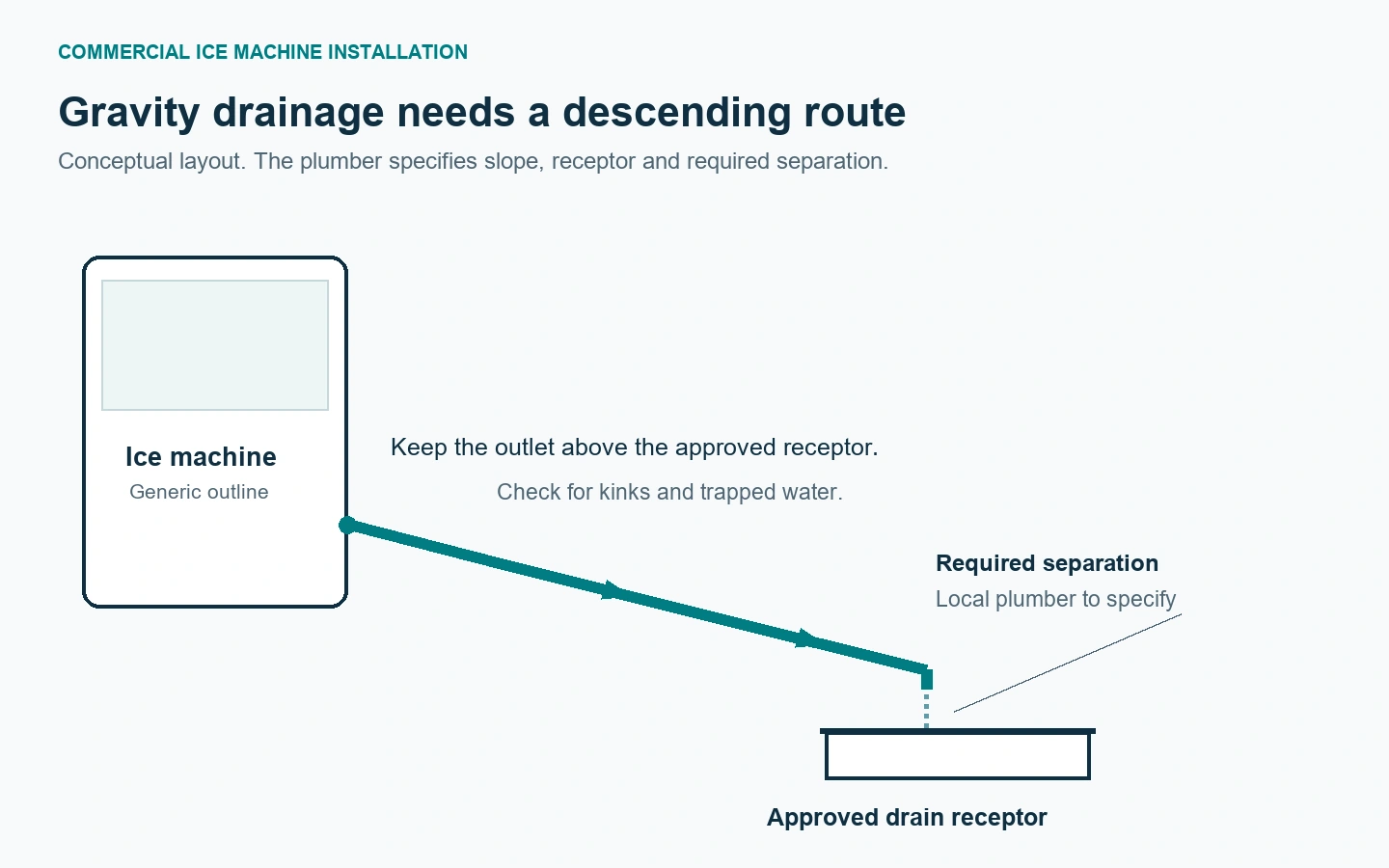
Gravity needs a descending route. The available split-machine instructions describe gravity drainage. Record the outlet and receptor elevations, then ask the plumber to approve the complete hose route before positioning the bin.
Keep drainage protection explicit.
The FDA Food Code 2022, section 5-402.11 restricts direct sewage connections from equipment containing food, subject to stated exceptions; the locally adopted code determines the approved arrangement.
Have the plumber approve a drainage drawing that identifies the permitted receptor and the required backflow protection for each discharge, so the installer can verify those details before connecting the supplied hoses.
Test Drainage Under Operating Conditions
Check for kinks and trapped water.
Observe the drain during the startup procedure and after an ice harvest. Confirm that discharge reaches the receptor without backing up into the bin or spilling onto the floor.
The manufacturer's flow-structure manual warns against combining pressurized condenser discharge with other drains. A proposed pump requires written equipment compatibility and local approval. Do not assume that a raised waste connection suits gravity drainage.
Confirm the Electrical Supply From the Nameplate
The ordered electrical version determines the supply and protection requirements.
Ask the Electrician to Approve the Circuit
Read the actual nameplate. Ask the electrician to confirm voltage, frequency, phase, grounding, protective devices, conductor sizing, plug or hardwired connection, and an accessible isolation method.
When arranging the installation, give the electrician the nameplate photograph and supplied instructions, then obtain confirmation that the building circuit, protective device, grounding arrangement, and accessible isolation method match the ordered electrical version. A control-box fuse rating is a component specification. It does not select the building circuit breaker. Electrical component replacement belongs to qualified service personnel. Avoid borrowing a wiring recommendation from a different model's manual.
Keep Certification Scope Separate From Installation Approval
Safety report KSAS012026-0004 lists AP-300P within its model scope under IEC 60335-1 and IEC 60335-2-89. The representative machine, series differences, and report ratings remain distinct from the delivered unit.
Request the relevant certification documents for the destination and configuration. A laboratory report supports its stated assessment; it does not approve a restaurant's plumbing or electrical work.
Commission the AP-300P and Record the Handover
Document operating checks before handing the machine to foodservice staff.
Inspect, Assemble, and Prepare the Machine
Inspect both packages first. Check the ice head, storage bin, accessories, controller, and visible condition. Record damage before removing the packaging or protective film.
Level the storage bin using its adjustable feet. Mount and align the ice head by the supplied assembly procedure, keeping the ice path unobstructed and all required seals correctly seated.
Keep the bin clean and inspect food-contact surfaces before startup. Before power is applied, verify water, drainage, electrical approval, and any transport-standing instruction stated in the delivered manual.
Verify the Operating Sequence and Bin Control
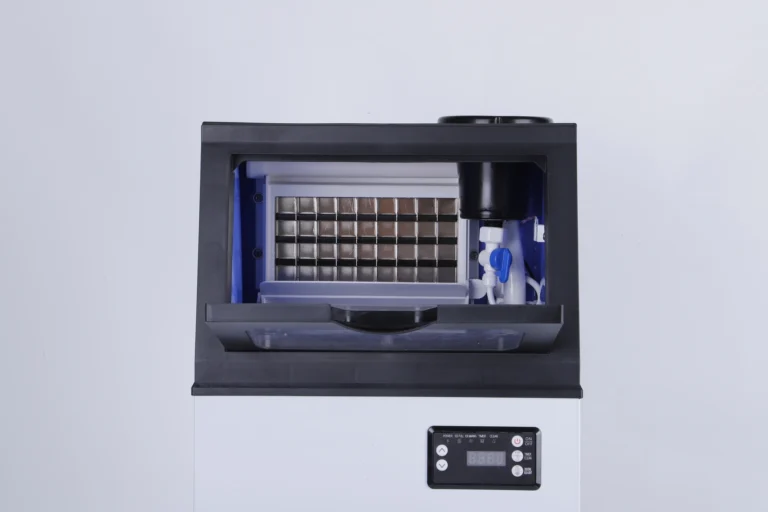
Observe water distribution across the grid during startup. Check the harvest and the bin's stopping response before handover. Record the controller setting and any fault code. Use the operating instructions that match the actual panel; supplied guides show several controller layouts.
Before handover, the installer should record the controller setting, observed water distribution, harvest response, bin stop response, leak inspection, drain performance, corrective work, and the identity of every person accepting the equipment.
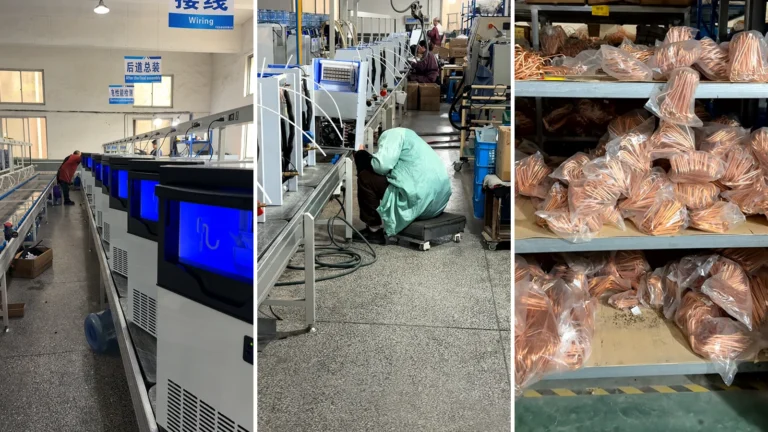
Retain the initial ice-handling instructions with the handover record. Cleaning guidance and new-machine commissioning can have different discard requirements. Inspect the supplier's quality-control process alongside the site acceptance record.
Train the operator to isolate power and water for the prescribed maintenance. Keep the scoop clean and store only ice in the bin. Make filter replacement and condenser access part of the operating layout.
Interpret the AP-300P Production Test Correctly
Test conditions explain output better than an isolated daily-capacity number.
Read the Dated Factory Test as One Sample Result
KAISON's internal report dated 15 May 2024 tested one AP-300P sample with an 11 x 12 grid and a 220 V, 50 Hz supply. It recorded both freezing and harvest times.
At 20°C room temperature and 10°C water temperature, the report recorded 1,420 g per harvest, a 13-minute 20-second freeze, and a 1-minute 50-second release. Its cycle-derived daily output was 135 kg.
At 32°C room temperature and 21°C water temperature, that sample produced 1,150 g per harvest.
Freezing took 14 minutes 42 seconds and release took 58 seconds. The report's daily calculation was 105 kg.
Keep Calculated Output Separate From Acceptance Criteria
The sample explains the method. Because the laboratory changed both room and inlet-water temperatures between tests, these results cannot isolate either variable's effect or establish a universal AP-300P performance guarantee.
The dated report supports comparison only when sample identity, room temperature, inlet-water temperature, weighed harvest, freeze time, release time, voltage, current, and power remain attached to each specific recorded result.
For a repeatable field record, weigh the harvested ice and time the complete cycle. Record room temperature and water temperature with the measurement. A daily extrapolation assumes uninterrupted cycling, which a full bin or service stop can interrupt.
| Recorded field | Cooler test | Warmer test |
|---|---|---|
| Sample | AP-300P, 11 x 12 grid | Same sample |
| Room / inlet water | 20°C / 10°C | 32°C / 21°C |
| Ice per harvest | 1,420 g | 1,150 g |
| Single cube mass | 10.7 g | 8.7 g |
| Freeze / release | 13 min 20 s / 1 min 50 s | 14 min 42 s / 58 s |
| Recorded current / power | 4 A / 820 W | 4.3 A / 850 W |
| Cycle-derived daily output in report | 135 kg | 105 kg |
| Source locator | Internal report dated 15 May 2024 | Same report; no printed report number |
| Calculation | Required inputs | Limitation |
|---|---|---|
| Daily extrapolation = harvest mass in kg x 1,440 / complete cycle minutes | Weighed harvest; freeze plus release time | Assumes continuous cycling; not measured 24-hour delivery |

Send the Site Record With the Procurement Request
A complete site record makes the requested configuration reviewable before shipment.
Include the intended model and destination. Attach the site photographs and utility measurements. Identify the required ice type. For OEM and ODM projects, confirm panel language and electrical version before approving the order.
Ask for order-specific terms.
The manufacturer's internal handover process calls for a nameplate photograph and purchase information. Its required operating video must clearly show the water distribution and water level with the controller setting visible.
When requesting a quotation, ask the supplier to confirm its production schedule against your intended installation date and order quantity, with written approval of any branding changes and the documentation supplied before shipment.
Use the product range to narrow the configuration and the purchasing FAQ to prepare order questions. Confirm the manufacturer's identity on the supplied technical documents. Compare project layouts in the application library. Keep technical acceptance separate from delivery dates. Send the record through the installation and model enquiry form.
- The AP-300P product document lists an assembled size of 560 x 830 x 1570 mm, excluding ventilation, connection, and service allowances.
- Safety report KSAS012026-0004 lists AP-300P within its model scope under IEC 60335-1 and IEC 60335-2-89; its scope does not approve site utilities.
- The mainframe and storage bin ship in separate packages measuring 625 x 645 x 635 mm and 880 x 640 x 990 mm in the product document.
- Gravity drainage requires an approved descending route and receptor; check each discharge during startup.
- Record the controller version with the site measurements so installation and support instructions match the delivered equipment.
Frequently Asked Questions About Commercial Ice Machine Installation
Confirm the supplied configuration when applying any general installation advice.
Does a commercial ice machine need a floor drain?
An approved discharge destination is necessary, but the required receptor depends on the equipment and the local plumbing rules.
A gravity outlet needs sufficient downward fall along the entire route. A nearby drain can still be unsuitable if its inlet is above the appliance outlet. The plumber should assess the waste connection and specify protection against contamination. An optional pump must be compatible with the machine and approved for that installation.
How much clearance does the AP-300P need?
The verified AP-300P product sheet does not publish a ventilation or service-clearance number.
Confirm the installation drawing supplied for the ordered cooling version before finalizing the room. Ventilation allowance also differs from the space needed to open the bin door or remove a service panel. Ask the installer to mark those access zones on the floor plan and preserve them after adjacent equipment is installed.
Does the machine require a dedicated electrical circuit?
The electrician should decide the circuit arrangement from the delivered AP-300P nameplate, supplied instructions, and locally applicable electrical requirements.
A licensed or otherwise locally qualified electrician should size and approve the installation using the appliance label and applicable electrical rules. Neither a catalogue wattage nor the internal control-box fuse establishes the branch protective-device rating. Supply variants must be checked individually. Keep the electrical inspection record with the equipment documents and identify the isolation point for staff.
Can the AP-300P be installed outdoors?
KAISON's verified AP-300P product sheet does not provide an outdoor-use approval or an environmental enclosure rating.
Shelter alone does not establish approval for exposure to rain, freezing conditions, sunlight, or moisture. Specify an indoor location with the required ventilation and drainage. If the project includes an outdoor serving area, choose equipment whose written specifications explicitly authorize that environment. Tell the supplier how the proposed location is enclosed and what temperatures it experiences before completing the purchase.
What additional services does a water-cooled model need?
A water-cooled configuration adds the cooling-water supply and discharge to the drinking-water connection used for ice.
Port identification must come from the delivered unit's drawing. The installation must provide the specified flow and approved wastewater handling. Cooling discharge can be pressurized, so it needs the manufacturer's specified routing rather than an assumed connection to the bin hose. Compare water availability and drainage capacity before approving the cooling method for the site.
Can the business owner install the machine?
An owner can assemble the site information and inspect the delivery with the supplier's instructions available.
Plumbing alterations and electrical work require the qualifications and approvals applicable locally. Installation includes checking the operating controls as well as the grounding and waste connections. Divide those responsibilities before the delivery appointment. Where technical intervention is required, arrange a qualified technician and preserve the equipment identity with the operating symptoms in its service record so remote support can assess the same configuration.
What should be checked before serving the first ice?
The commissioning record should show successful filling and leak checks, unobstructed wastewater flow, reliable release of ice, and the correct response when storage reaches its stopping condition.
Food-contact parts require the specified initial preparation. Retain chemical instructions for any cleaning or sanitation step, then complete the required rinsing and ice disposal. The appliance's startup instructions determine readiness; appearance alone cannot verify hygiene or confirm that the installation has passed its operating checks.
What information should be confirmed before shipment?
Confirm the model and its electrical label, cooling method, included accessories, and supplied instruction revision.
Review the package dimensions against the receiving route. Send the supplier the site photographs and utility findings, including the destination's documentation requirements. Record the agreed production and dispatch schedule in the order confirmation. A service video is useful for demonstrating operation, but the written technical documents should resolve connection details before the installer attends the site.