Written by gary@nbkaison.com
How to Clean a Commercial Ice Machine Safely
How to clean a commercial ice machine safely depends on its manual, approved chemicals, and separate cleaning, descaling, and sanitizing stages. Shut down the machine as instructed, discard stored ice, remove only approved parts, and use chemicals listed for that model and surface. Rinse wherever the manual requires it, rebuild the machine correctly, discard the specified startup ice, and record the work. There is no universal vinegar formula, service interval, cycle duration, or discard quantity. The correct procedure depends on the manufacturer’s instructions, soil, water conditions, operating load, and local food rules. Stop when access requires electrical, refrigeration, sealed water-system, or damaged-component work that belongs to a qualified technician.
Why Commercial Ice Machine Cleaning Matters

Clean equipment protects ice quality and keeps service predictable.
FDA regulates packaged ice as food, and its Food Code treats ice makers and bins as food-contact equipment cleaned at the manufacturer’s frequency or often enough to prevent soil and mold.
Scale and blocked airflow can reduce ice output.
Biofilm, residue, and drain contamination can cause odor, degrade ice quality, and recontaminate finished ice after an internal cycle.
Operators using a commercial ice maker need a procedure covering its water, storage, airflow, and drainage systems.
Cleaning vs. Descaling vs. Sanitizing
These three processes solve different maintenance problems inside the machine.
What Cleaning Removes
Cleaning removes visible soil.
Detergent and mechanical action loosen grease, dust, syrup residue, loose debris, and films from approved surfaces, creating the clean base that later treatment needs to reach the material underneath.
What Descaling Removes
Descaling targets mineral deposits.
The approved descaler circulates through designated water paths or contacts specified components according to the machine manual, with concentration, contact time, temperature, and rinsing controlled by that instruction.
What Sanitizing Controls
Sanitizing follows effective cleaning.
A labeled food-contact sanitizer is applied at its required concentration and contact time to reduce microorganisms on already cleaned surfaces, then drained, rinsed, or air-dried exactly as its label and the equipment manual direct.
Cleaning, descaling, and sanitizing compared
| Process | Removes | Product Type | Typical Target |
|---|---|---|---|
| Cleaning | Soil, loose residue, grease, and debris | Manual-approved cleaner | Bin, scoop, removable parts, and accessible food-contact surfaces |
| Descaling | Mineral deposits in approved water paths | Model-compatible descaler | Water circuit and approved ice-making components |
| Sanitizing | Microorganisms remaining after effective cleaning | Labeled food-contact sanitizer | Cleaned food-contact surfaces approved by the manual |
Never combine chemical products unless both labels expressly permit it. KAISON should state this boundary in every model-specific cleaning guide because improvised mixtures can release hazardous vapors, damage materials, or leave residues in the water path.
Check the Model Before You Start
The model number determines which cleaning procedure is safe and complete.
Locate the Model Number and Manual
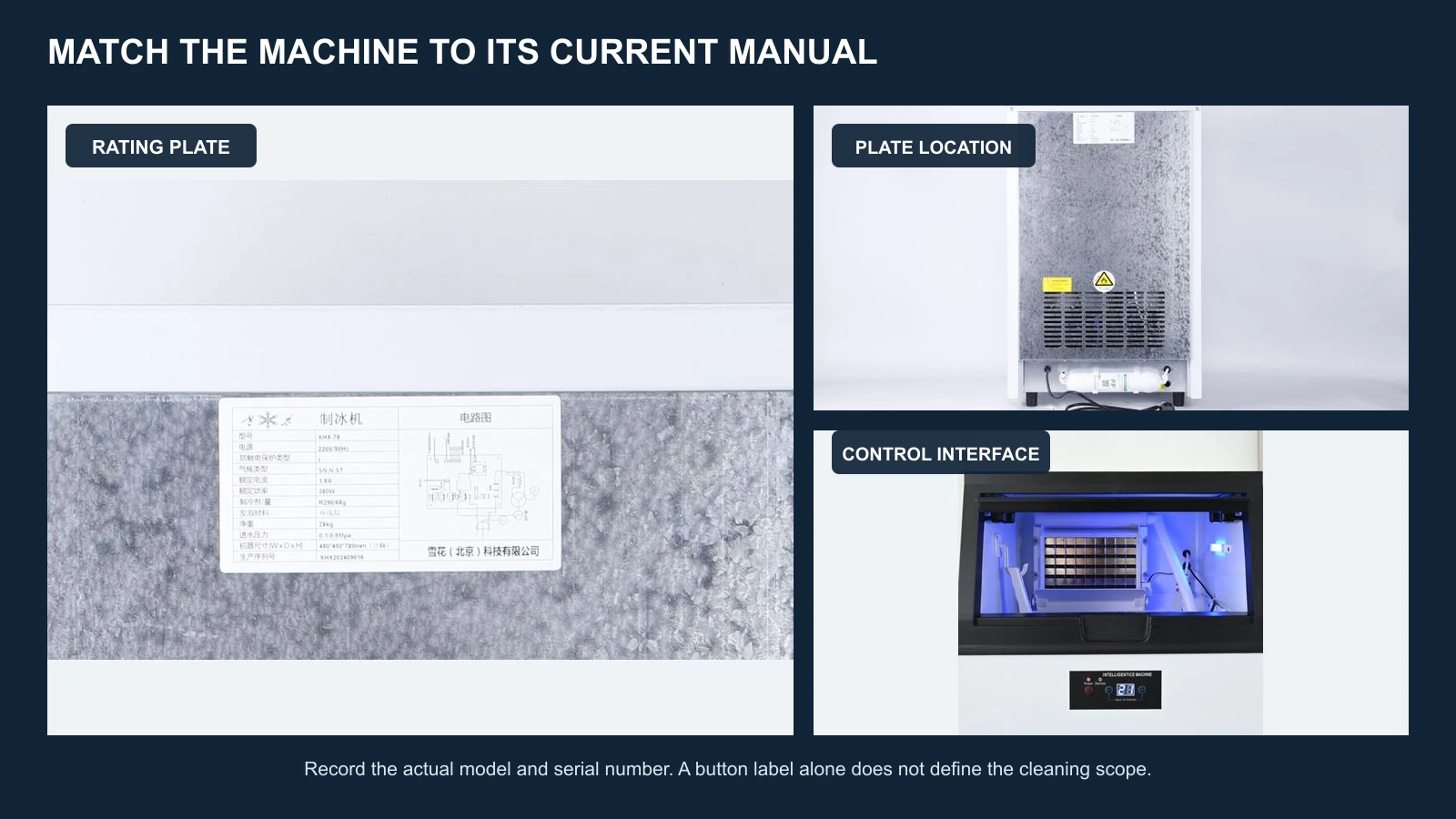
Find the rating plate first.
Record the model and serial number before opening a panel, choosing a chemical, or pressing a clean button, because similar cabinets can contain different pumps, evaporators, drains, controls, and refrigerants.
CVC report KSAS012026-0004 identifies its tested KL-650 sample as 780 × 850 × 1,850 mm, 220–240 V, 60 Hz, R290 with a 148 g charge, and an IPX0 ingress rating.
IPX0 is not a wash-down rating, so the report supports a strict rule for that sample: never hose the cabinet or direct liquid toward electrical areas.
Confirm Approved Chemicals
Read both governing documents.
The machine manual controls equipment compatibility, while the chemical label controls dilution, handling, contact time, ventilation, protective equipment, and any rinse requirement; neither source can safely replace the other.
Do not assume household vinegar, dish soap, chlorine bleach, or an unlabeled acid is acceptable. If the manual does not identify a compatible product, request written guidance from the manufacturer before introducing a chemical into the water circuit.
Identify Removable and Technician-Only Parts
Remove only listed components.
Bin doors, curtains, distribution tubes, floats, probes, water troughs, scoops, filters, and panels vary by design, so a part that lifts out on one machine may be wired, sealed, or calibrated on another.
Plan Downtime and Ice Supply
Schedule the entire recovery window.
Include ice disposal, disassembly, chemical contact time, rinsing, drying, reassembly, startup, discarded batches, and performance checks before promising that the machine will return to service.
A restaurant ice maker may need backup supply, while a hotel ice machine may require floor-by-floor scheduling.
Tools and Supplies
Prepare every approved item before taking the machine out of service.
The working kit should include the model manual, chemical labels, required personal protective equipment, soft cloths, nonabrasive brushes, food-contact-compatible supplies, labeled containers, required test materials, clean towels, and a maintenance record.
Do not return a brush, cloth, bucket, or scoop to food-contact work after it has touched a floor, condenser, drain, waste surface, or an unclean service area.
The FAQ and after-sales page is a starting point, not a substitute for the supplied model document. KAISON’s service team can match a control interface, drain arrangement, and maintenance video to the model number.
How to Clean a Commercial Ice Machine Step by Step
Use this sequence as a control map, then follow the manual.
1. Shut Down the Machine and Water Supply
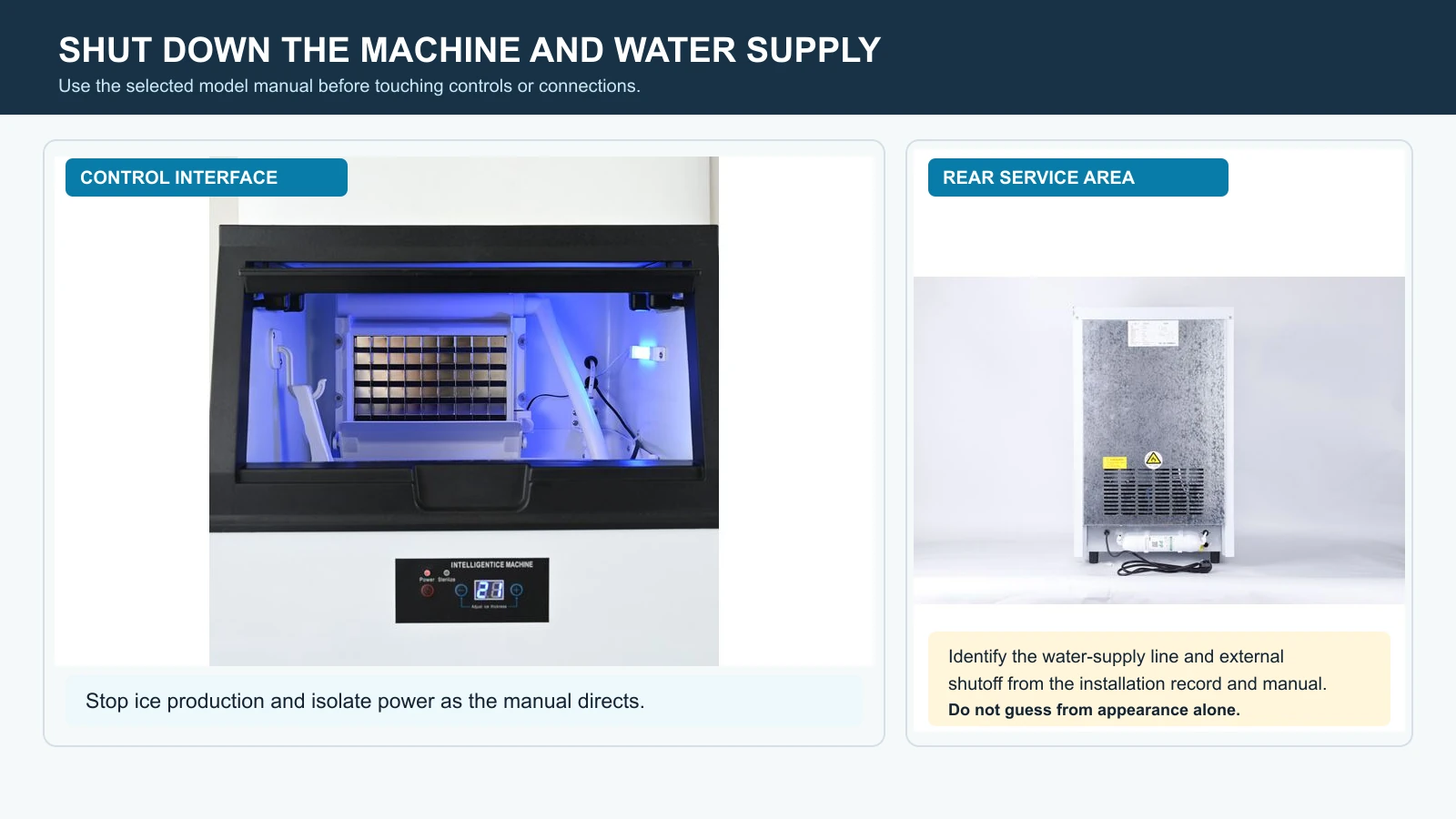
Use the shutdown sequence stated in the manual, stop ice production, isolate power where instructed, close the relevant water supply, and prevent another employee from restarting the machine during service.
2. Remove and Discard Existing Ice
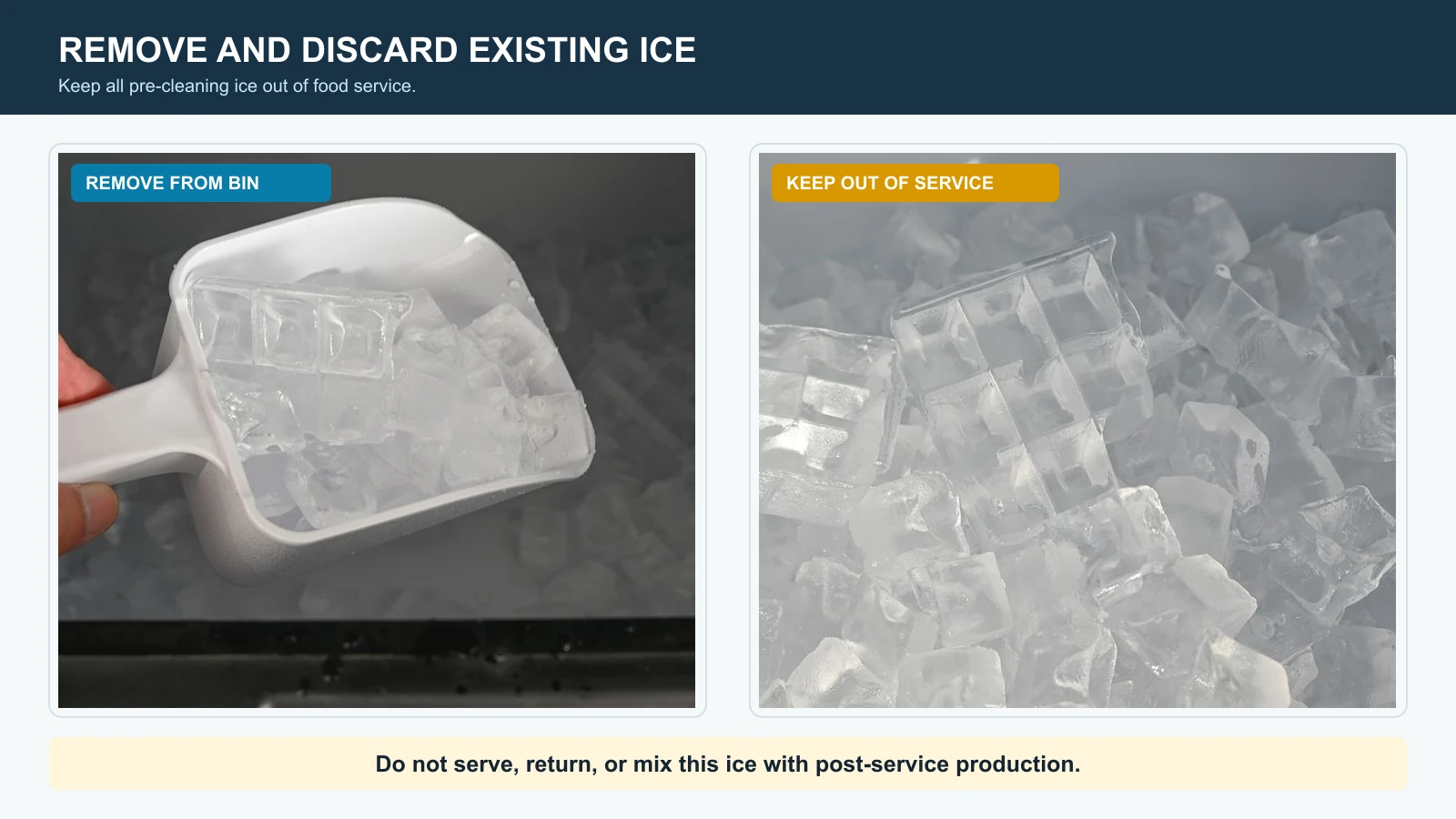
Ice present before cleaning can contain loosened soil or receive chemical splash, so it must not be served, returned to the bin, or mixed with post-service production.
3. Remove Manual-Approved Components
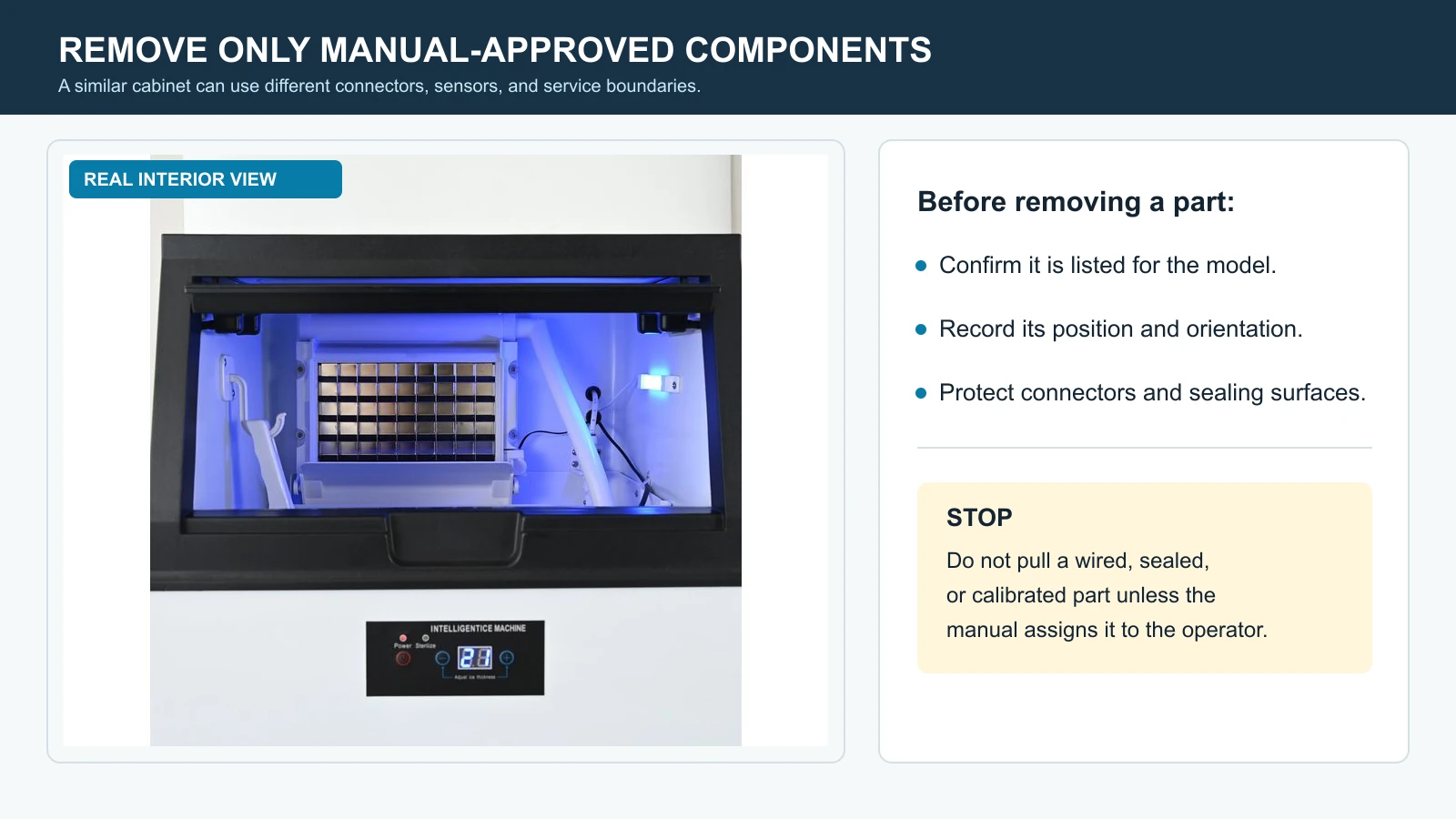
Take out only the curtains, tubes, troughs, probes, panels, filters, or other pieces named in the model procedure, while protecting connectors and recording the correct orientation for reassembly.
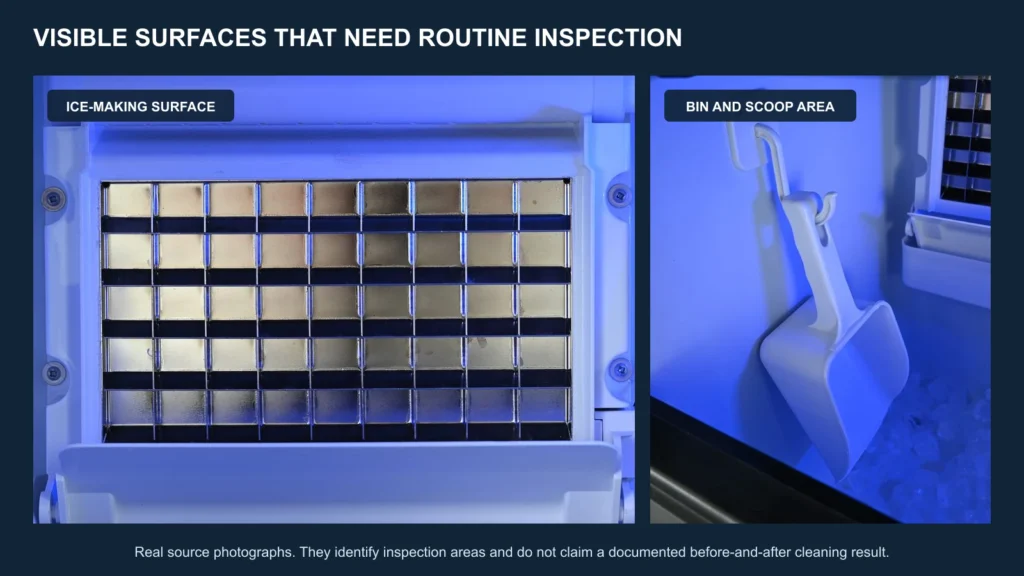
4. Clean the Bin, Scoop and Food-Contact Surfaces
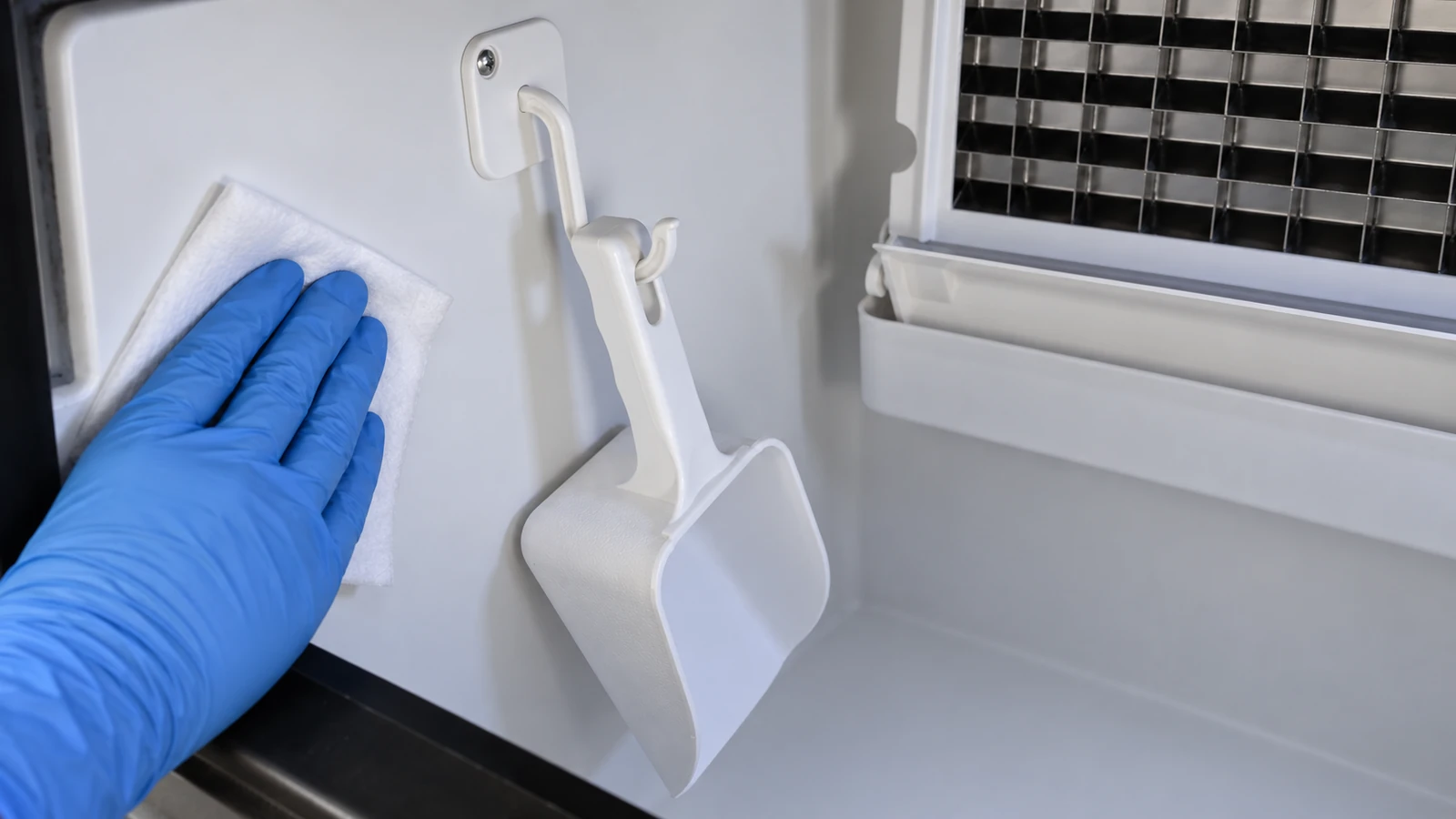
Remove visible soil with the approved cleaner and nonabrasive tools, reaching corners, seams, doors, baffles, chutes, and the scoop holder without scratching surfaces or flooding insulated and electrical areas.
A built-in-bin ice machine and a separate-bin modular machine require different inspection zones.
5. Run the Approved Descaling or Cleaning Cycle
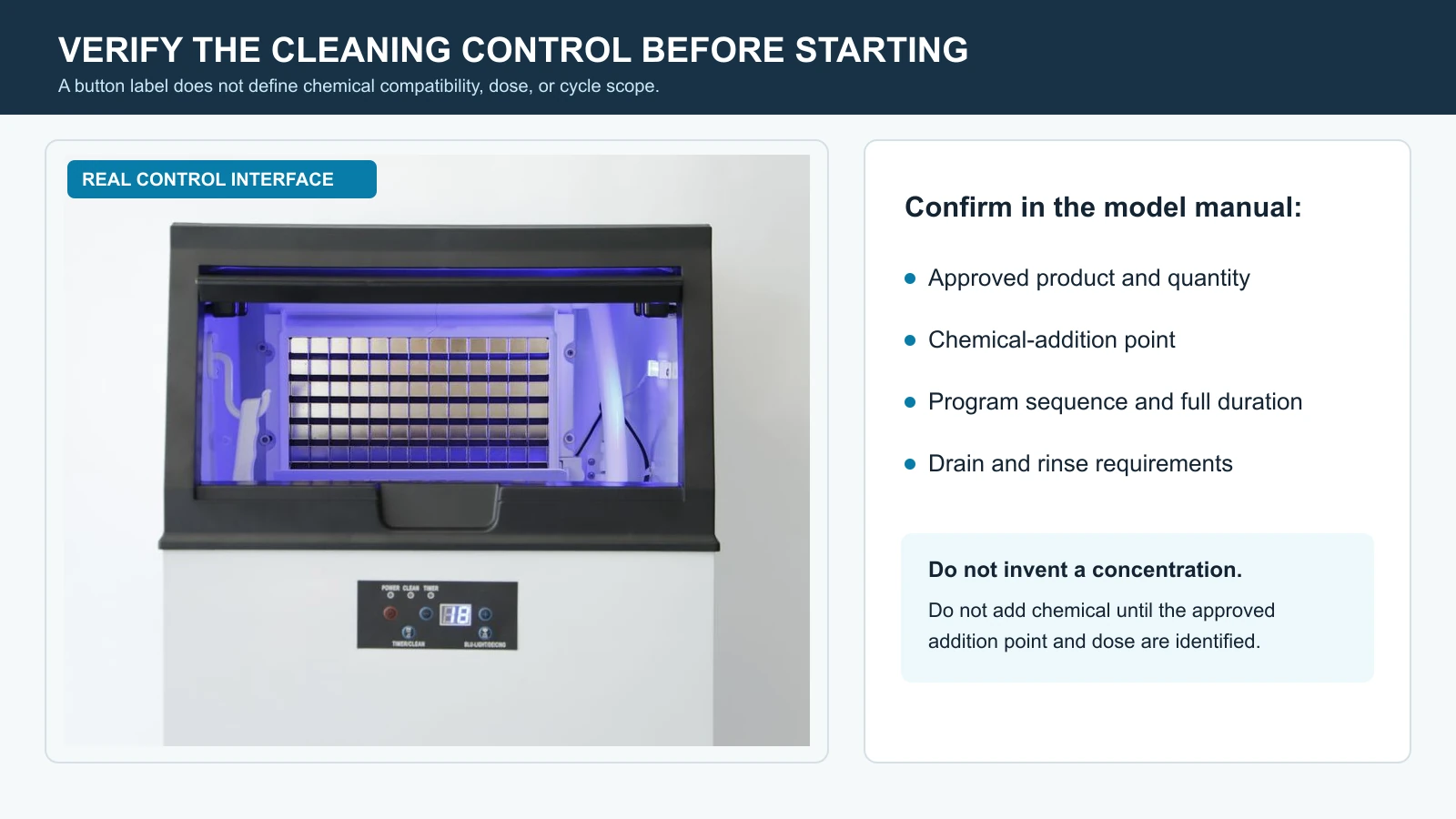
Add only the product and quantity authorized for the model, start the specified cycle, and allow every programmed stage to finish without shortening circulation or opening protected areas during operation.
6. Drain and Rinse the Water System
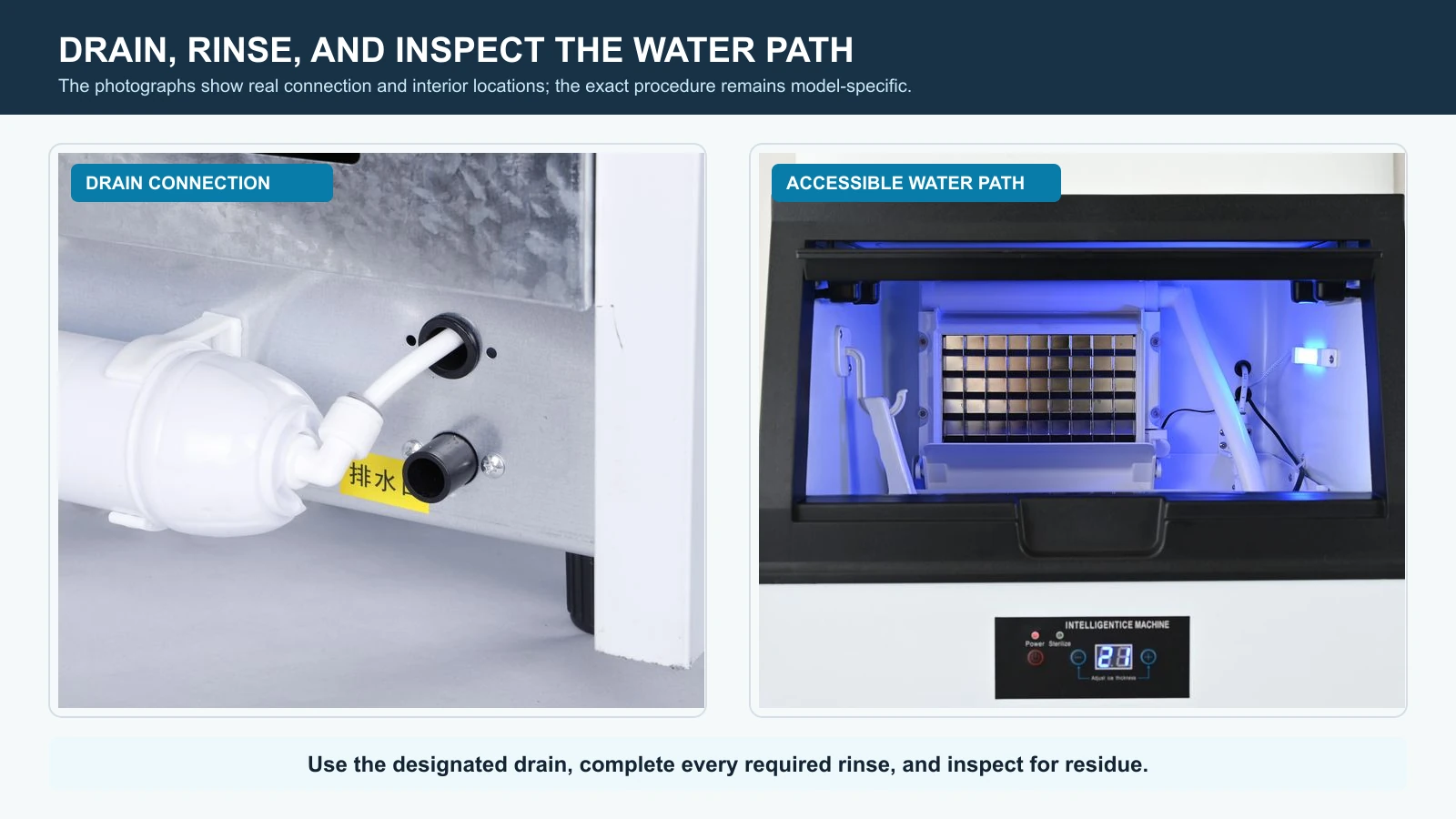
Open the designated drain, capture waste as local requirements demand, complete each specified rinse, and inspect the trough and accessible water paths for residue before moving to sanitizing.
7. Sanitize the Approved Components
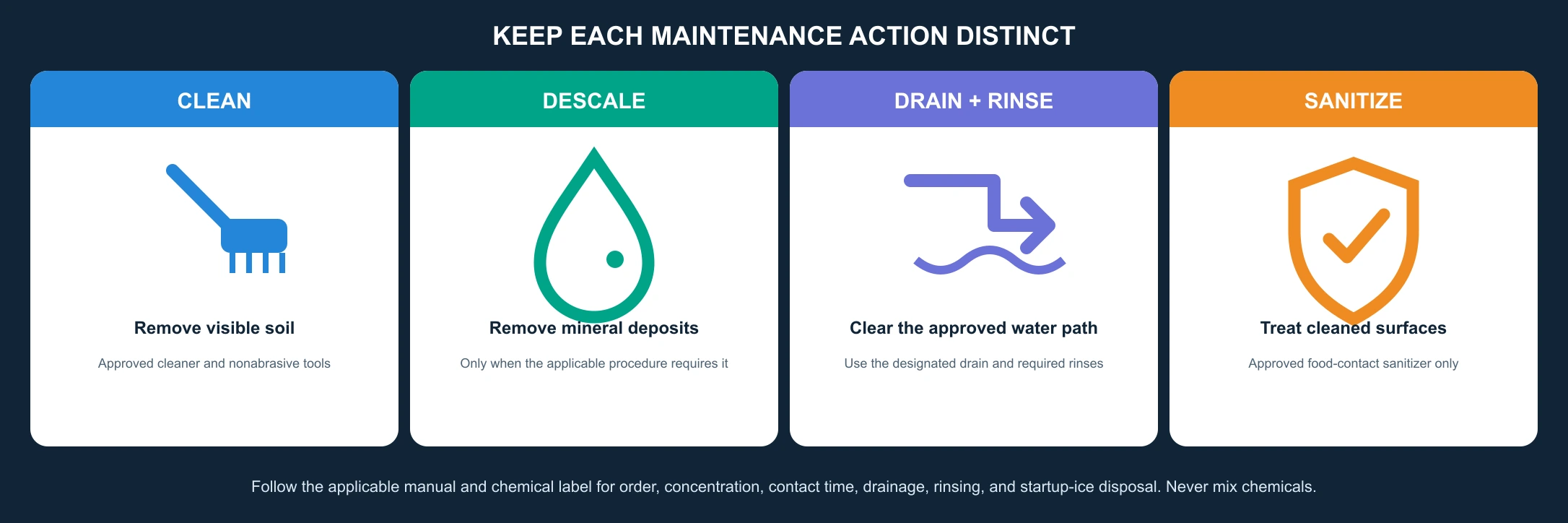
Apply sanitizer only after cleaning, verify concentration with the method required by its label or site program, maintain the full contact time, and complete its drain, rinse, or air-dry instruction.
8. Clean the Air Filter, Condenser and Exterior
Use the manual’s dry or controlled cleaning method for the air filter and condenser, then wipe exterior controls and handles without forcing moisture through vents or around electrical components.
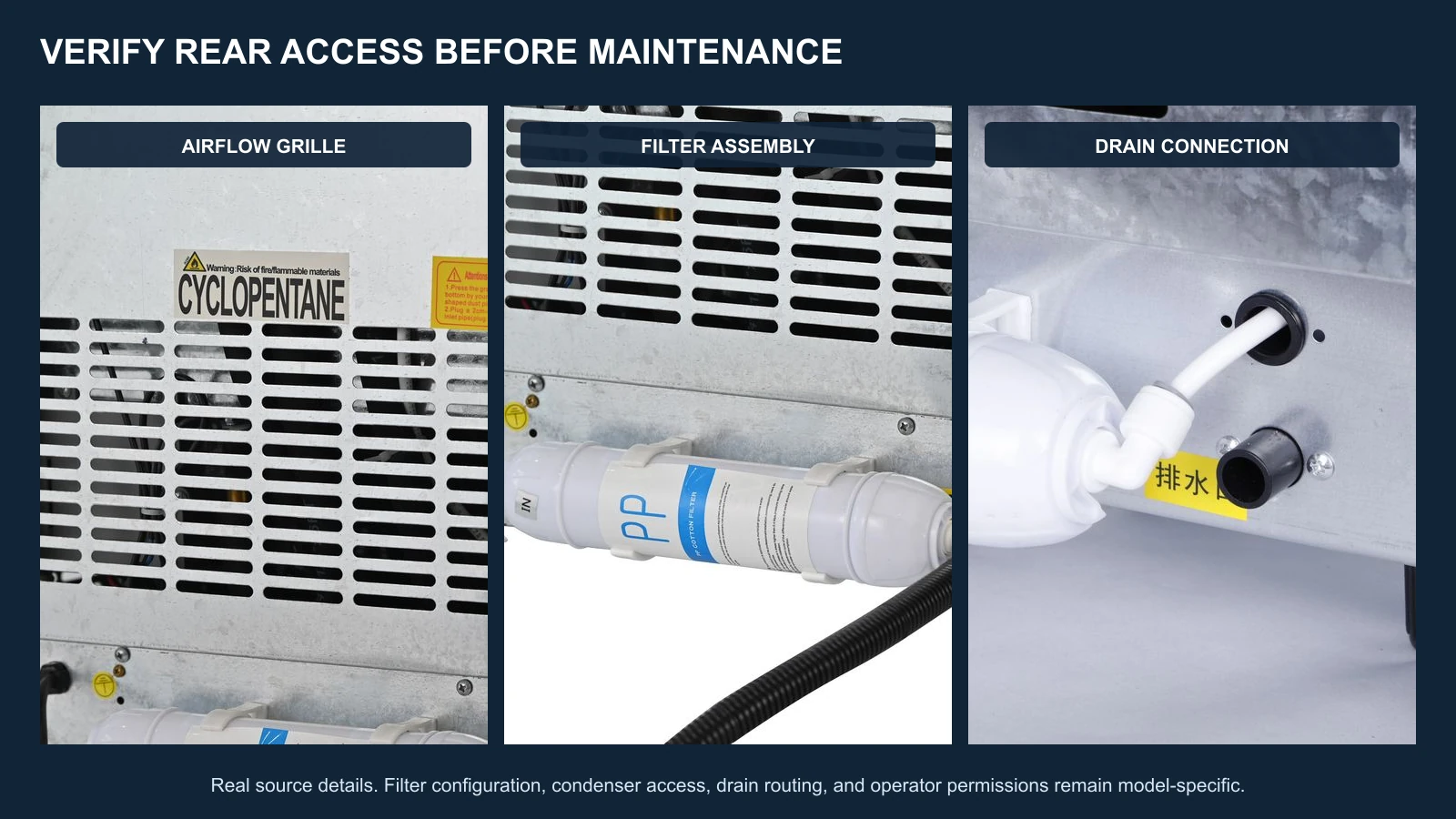
An air-cooled ice machine and a water-cooled ice machine require different heat-rejection maintenance.
9. Reassemble and Restart the Machine
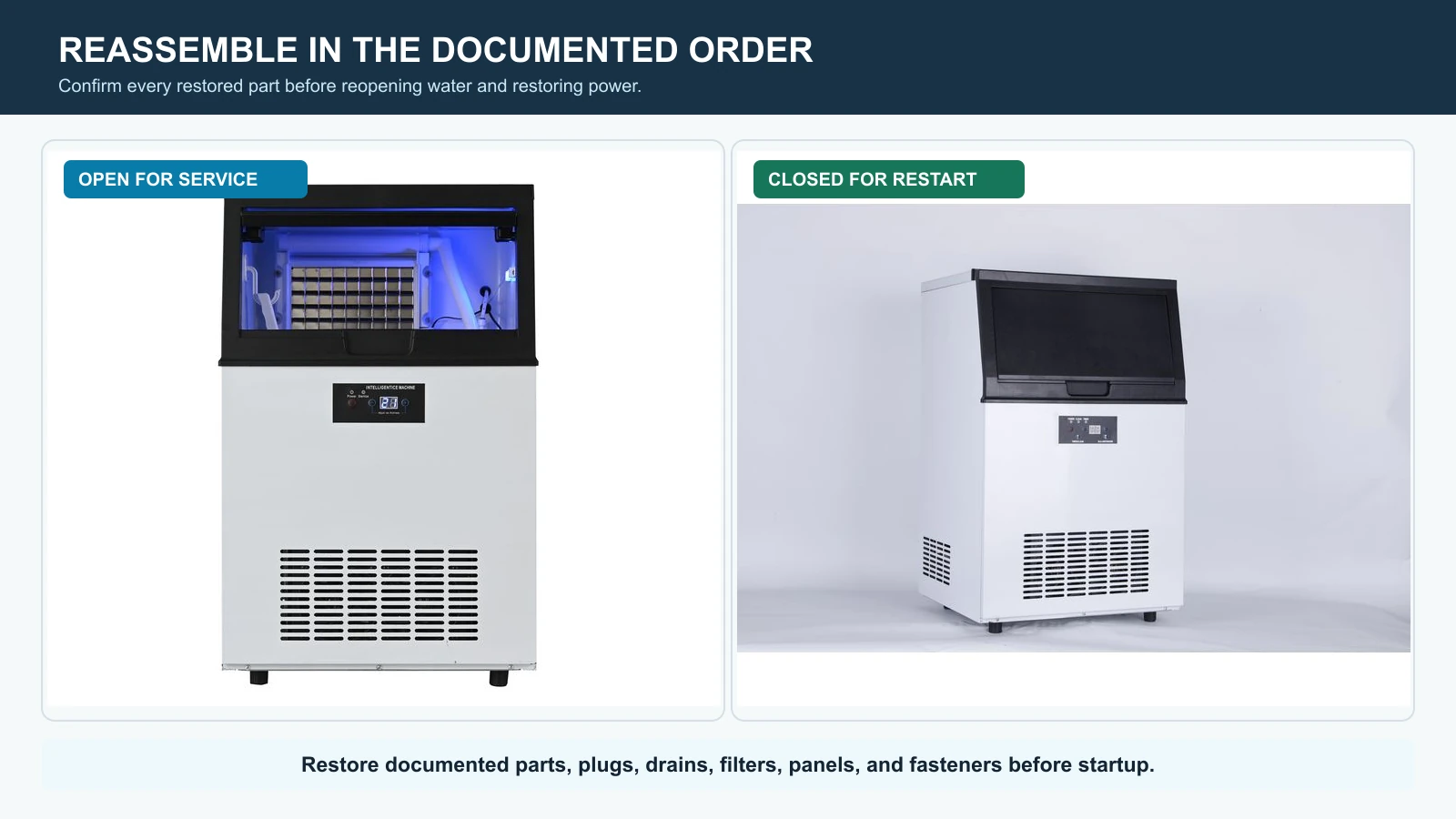
Restore tubes, curtains, probes, panels, plugs, drains, filters, and fasteners in their documented positions, then reopen water and restore power through the approved startup sequence.
10. Discard the Required Ice and Verify Operation
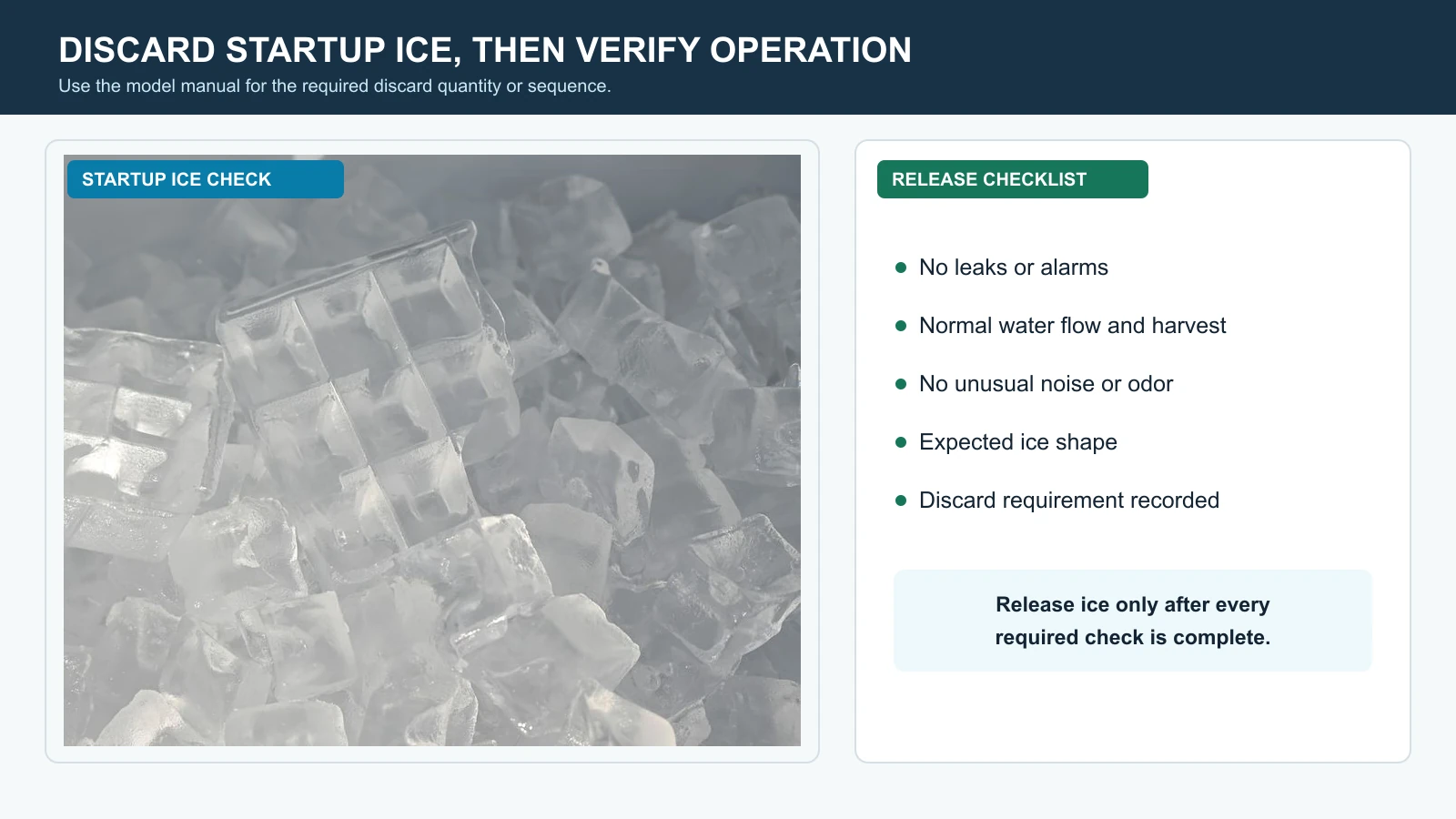
Discard the number of batches specified by the model manual, then check for leaks, alarms, unusual noise, correct water flow, normal harvest, acceptable odor, and the expected ice shape.
Record the result. A café ice machine or bar ice machine needs named release approval.
How Often Should a Commercial Ice Machine Be Cleaned?
The correct schedule combines fixed tasks with condition-based intervention.
FDA Food Code §4-602.11(E)(4) directs operators to follow the manufacturer’s frequency for enclosed components such as ice makers and bins, or to clean often enough to prevent soil and mold when specifications are absent.
Use the current FDA Food Code as a model reference, then verify the rules adopted by the jurisdiction where the machine operates.
KAISON’s current support material recommends condenser cleaning every six months and earlier attention where operating conditions demand it. The model manual, airflow conditions, kitchen grease, dust loading, water quality, inspection findings, and local rules still control the site schedule.
Maintenance schedule framework
| Task | Trigger or frequency source | Responsible person | Required record |
|---|---|---|---|
| Exterior and handles | Site hygiene plan and visible soil | Trained operator | Date and initials |
| Scoop and holder | Site hygiene plan, contamination event, local rule | Trained operator | Date and corrective action |
| Bin and food-contact parts | Model manual, local rule, soil or mold | Trained operator or technician | Parts, chemical, concentration, contact time |
| Water circuit and descaling | Model manual, scale observation, water conditions | Trained operator or technician | Cycle, product, rinse result |
| Air filter and condenser | Model manual and airflow inspection | Trained person or technician | Condition before and after service |
| Drain | Odor, slow flow, overflow, scheduled inspection | Qualified person | Finding and action |
| Water filter | Filter specification, volume, time, pressure, water quality | Trained operator | Cartridge code and replacement date |
Cleaning Differences by Ice Machine Type
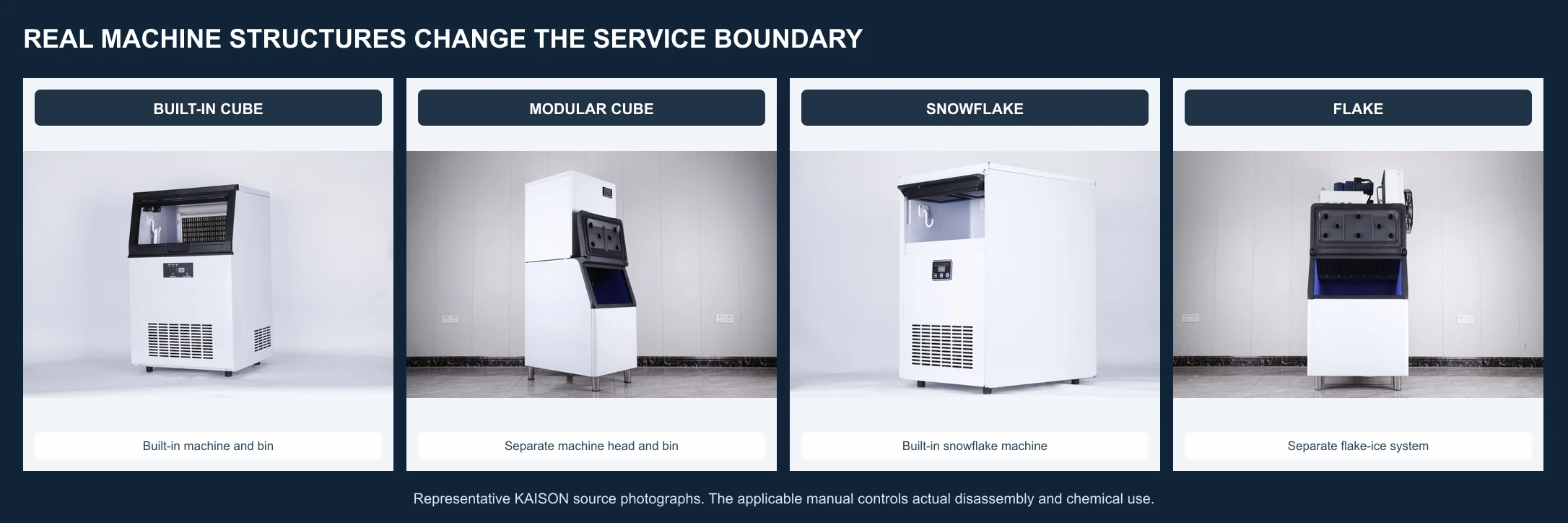
Machine architecture changes the access points and the contamination path.
Cube Ice Machines
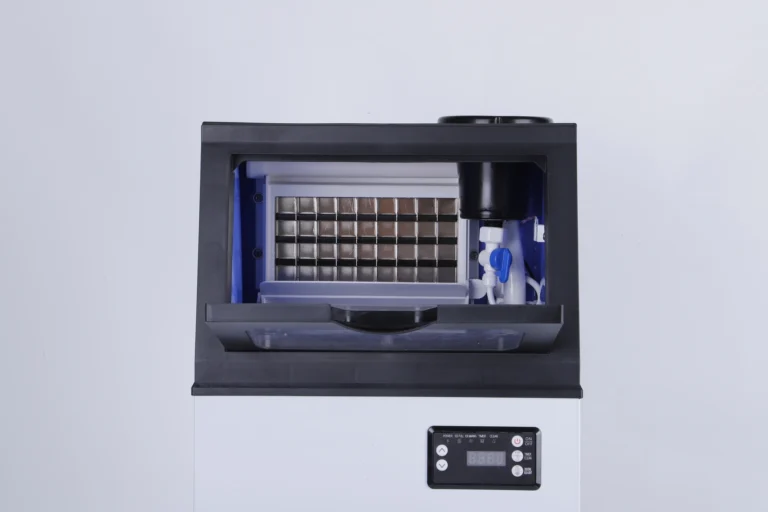
A cube ice machine may have curtains, distribution tubes, troughs, probes, and a cube-forming evaporator. Match it to a model record, such as the KX-55 product page.
Nugget Ice Machines
A nugget ice machine can include an auger and extrusion system with technician-only internal parts.
Flake Ice Machines
A flake ice machine uses a different freezing and removal mechanism from a cube machine.
Tube and High-Capacity Ice Machines
An industrial ice machine can connect the ice-making head to separate storage, water treatment, drainage, and conveying equipment. Each subsystem needs an approved service boundary.
Modular Heads and Built-In Bins
Separate modules create more boundaries.
Inspect the machine head, adapter, bin liner, door, scoop area, drain, and adjoining surfaces as distinct zones, because completing the head’s programmed cycle does not prove that the storage assembly is clean.
When to Stop and Call a Technician
Stop when routine access becomes repair, diagnosis, or hazardous service.
Call a technician for persistent slime or odor after cleaning, a blocked or leaking drain, repeated clean-cycle errors, damaged evaporator plating, damaged wiring, pump faults, refrigerant concerns, or disassembly beyond the user manual.
A gouged evaporator, loose sensor, cracked tube, degraded seal, or corroded connector needs diagnosis because aggressive cleaning can hide the symptom while increasing leakage, harvest, electrical, or contamination risks.
The manufacturer provides maintenance videos, spare-parts coordination, and remote guidance. Check the quality-control process before assigning service responsibility.
How to Reduce Scale and Contamination
Prevention starts with water, handling, airflow, drainage, and documentation.
Select filtration from an actual water assessment and the machine specification, then replace cartridges by the filter maker’s rated time, volume, pressure, and water-condition limits instead of waiting for taste or flow complaints.
Store the scoop outside the ice, keep the bin closed, wash hands before service, protect food-contact tools, remove spills promptly, and never use the ice bin as storage for bottles, cloths, or packages.
Keep drains open and correctly separated. Maintain the installation clearances stated by the model, especially around equipment placed in warm kitchens, dusty service corridors, or grease-laden cooking areas.
What Buyers Should Check Before Purchasing
Cleaning access is a purchasing specification, not an after-sales detail.
Ask suppliers to identify removable food-contact parts, automatic-cycle scope, drain location, condenser access, filter access, approved chemical documentation, operator tasks, technician tasks, training media, spare parts, and service response channels.
Request evidence for each claim.
KAISON’s OEM and ODM process addresses maintenance access and documentation. Its product range supports configuration comparisons.
Ask how the cleaning window affects ice supply, labor, access, and backup capacity. This makes maintainability a measurable purchasing requirement.
Commercial Ice Machine Cleaning Checklist
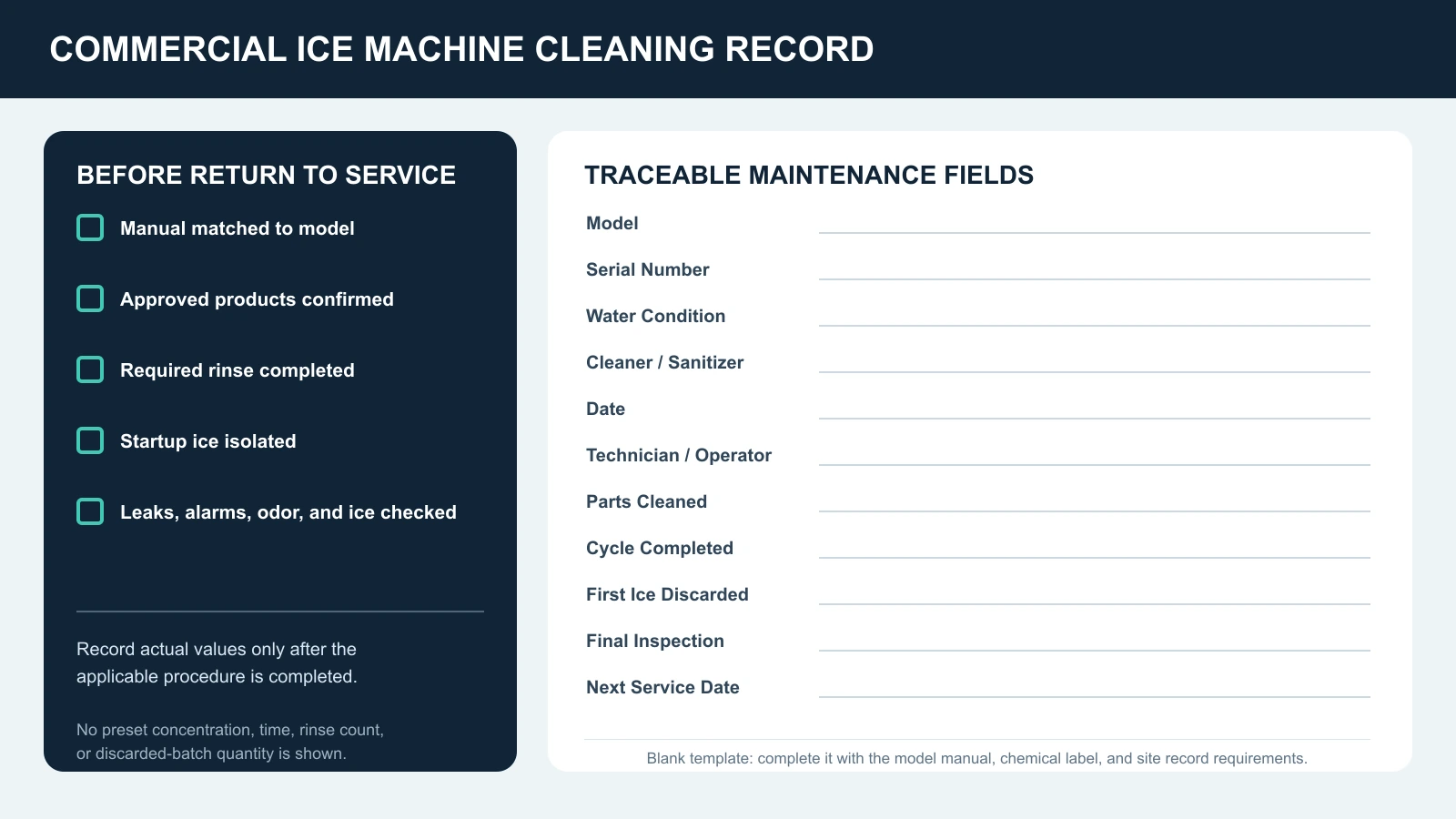
A signed record makes each cleaning event traceable and repeatable.
Use one form for the model, serial number, date, water condition, chemical name, lot, concentration, contact time, parts removed, cycle result, rinse confirmation, discarded ice, final inspection, operator, reviewer, and next due date.
Commercial ice machine cleaning checklist
| Field | Entry required |
|---|---|
| Model | Exact model designation |
| Serial Number | Equipment serial number |
| Water Condition | Source, treatment, hardness information, and observed condition |
| Cleaner/Sanitizer | Product name and label-directed preparation details |
| Date | Cleaning date |
| Technician/Operator | Name and role of the person completing the work |
| Parts Cleaned | Every component and area treated |
| Cycle Completed | Program used, result, and any interruption |
| First Ice Discarded | Required disposal sequence and completion record |
| Final Inspection | Leak, alarm, odor, ice, and operating checks |
| Next Service Date | Scheduled date or condition-based trigger |
The record should travel with the machine history. It gives operators, managers, distributors, and service teams a shared reference when odor, scale, low production, a recurring alarm, or a warranty question appears later.
These answers address the decisions operators make during routine service.
Conclusion and CTA
Safe cleaning begins with the manual for the exact machine.
Keep cleaning, descaling, and sanitizing separate, complete every prescribed rinse, record each maintenance event, and stop when the procedure reaches restricted electrical, refrigeration, pump, or damaged-component work that requires a qualified service technician.
Send KAISON your machine model, application and water conditions to receive the correct cleaning documentation or technical guidance.
Frequently Asked Questions
Can I clean a commercial ice machine with vinegar?
Do not introduce vinegar unless the manufacturer approves it for that exact model and states the conditions. An acid that removes scale from one water path can attack another machine’s plating, seals, tubing, or finish, so the manual must control compatibility, dilution, exposure time, and rinsing requirements. If vinegar is absent from the procedure, request a compatible commercial descaler. A portable-machine video is not evidence for commercial equipment.
Can I use dish soap inside an ice machine?
Dish soap may be suitable on removable parts only when the manual permits it and complete rinsing is possible. Do not pump it through an internal water circuit without written approval. Foam and fragrance can remain in tubing, pumps, troughs, or cavities, affecting taste and restart checks. Use the manual and detergent label together. If either is silent about internal use, request the specified cleaner.
How much does professional ice machine cleaning cost?
There is no responsible universal price because labor depends on machine type, access, contamination, scale, chemicals, parts, travel, and repair work. Request a written scope identifying the model, components serviced, products, tests, discarded ice, documentation, and exclusions. Compare matching scopes. A bin wipe cannot be priced against a service covering the water system, evaporator, condenser, drain, reassembly, and operational inspection.
How long does a commercial ice machine cleaning cycle take?
The programmed cycle is only one part of the service window. Downtime also includes shutdown, ice removal, approved disassembly, manual work, chemical contact, drainage, rinsing, sanitizing, reassembly, startup, discarded production, and inspection. Obtain the cycle duration from the model manual, then add preparation and verification time. Never shorten a chemical stage or rinse to meet a deadline because incomplete treatment can leave deposits or residue.
How many batches of ice should be discarded after cleaning?
Discard the quantity or sequence stated by the manufacturer for the model and chemical procedure. It may be expressed as batches, production time, a flush sequence, or another measurable condition. Do not copy a number from another brand’s manual. Isolate startup ice until the requirement is complete and the final ice passes odor, appearance, and operational checks. Record the discard and release authorization.
Why does the machine still smell after cleaning?
Persistent odor can come from a dirty bin, scoop holder, chute, drain, filter, stagnant area, missed part, or contamination outside the programmed water path. It may also indicate incomplete rinsing or damaged material. Stop producing service ice and inspect every operator-accessible zone. If odor remains after the documented procedure, contact qualified service. Repeating chemicals blindly can damage components without correcting the source.
Does a self-cleaning cycle clean the storage bin?
Do not assume it does. A programmed cycle follows a defined water path, while the bin, door, liner, scoop, baffles, chute, adapter, and drain may sit outside that route. Check what the model procedure reaches, then clean and sanitize the approved remaining surfaces. Record the automatic cycle and bin service separately. A completed program does not prove every food-contact surface is clean.
When should the water filter be replaced?
Use the filter manufacturer’s time, treated-water volume, pressure, and water-condition limits together with the equipment manual. A calendar alone may fail at a high-volume site, while low volume can still bring sediment, hardness, chlorine, or microbiological concerns. Record the cartridge model, installation date, replacement date, and reason. Replace a damaged, contaminated, blocked, or flood-exposed cartridge according to its instructions immediately.