KAISON Team
Commercial Ice Types Explained: Cube, Flake, Nugget, Snowflake, and Gourmet Ice
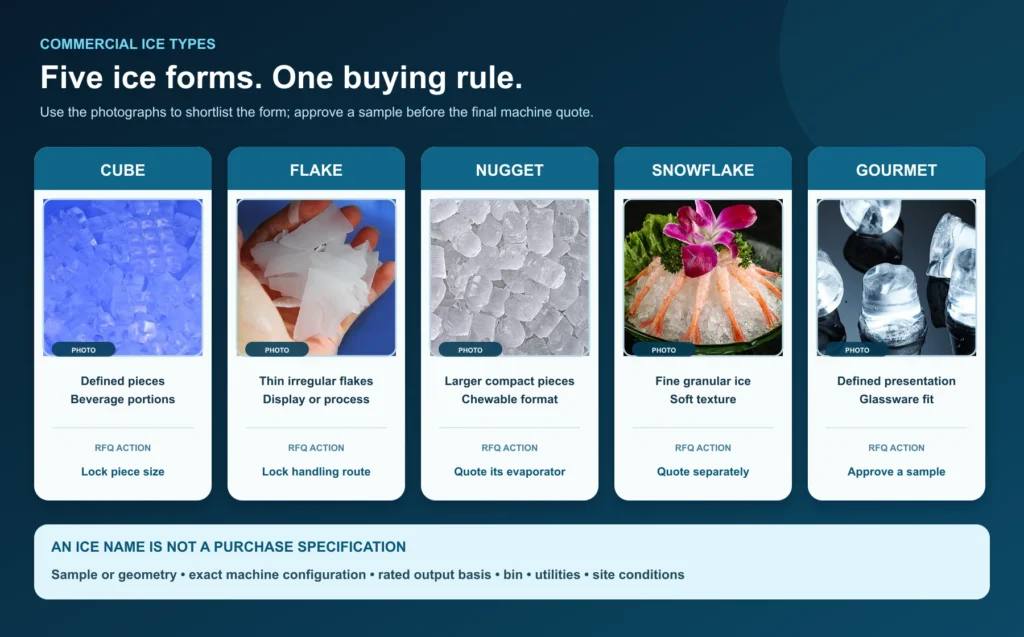
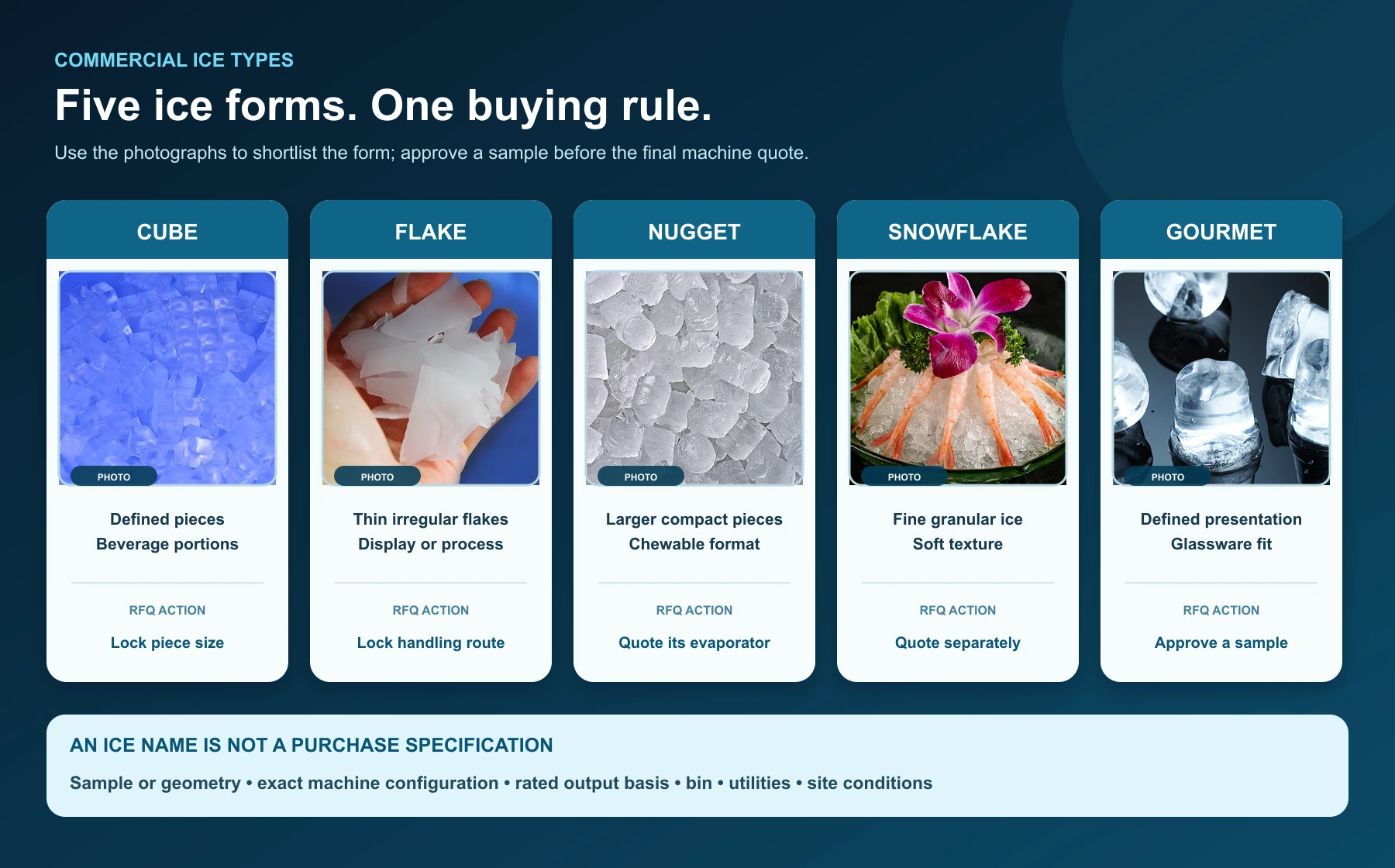
Commercial ice types should be selected by the job the ice must perform, not by a familiar name alone. Cube and gourmet forms suit beverage presentation and controlled portioning. Flake spreads across displays and products. Snowflake is a fine granular form, while nugget uses larger chewable pieces. Supplier terminology can vary, so a purchase specification should include a sample or exact geometry, the machine configuration, rated production conditions, storage, dispensing method, utilities, and site environment. Use those details to compare quotations because two machines carrying the same ice-type label may not deliver the same piece, output, or handling result.
Compare Commercial Ice Types by Form, Use, and Configuration
Start with the required ice form, then define its operating conditions.
Five names do not create five complete specifications
Names can start a shortlist, but they do not complete the specification. A buyer still needs to know how the ice will contact a drink or product, move through equipment, sit in storage, and reach the user.
Make the end use specific.
For each use point, record the visible form, acceptable dimensions, whether pieces must remain separate, how staff will scoop or dispense them, and how quickly the next service period consumes the stored supply.
| Ice type | Visible form | Common purchasing context | Detail to lock before quotation |
|---|---|---|---|
| Cube | Defined solid cube or rectangular piece | Beverages, mixed drinks, hotels, restaurants | Piece dimensions, thickness setting, daily output and bin |
| Flake | Thin irregular flakes | Seafood or food display, handling, process cooling | Product contact, distribution method, output and matched storage |
| Snowflake | Fine granular ice in the KAISON range | Cafés, food presentation and sample-defined applications | Supplier sample, KL snowflake configuration and rated output |
| Nugget | Larger compact chewable pieces in the KAISON range | Beverage service requiring a chewable piece | Supplier sample, KL nugget configuration and its own rated output |
| Gourmet | Defined presentation piece | Bars, premium drinks and visible service | Piece dimensions, glassware fit, output and storage |
The complete commercial ice-machine range lets buyers browse by ice type, capacity, installation style, and application. Use the table as a briefing tool before opening individual product pages.
Choose Cube Ice for Repeatable Beverage Portions
Cube ice gives beverage teams a defined, repeatable piece format.
Specify the cube instead of ordering by category name
The buyer should match the piece to glassware, drink build, scoop or dispenser, presentation standard, and expected service volume. Ask for an actual sample when appearance or fit matters.
Size is part of the order.
KAISON lists 20 × 20 × 20 mm and 22 × 22 × 22 mm cube choices for the AP-300P, while larger grid options are quoted on higher-output models, so the final order must identify the chosen setting.
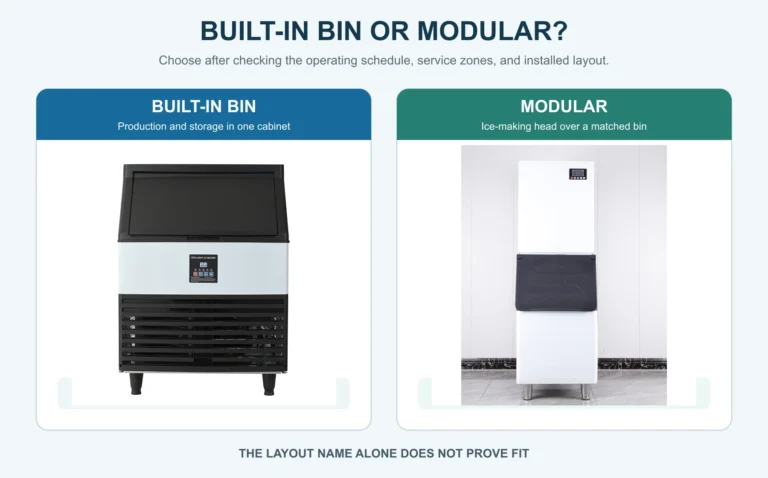
The current cube ice machine category covers built-in and separate-bin layouts. A restaurant may use one cube format across soft drinks and table service, while a bar may set a different visual standard for mixed drinks.
Review the restaurant ice-maker application and bar ice-machine application separately when their service patterns differ. Do not assume one shared daily total proves that a single ice form, machine, or bin will serve both stations well.
Use Flake Ice Where Coverage and Handling Matter
Flake ice spreads across products and irregular display surfaces easily.
Define the contact task and the storage route
Thin, irregular flakes can be distributed over seafood, food displays, or process loads where broad contact and flexible placement matter. That application still needs a quantified operating brief.
Check the full handling path.
Record whether the ice contacts food, how staff transfer it, the depth and area of each display, refill times, drainage, storage method, and every sanitation requirement imposed by the operator or destination market.
The flake ice machine range currently covers models from 200 to 3000 kg per day with matched bins and air- or water-cooled choices. Those catalog figures create a shortlist, not a promise of output under every site condition.
For larger process or display projects, use the industrial ice-machine application to organize capacity and installation questions. Keep any cooling-performance claim tied to a defined load and controlled test because ice shape alone does not prove a universal result.
Separate Snowflake Ice from Nugget Ice in Every Quote
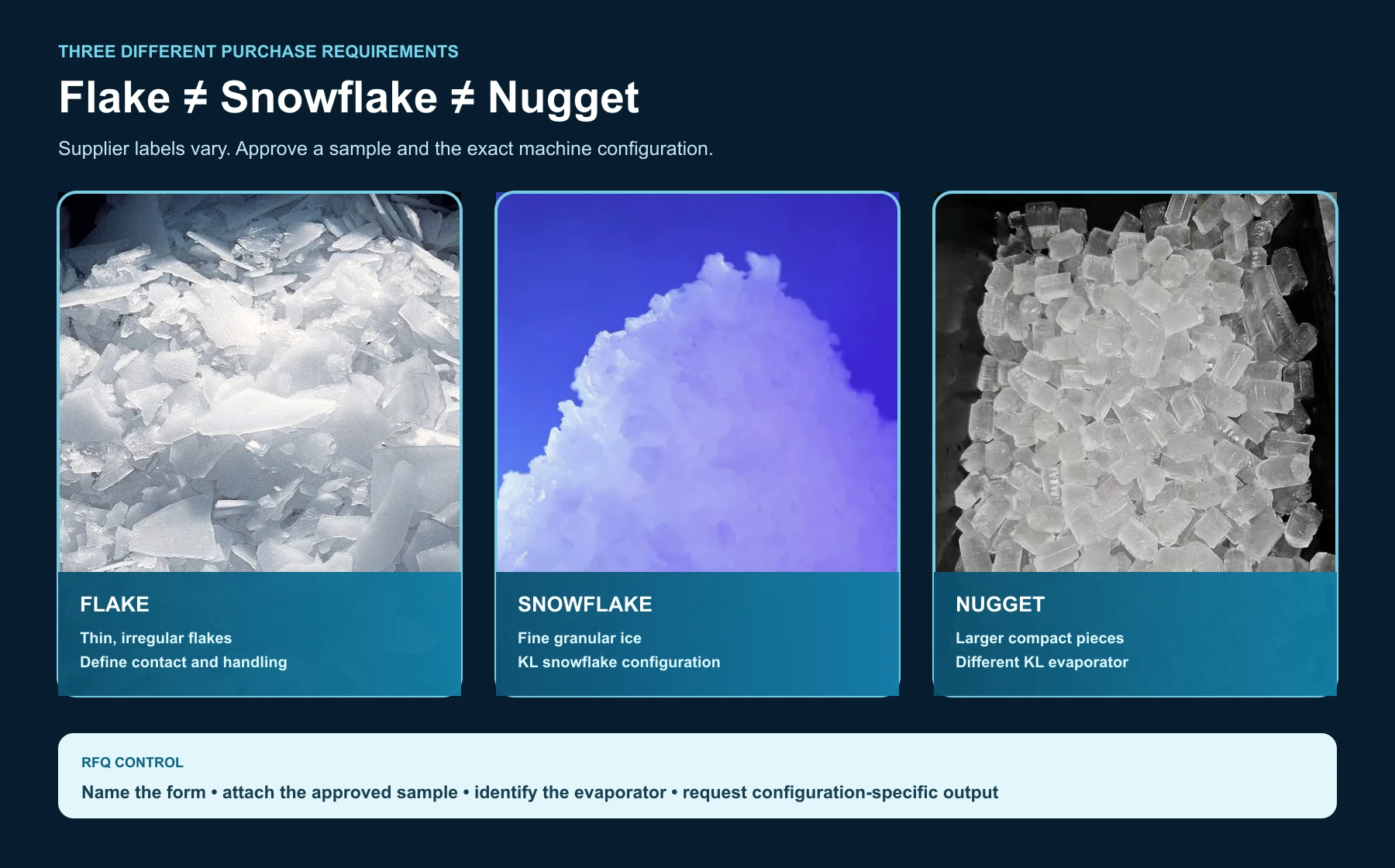
Snowflake and nugget require separate samples, configurations, and output data.
Do not let one model number hide two evaporators
The current KL range page describes snowflake as fine granules and nugget as larger chewable pieces. Other suppliers may use those names differently, which makes a photo, sample, or dimensional description essential.
The distinction changes the machine.
Current KL models can be ordered for snowflake or nugget ice, but the nugget option uses a different evaporator under the same model number and needs configuration-specific rated production information in the quotation.
The published KL comparison table is for the snowflake configuration. Its KL-100 entry shows 100 kg per 24 hours, a 30 kg bin, and 515 × 615 × 830 mm dimensions, so buyers must not reuse that output as nugget data.
Review the snowflake ice machine category to see the current KL family, then require the supplier to write either `snowflake` or `nugget` on the configuration line. A café ice-machine application can clarify service needs, but treat the approved sample as the acceptance reference.
Select Gourmet Ice Around Presentation and Glassware
Gourmet ice is chosen when a defined presentation piece matters.
Approve the piece beside the intended serving vessel
Evaluate the actual piece in the glass, with the drink build and service method used by the operation. Record the dimensions and accepted appearance instead of relying on a premium-sounding label.
Photograph the approved sample.
A practical approval sheet should place the ice beside a scale, identify the machine and setting, show the target glassware, and state who accepted the result for the proposed menu or hospitality concept.
The current KAISON gourmet ice machine range includes spray-type models for visible beverage service. The G8H-32PG technical table lists 50 kg per 24 hours, a 35 kg bin, 730 W, and a 500 × 595 × 850 mm cabinet.
Its listed piece is 28 × 28 × 32 mm. Compare that geometry with glass openings, garnish, scoop size, and service pace before reviewing the hotel ice-machine application for a broader property plan.
Compare Current KAISON Models Without Mixing Configurations
Model examples become useful only after the required ice is approved.
Keep form, output, bin, and site basis together
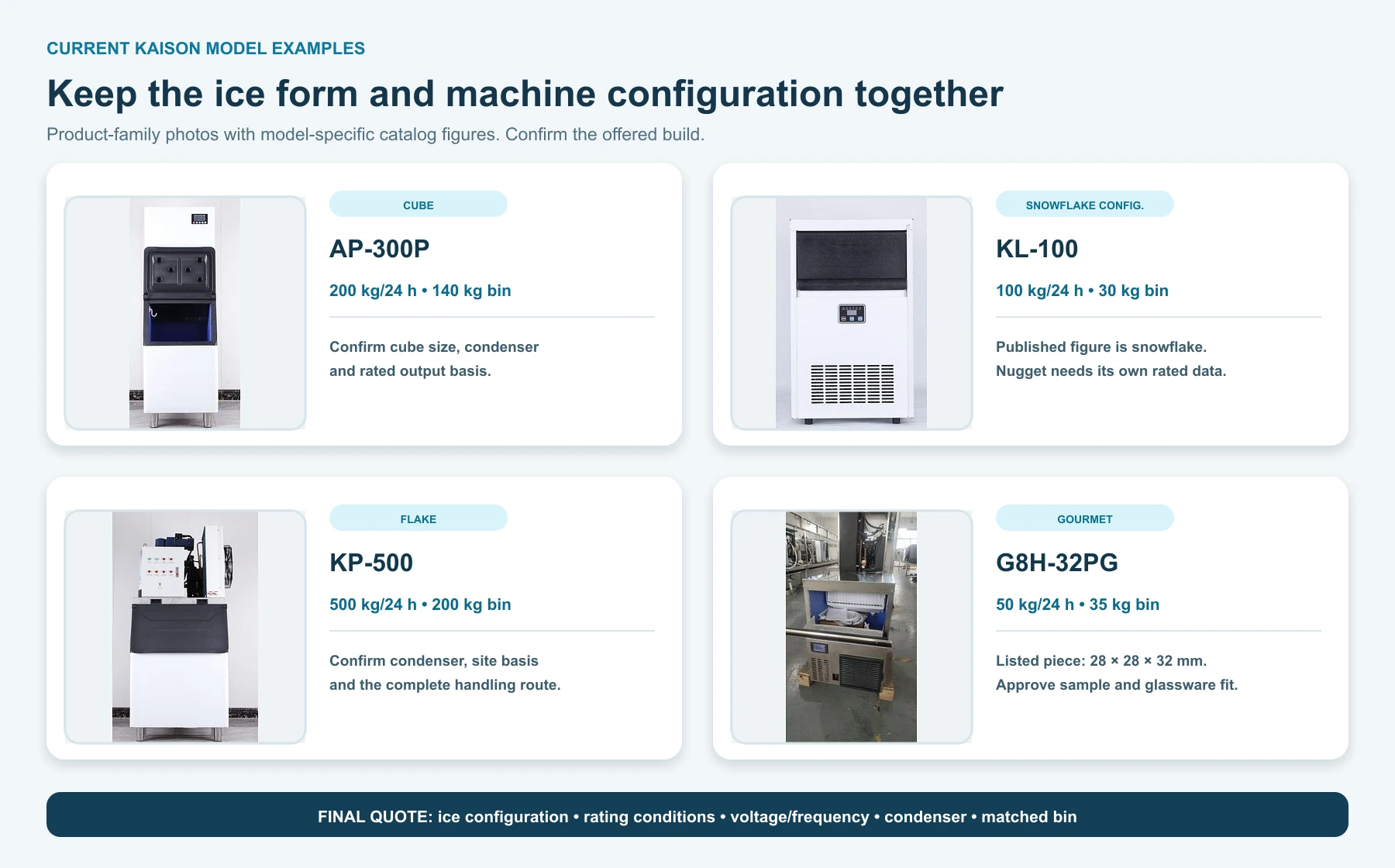
The following models show how different ice requirements lead to different cabinets and capacities. They are catalog examples, not substitutes for a project-specific selection.
Keep every row configuration-specific.
Output comparisons are meaningful only when the quotation also identifies the selected ice geometry, rated ambient and inlet-water conditions, voltage and frequency, condenser choice, matched bin, and any site derating or installation limit.
| Requirement | Model example | Catalog production | Storage | Key configuration note |
|---|---|---|---|---|
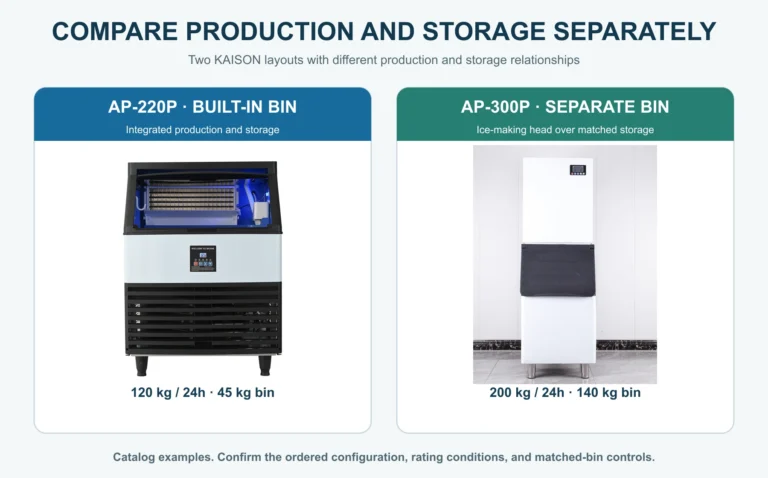
| Cube | AP-300P | 200 kg/24 h | 140 kg | Confirm cube size, air/water cooling and rated conditions |
| Snowflake | KL-100 | 100 kg/24 h for snowflake configuration | 30 kg | Nugget uses a different evaporator and needs its own output data |
| Flake | KP-500 | 500 kg/24 h | 200 kg | Confirm air/water cooling, site basis and handling route |
| Gourmet | G8H-32PG | 50 kg/24 h | 35 kg | Listed 28 × 28 × 32 mm piece; confirm sample and glassware fit |
Daily production does not describe peak withdrawal, usable reserve, or recovery time. Size those separately after choosing the ice form, then compare the complete machine and storage arrangement with the operating schedule.
Approve an Ice Sample Before the Purchase Order
A signed sample closes the gap between names and delivered results.
Build a compact approval record for each required form
Request a labeled photograph or physical sample from the offered configuration. Place it beside a ruler, record representative dimensions, and note any appearance or handling condition that determines acceptance.
Make one person responsible.
The record should connect the approved form to the model, evaporator or grid, voltage and frequency, condenser, catalog output basis, bin, water requirements, drain, destination, and quotation revision used for the order.
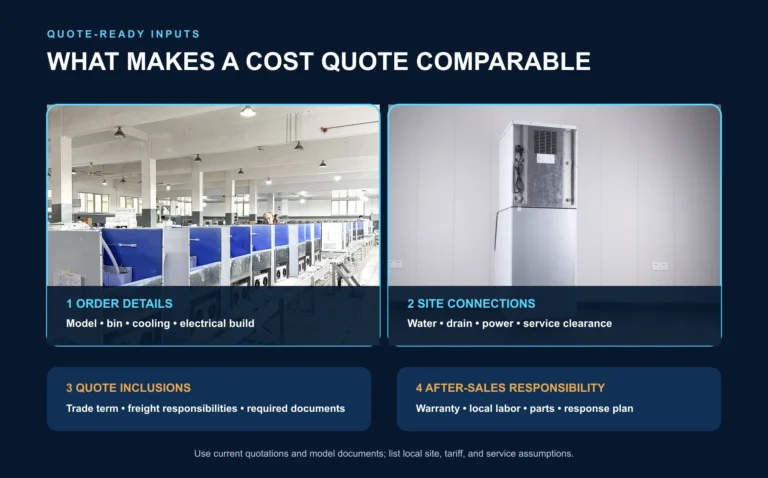
Buyers can also confirm that the selected cabinet fits the site by using the commercial ice-machine installation requirements. Check delivery access, ventilation, water, drainage, electrical supply, service clearances, room conditions, and cleaning access before approval.
Do not approve from a promotional photograph alone. A marketing image may not show scale, the machine setting, or the sample condition, so connect the visual reference with written geometry and the exact offered build.
- Compare 5 ice requirements by visible form, end use, handling route, machine configuration, output, and storage.
- AP-300P is a 200 kg/24 h cube example with a 140 kg bin; the cube setting still belongs in the order.
- KL-100 is listed at 100 kg/24 h for its snowflake configuration; nugget uses a different evaporator and needs separate rated data.
- KP-500 is a 500 kg/24 h flake example, while G8H-32PG lists 50 kg/24 h for a 28 × 28 × 32 mm gourmet piece.
- Approve a labeled sample or dimensional reference before issuing the purchase order.
Frequently Asked Questions About Commercial Ice Types
These answers help buyers turn an ice name into a specification.
Keep the final quotation configuration-specific.
Every answer should connect the required form with the end use, approved sample, machine build, production basis, storage, handling method, site utilities, and service schedule before the purchase order is released.
Which commercial ice type is best for drinks?
There is no single best form for every drink program. Start with the glassware, drink build, appearance standard, service pace, scoop or dispenser, and customer experience. Cube ice gives a repeatable defined piece, gourmet ice emphasizes a presentation format, and the current KL range describes nugget as a larger chewable piece. Approve an actual sample or measured geometry, then confirm production, storage, peak draw, recovery time, cleaning, and site conditions for the exact offered machine.
What is the difference between flake and snowflake ice?
Current KAISON category pages describe flake ice as thin irregular flakes for applications such as display, handling, or process cooling, while snowflake ice is a fine granular product from the KL family. Supplier terminology can differ, so do not rely on the two names alone. Ask for side-by-side samples, representative dimensions, the exact machine and evaporator, rated production data, storage method, and the handling path required by the operation.
Is snowflake ice the same as nugget ice?
No, they are separate configurations in the current KL range. Snowflake is described as fine granules, while nugget consists of larger chewable pieces. The nugget option uses a different evaporator even when the model number is unchanged, and the published KL comparison table reports snowflake-configuration output. A nugget quotation should therefore identify the nugget evaporator, show the offered sample, and provide rated production data for that exact build.
Does ice shape determine how fast it melts?
Shape can influence exposed surface and how ice interacts with a drink or product, but do not assume one universal melt ranking. Piece mass, dimensions, initial temperature, water content, storage, ambient conditions, drink temperature, agitation, and the test method can all affect the result. If melt behavior is a purchase requirement, compare samples by equal mass under a written controlled procedure and record the machine configuration used to make them.
Can one machine make several commercial ice types?
Some product families offer more than one configuration, but that does not mean one installed machine changes among all forms. The KL family, for example, can be ordered for snowflake or nugget ice, and the nugget version uses a different evaporator. Treat the chosen ice form as part of the machine build. Confirm the evaporator or grid, sample, output basis, bin, voltage, frequency, cooling method, and model code in the final quotation.
How should I compare ice machine production figures?
Compare production only after the ice form and configuration are identical or clearly separated. Ask each supplier to state the rated ambient air and inlet-water conditions, voltage, frequency, condenser, ice setting, and bin arrangement behind the kilograms-per-day figure. Then test daily demand, peak withdrawals, usable reserve, and recovery time separately. A higher catalog number does not compensate for the wrong ice form, an incompatible storage route, or a site condition outside the quoted basis.
What should an ice sample approval include?
Use a labeled photograph or physical sample from the offered configuration. Show scale with a ruler, record representative dimensions, identify the model and evaporator or grid, and note the intended glassware, display, dispenser, or product-contact task. Add the quotation revision, rated output basis, bin, voltage, frequency, condenser, destination, and approving person. This record gives purchasing, production, inspection, and the supplier one shared reference for the delivered result.
What information should I send for a commercial ice machine quote?
Send the end use, approved ice sample or geometry, busiest-day demand, timed peak withdrawals, opening reserve, refill deadline, storage and dispensing method, operating hours, and every station sharing the supply. Include ambient and inlet-water temperatures, water quality, voltage, frequency, condenser preference, drainage, clearances, delivery route, destination, quantity, and required compliance documents. Ask for the exact configuration, rated output basis, bin, dimensions, power, installation limits, lead time, warranty, and current manuals.
Send a Configuration-Specific Ice Machine RFQ
A complete RFQ lets suppliers quote the same operational requirement.
Ask for the machine behind the ice name
State the end use, approved form or sample, daily demand, peak withdrawal schedule, starting reserve, refill deadline, storage and dispensing method, operating hours, and every station sharing the supply.
Add the site conditions next.
Include ambient and inlet-water temperatures, water quality, voltage, frequency, condenser preference, drainage, clearances, delivery route, destination, quantity, required compliance documents, and the date when production must begin.
Ask the supplier to return the exact model and configuration, rated output basis, bin, dimensions, power, cooling method, installation limits, lead time, warranty, and current manuals. Require every assumption in one dated quotation revision. Any unconfirmed item should remain visible in the quotation.
Use the contact page to send the RFQ, site photographs, demand schedule, and sample approval sheet together. The resulting comparison will be based on delivered ice and operating fit, not five category names in isolation.