KAISON Team
Commercial Ice Machine Total Cost of Ownership: Purchase, Installation, Utilities, and Maintenance
Commercial ice machine total cost of ownership combines acquisition, installation, utilities, maintenance, repair exposure, and continuity costs for one defined configuration and time horizon. A machine-only price cannot answer the question because the storage bin, cooling method, electrical supply, shipping scope, site work, production level, local tariffs, and service coverage change the result. Build the budget from a written quotation, model performance data, site-specific contractor prices, and local utility rates, then compare every supplier on the same boundary. The lowest initial quote can become expensive once excluded work and operating risks are visible.
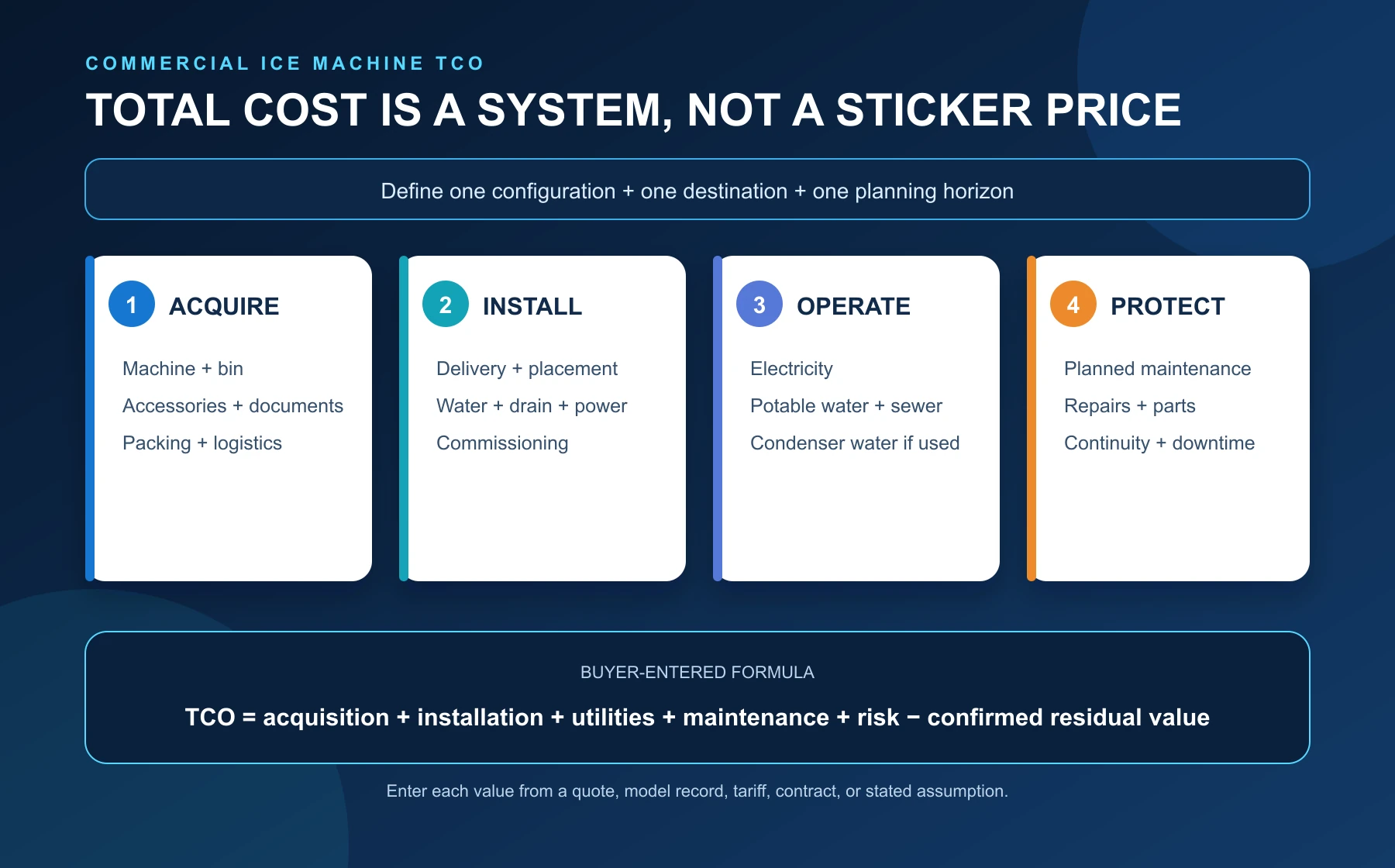
Start with One Machine and One Cost Boundary
Fix the offered configuration before comparing any commercial ice machine cost.
Set the boundary first.
Two suppliers can quote the same nominal daily output while offering different storage bins, condensers, electrical builds, certification documents, shipment terms, commissioning limits, and service responsibilities, making their headline prices fundamentally incomparable.
Define the equipment you are pricing
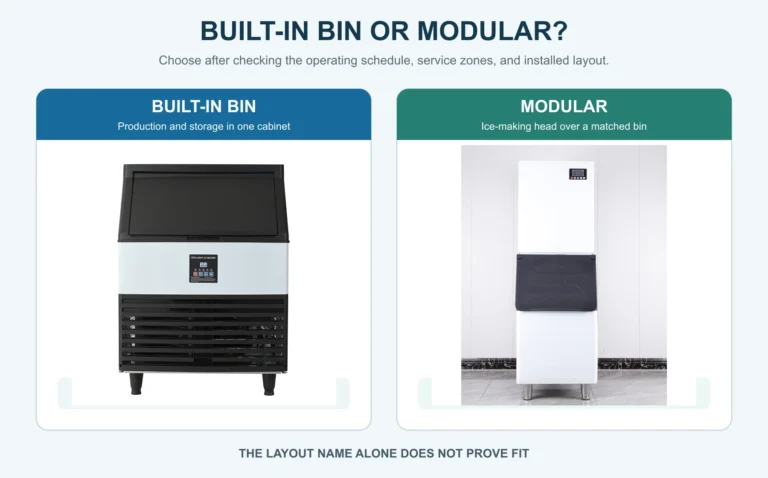
Record the ice type, documented production, storage arrangement, condenser configuration, voltage, frequency, refrigerant, dimensions, and required certifications for each offer. A compact integrated cabinet, a modular head with a separate bin, and a water-cooled system are different projects even when their daily output looks similar.
Use the commercial ice maker range to choose the relevant family, then keep that family constant across quotations. Compare built-in-bin machines with other integrated cabinets and separate-bin modular machines with systems that identify the compatible head, bin, controls, and accessories.
Treat a countertop ice maker as its own format because its water supply, storage, placement, and wholesale order structure can differ from larger foodservice systems.
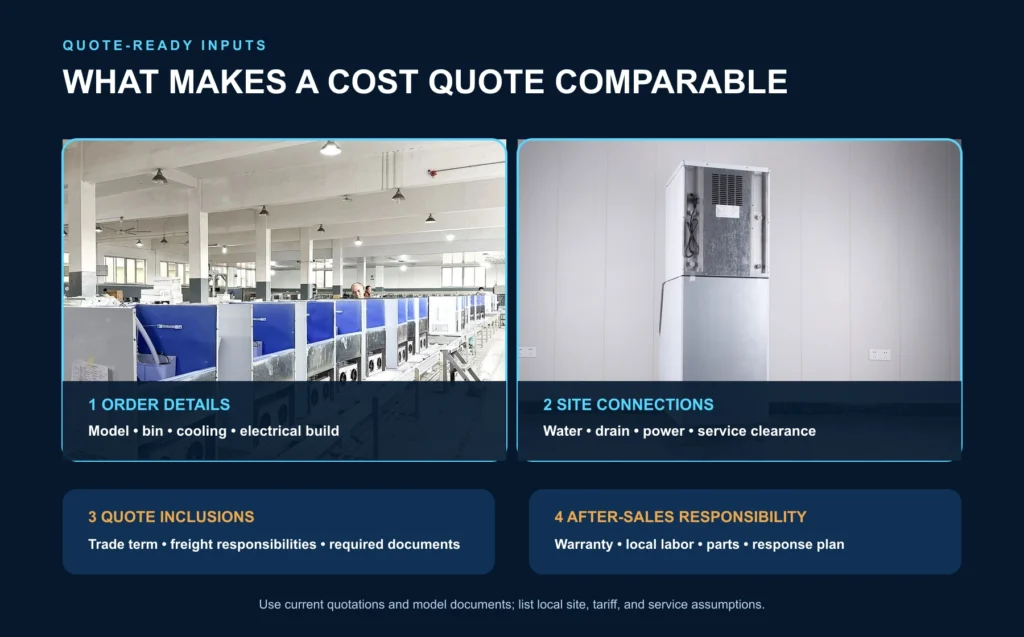
The purchase boundary must also state what the quoted price excludes. Without that sentence, a low equipment figure may omit the bin, water filter, packing, inland transport, export documents, freight, destination charges, local delivery, commissioning, or spare parts.
| Cost block | Confirm in the supplier offer | Confirm locally | Common exclusion risk |
|---|---|---|---|
| Equipment | Exact model, head, bin, cooling, voltage, frequency, accessories, documents | Required approvals and site compatibility | A head-only quote compared with a complete system |
| Logistics | Packing, pickup point, trade term, freight scope, lead time | Port, customs, duty, tax, final delivery, lifting | Different trade terms treated as equal prices |
| Installation | Supplier connection limits and commissioning boundary | Water, drain, electrical, ventilation, placement, permits | Site work assumed to be included |
| After-sales | Warranty document, parts scope, manuals, recommended spares | Local labor, travel, response time, backup ice | Parts warranty mistaken for full local service |
Calculate Purchase and Landed Acquisition Cost
Separate the equipment price from every charge required to receive it.
Normalize the terms.
A complete acquisition comparison shows who pays for each movement from factory pickup through customs and final placement, which charges are fixed, and which may change before delivery at destination.
Normalize commercial terms before choosing the lowest offer
Start with the quoted equipment and options, then add packing, origin handling, freight, and applicable insurance. Add destination charges, duty, tax, broker fees, inland delivery, lifting, and storage before installation. Use current written quotations because destination, shipment method, currency, and trade term can change them materially.
Write every comparison in one currency and record the exchange-rate date instead of hiding currency movement inside a supplier price. Keep payment schedule, validity period, production lead time, shipping term, warranty scope, and included documents beside the total because they change cash exposure and project risk.
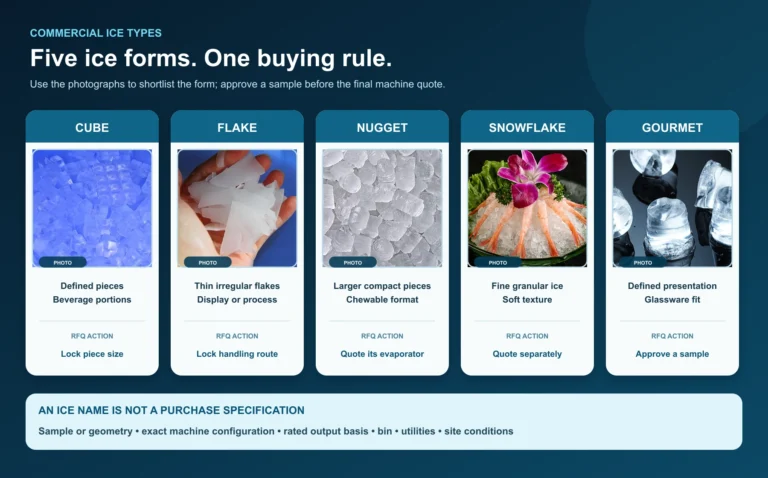
Do not compare only production labels. A cube ice machine and a flake ice machine serve different applications. Larger bins, alternative cooling arrangements, and destination-specific electrical builds can change both acquisition and operating cost.
| Line item | Offer A | Offer B | Document to attach |
|---|---|---|---|
| Machine and required accessories | Enter quote | Enter quote | Model-specific quotation |
| Packing and origin handling | Enter quote | Enter quote | Packing list and trade term |
| International freight and insurance | Enter quote | Enter quote | Current freight offer |
| Destination duty, tax, and clearance | Enter local amount | Enter local amount | Broker or customs calculation |
| Final delivery, lifting, and storage | Enter local amount | Enter local amount | Logistics contractor quote |
| Recommended startup spares | Enter quote | Enter quote | Itemized parts list |
| Landed acquisition total | Calculate | Calculate | Same currency and date |
Budget Installation from the Actual Site
Price installation from drawings, photographs, utilities, and a defined connection point.
List every site task and responsible party
Installation may include unloading, access, floor preparation, placement, water treatment, potable-water piping, drainage, backflow protection, electrical work, ventilation, condenser work, startup checks, and staff handover. The applicable work depends on the offered model and local code, so a fixed installation percentage is unreliable.
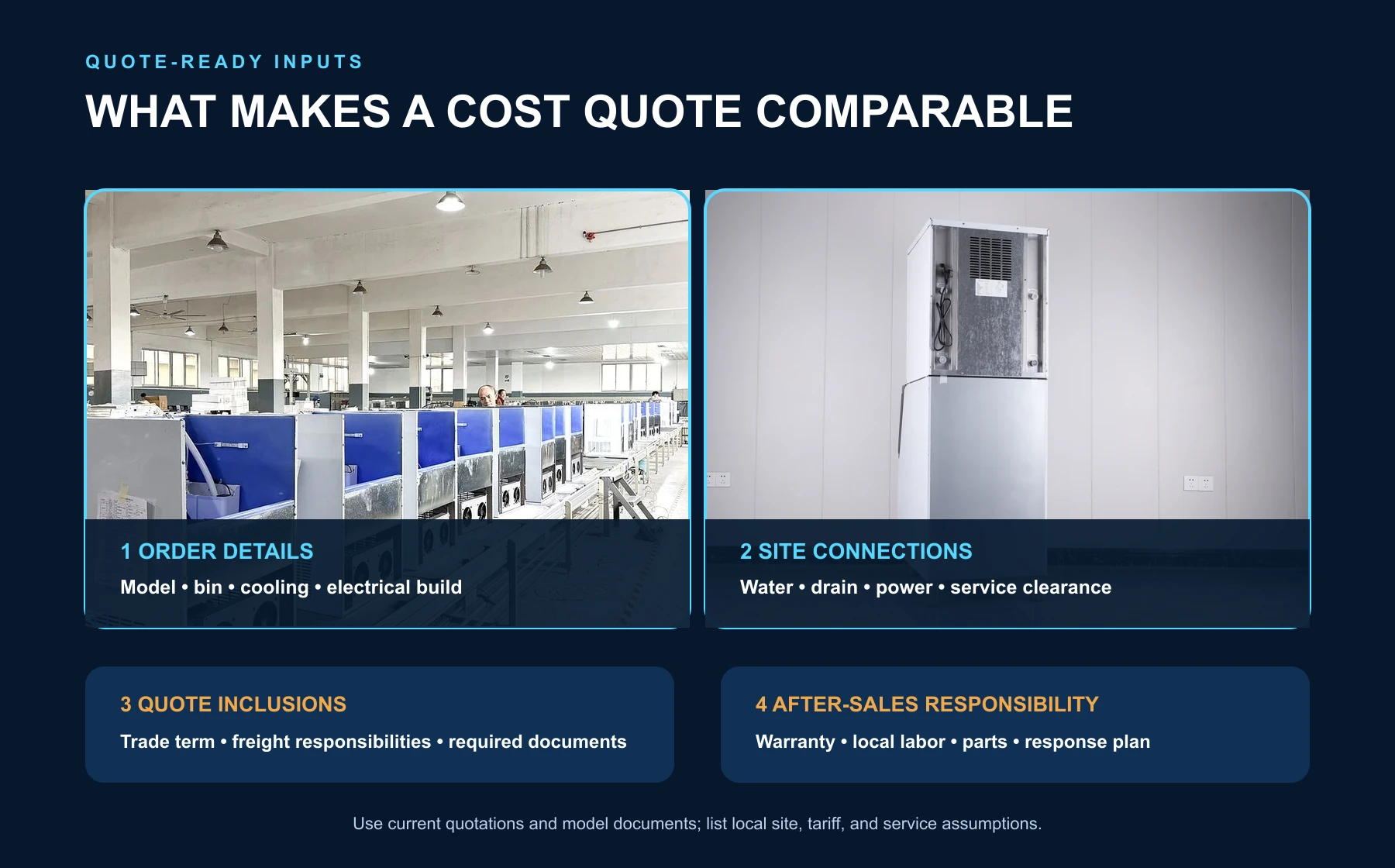
Review the commercial ice machine installation requirements before issuing the order. Send the installer the model dimensions, connection data, clearances, heat-rejection arrangement, and delivery route, then request a written scope that identifies materials, labor, permits, commissioning, and excluded building work.
Cooling choice deserves its own line. An air-cooled ice machine needs the specified airflow and ambient conditions. A water-cooled ice machine can add condenser-water connections and consumption unless the project uses an approved recirculating arrangement.
Collect site facts before shipment: room temperature range, inlet-water temperature and quality, pressure, drain location, voltage, frequency, breaker capacity, door dimensions, lift access, floor loading, service clearance, and photographs. Correcting one mismatch during specification is usually more controllable than arranging rework after delivery.
Installation prices become comparable only when every contractor receives the same model data, connection limits, delivery route, room conditions, acceptance checklist, and clearly assigned commissioning responsibility for the proposed destination site.
For a KAISON quotation, record the ice family, storage arrangement, electrical build, cooling method, and destination consistently across every commercial comparison.
| Work package | Required input | Pricing source | Acceptance record |
|---|---|---|---|
| Delivery and placement | Packed dimensions, weight, route, lifting point | Local logistics contractor | Equipment positioned without damage |
| Water and treatment | Connection, pressure, quality, filter specification | Licensed installer and treatment supplier | Flow, pressure, leak, and filter checks |
| Drainage | Drain type, fall, air gap, route | Licensed installer | Free drainage and no standing water |
| Electrical | Voltage, frequency, phase, load, isolation | Qualified electrician | Correct supply and protective devices |
| Ventilation or condenser work | Air path or condenser design | HVAC/refrigeration contractor | Clearances and heat rejection verified |
| Commissioning | Model checklist and operating conditions | Qualified service provider | Startup record and staff handover |
Calculate Utilities from Comparable Performance Data
Use production-based consumption data instead of multiplying nameplate power by twenty-four hours.
Calculate electricity for the planned ice volume
Commercial machines cycle or modulate, so rated electrical input multiplied by every hour in a year can misrepresent consumption. Request the offered model's energy consumption rate under stated conditions, preferably in kWh per 45 kg or 100 lb of ice, and record whether the figure is tested, certified, calculated, or estimated.
AHRI Standard 810 establishes rating and published-data requirements for automatic commercial ice makers. The US Department of Energy commercial ice-maker page also identifies energy consumption and harvest-rate testing as regulated performance concepts for covered equipment.
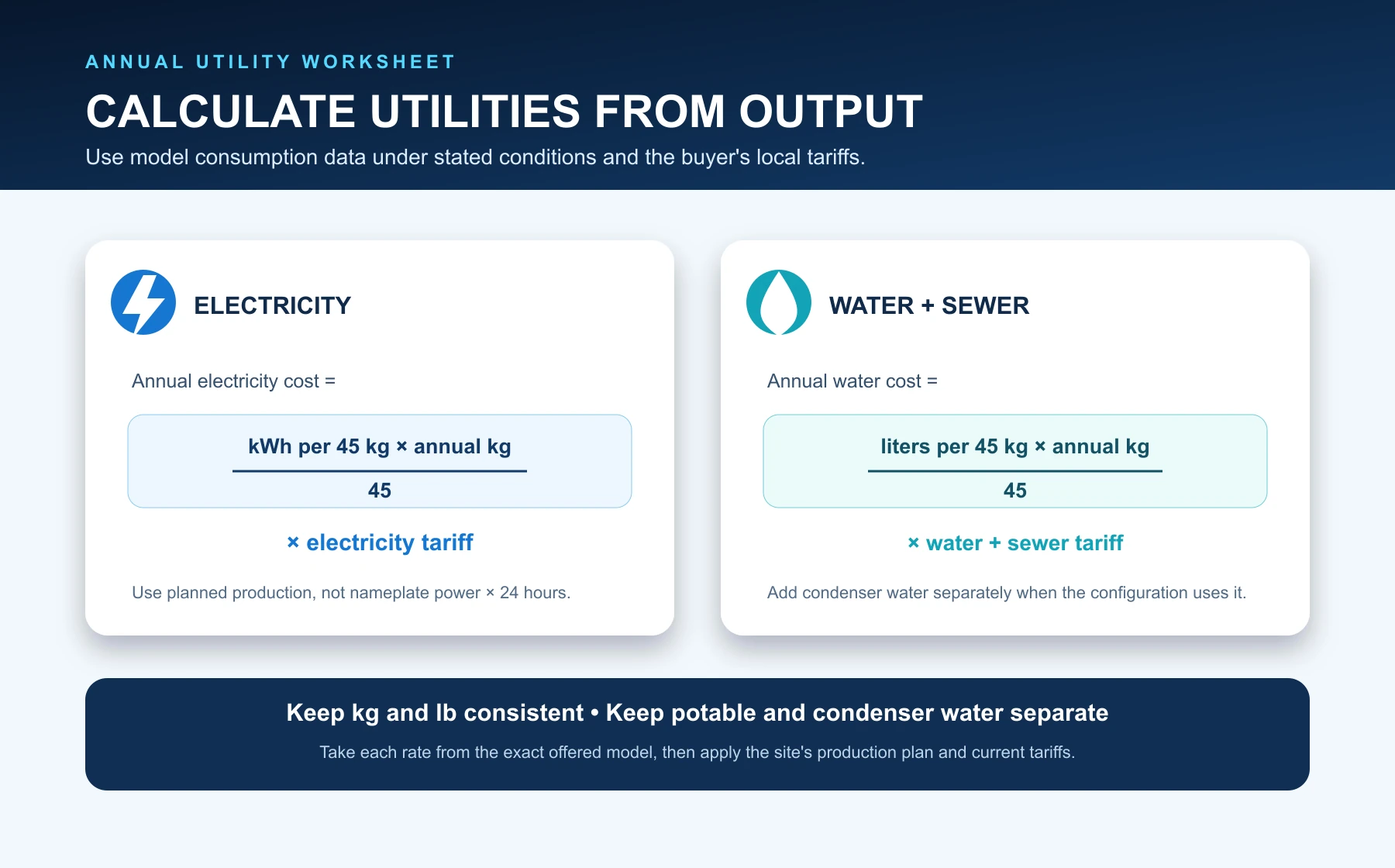
Calculate `annual electricity cost = energy rate per 45 kg × annual ice production ÷ 45 × electricity tariff`. Keep kilograms and pounds consistent, use the actual planned production rather than maximum catalog output, and run another scenario for the busiest expected year.
Keep potable water and condenser water separate
Calculate `annual potable-water cost = potable-water rate per 45 kg × annual ice production ÷ 45 × combined water and sewer tariff per unit`. If the system uses condenser water, add that volume on a separate line instead of mixing it with water frozen into ice and purge water.
The ENERGY STAR commercial ice-maker criteria compare energy consumption and potable water use per 100 lb of ice for eligible air-cooled equipment. Certification scope matters: the program page states that water-cooled models are not eligible, so an ENERGY STAR label cannot be assumed for every configuration.
| Input | Buyer entry | Unit and source |
|---|---|---|
| Annual ice production | Enter | kg/year from operating plan |
| Energy consumption rate | Enter | kWh/45 kg from model data |
| Electricity tariff | Enter | Local currency/kWh from bill |
| Calculated electricity cost | Calculate | Energy rate × annual kg ÷ 45 × tariff |
| Potable-water use rate | Enter | L/45 kg from model data |
| Condenser-water use rate | Enter separately if applicable | L/45 kg from model data |
| Water and sewer tariff | Enter | Local currency/L or converted from m³ |
| Calculated water cost | Calculate | Total applicable liters × tariff |
Budget Maintenance, Repairs, and Downtime
Build maintenance cost from the exact manual, water conditions, and service plan.
Separate routine care from failure risk.
Suppliers should state who pays for consumables, scheduled labor, technician travel, parts, warranty diagnosis, records, and emergency response at the destination site.
Maintenance estimates become useful only when the manual, water analysis, filter specification, operating hours, local labor rate, travel allowance, parts access, and response time all match the offered machine and site.
Separate planned care from failure exposure
Planned cost can include operator cleaning time, approved chemicals, filter cartridges, descaling, sanitation, condenser cleaning, inspection, travel, and contracted preventive service. Use the model manual and the site's water-treatment plan to set tasks and intervals rather than copying a universal calendar from another machine.
The preventive maintenance checklist helps organize responsibilities, but the offered build and local service provider must control the final schedule. Ask which records are required for warranty support and whether parts, labor, travel, refrigerant work, water-related failures, and consumables are included or excluded.
Unplanned repair cost is different from planned maintenance. Set a buyer-approved repair reserve or service-contract budget from local callout rates, parts access, technician travel, and the promised response time at the destination. Do not turn a competitor's historical repair average into a supplier promise.
Add a separate budget for downtime. Record bagged ice, temporary equipment, extra handling, relevant product loss, overtime, and lost service for the buyer's operation. State who supplies backup ice or replacement equipment during a covered failure.
KAISON can review the selected model and required documents, while the buyer keeps local labor, tariffs, and continuity assumptions under its own control.
| Activity | Operator | Local service provider | Supplier/document source |
|---|---|---|---|
| Exterior and accessible-area cleaning | Assign and train | Verify when contracted | Model cleaning instructions |
| Water treatment and cartridges | Monitor condition and records | Supply/replace if contracted | Filter specification and water analysis |
| Internal service and refrigeration work | Do not assign beyond manual | Qualified technician | Service manual and parts list |
| Warranty claim | Preserve records and claim materials | Diagnose when authorized | Written warranty and claim procedure |
| Backup ice or temporary equipment | Define operating plan | Confirm response option | Service contract or local contingency quote |
Build a Three- or Five-Year Commercial Ice Machine Total Cost of Ownership Comparison
Use one time horizon, currency date, production plan, and responsibility boundary.
Keep assumptions visible.
The calculation should show when each cash flow occurs, which values are quoted, which are measured, which remain uncertain, and who owns each risk through the selected planning horizon for approval.
Calculate the complete ownership case
Use `TCO = landed acquisition + installation + utilities + planned maintenance + repair and continuity allowance + financing and local charges + replacement or disposal effects − confirmed rebates or residual value`. Include a value only when its source and timing are documented, and keep uncertain items visible as assumptions.
Compare purchase, finance, rental, or service-contract options over the same period. A monthly agreement may include installation and repairs while excluding utilities, damage, filters, escalation, relocation, or early termination. An owned system may have a lower recurring invoice while leaving service and continuity risk with the buyer.
Run low, base, and high scenarios for annual production, electricity tariff, water/sewer tariff, maintenance frequency, repair exposure, exchange rate, and downtime. Sensitivity testing shows which assumption can change the decision and which specification needs clearer written confirmation before approval.
| Cost category | Year 0 | Year 1 | Year 2 | Year 3 | Years 4-5 if used | Document or assumption |
|---|---|---|---|---|---|---|
| Landed acquisition | Enter | Not applicable | Not applicable | Not applicable | Replacement only if planned | Supplier and logistics quotes |
| Installation and commissioning | Enter | Not applicable | Not applicable | Not applicable | Site change if planned | Contractor quote |
| Electricity | Not applicable | Calculate | Calculate | Calculate | Calculate | Model rate, production, tariff |
| Water and sewer | Not applicable | Calculate | Calculate | Calculate | Calculate | Model rate, production, tariff |
| Planned maintenance | Not applicable | Enter | Enter | Enter | Enter | Manual and service offer |
| Repair/continuity allowance | Not applicable | Enter | Enter | Enter | Enter | Buyer scenario or contract |
| Finance, tax, rebate, residual value | Enter separately | Record timing | Record timing | Record timing | Record timing | Local adviser and documents |
| Total | Calculate | Calculate | Calculate | Calculate | Calculate | Same currency and horizon |
- Define one machine, storage, cooling, electrical, destination, and service configuration before comparing prices.
- Separate equipment, logistics, site work, utilities, maintenance, repairs, and downtime in the budget.
- Use AHRI Standard 810 performance concepts when comparing published harvest and consumption data.
- Calculate utilities from kWh and water per 45 kg (100 lb), actual production, and local tariffs.
- Use the exact model manual and water conditions to build the maintenance plan.
- Compare ownership and rental on the same time horizon, currency basis, inclusions, and risk boundary.
Frequently Asked Questions
Use these answers to prepare a comparable cost request.
Keep the supporting documents beside the worksheet.
Each figure should trace to a quotation, model record, tariff, contract, or stated buyer assumption.
How much does a commercial ice machine cost?
No single global figure applies to every commercial ice machine. The result depends on ice format, output, storage, condenser type, electrical build, certifications, accessories, shipment destination, trade term, local site work, and service coverage. Ask for an itemized machine quotation, then add landed logistics, installation, annual utility use, planned care, repair exposure, and business-continuity costs over a fixed period. Use published price ranges only for early orientation, never as a substitute for a configuration-specific budget.
What should a commercial ice machine purchase quote include?
Require the exact model, ice type, production basis, storage bin, cooling method, voltage, frequency, refrigerant, dimensions, connections, clearances, accessories, and required documents. The commercial section should identify packing, quantity, currency, price validity, payment schedule, lead time, trade term, freight boundary, warranty, manuals, parts coverage, and recommended startup spares. Ask the supplier to list every exclusion. This prevents a head-only or factory-gate offer from being compared with a delivered, complete, commissioned system.
How do I estimate commercial ice machine installation cost?
Give a qualified local contractor the selected model's connection data, packed and operating dimensions, weight, clearances, heat-rejection method, and delivery route. Request itemized prices for unloading, placement, water treatment, potable-water piping, drainage, electrical work, ventilation or remote-condensing work, permits, startup, and training. Include photographs and measured utility information. A percentage of machine price is unreliable because building access, code, pipe distance, electrical capacity, and condenser design are site-specific.
How do I calculate a commercial ice machine's electricity cost?
Obtain the model's energy-consumption rate in kWh per 45 kg or 100 lb under stated test conditions. Multiply that rate by planned annual ice production divided by the same ice unit, then multiply by the local electricity tariff. Keep units consistent and model more than one production and tariff scenario. Do not multiply nameplate input by every hour of the year unless verified operating measurements support that duty cycle, because ice makers cycle and stop when controls are satisfied.
How do I calculate water and sewer cost?
Request potable-water use per 45 kg or 100 lb of ice and note the test conditions. Multiply it by planned production, then apply the buyer's combined water and sewer tariff after converting liters, gallons, or cubic meters correctly. For water-cooled equipment, record condenser water separately and confirm whether it is once-through or part of an approved recirculating system. Do not mix potable production water, purge water, and condenser water into one unexplained assumption.
How should maintenance and repairs be budgeted?
Build planned maintenance from the offered model's manual, site water analysis, filter specification, operating environment, and a written local service proposal. Include approved chemicals, cartridges, operator time, scheduled professional work, technician travel, and required records. Treat repairs as a separate reserve or contract decision based on local labor, parts availability, response time, and warranty boundaries. Add a continuity allowance for backup ice, temporary equipment, overtime, or interrupted service using the buyer's own exposure.
Is buying or renting a commercial ice machine cheaper?
The answer depends on the comparison period and contract boundary. Buying concentrates equipment and installation spending early while leaving maintenance, repair, and continuity risk with the owner unless separate coverage is purchased. Rental or leasing can smooth cash flow and transfer selected responsibilities, but the agreement may exclude utilities, filters, damage, escalation, relocation, or early termination. Compare both options in one currency over the same years, production plan, service scope, and downtime assumption before deciding.
What information should I send for a total-cost quote?
Send daily and peak ice demand, ice type, storage requirement, cooling preference, room temperature, inlet-water temperature and quality, pressure, drain details, voltage, frequency, available circuit, delivery route, clearances, destination, quantity, and requested trade term. Attach site and access photographs. Request output conditions, energy and water consumption, connections, required accessories, documents, packing, lead time, warranty, manuals, spares, and explicit exclusions. This turns a general price request into a budget-ready commercial response.
Send a Cost-Ready RFQ to KAISON
Send one operating, site, destination, and documentation brief with every inquiry.
Request a comparable written response
State daily ice demand, peak withdrawals, ice type, reserve, cabinet, cooling method, and ambient and inlet-water conditions. Add voltage, frequency, water quality, drain arrangement, service access, destination, trade term, and required certifications. Attach room and delivery-route photographs so configuration and installation questions appear before the final offer.
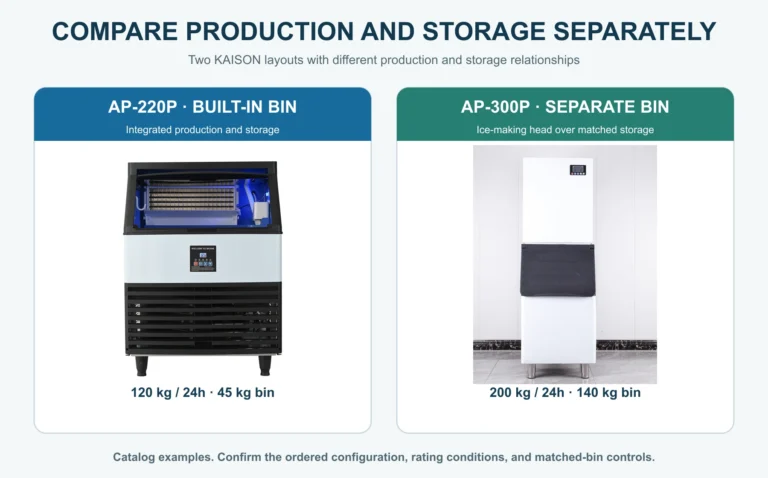
Request the exact model, head-and-bin pairing, output basis, energy and water data, dimensions, connections, clearances, accessories, packing, lead time, trade term, payment schedule, warranty document, manuals, parts list, recommended spares, and supplier/local-contractor responsibilities. The AP-220P page and AP-300P page illustrate why buyers should quote a named configuration instead of asking for one generic machine price.
Use the complete product range to prepare the shortlist, then send the worksheet, site details, and photographs through the contact page. A useful response should let the buyer calculate landed acquisition, installation, utilities, maintenance, and continuity exposure without filling hidden gaps with industry averages.
Restaurants can also review the restaurant ice-machine application page, while hospitality projects can separate guest and service needs through the hotel ice-machine application page.
High-drink-volume projects can compare the bar ice-machine application page with the café ice-machine application page before finalizing one demand brief.