KAISON Team
How to Size a Commercial Ice Machine: Production, Peak Draw, and Bin Capacity
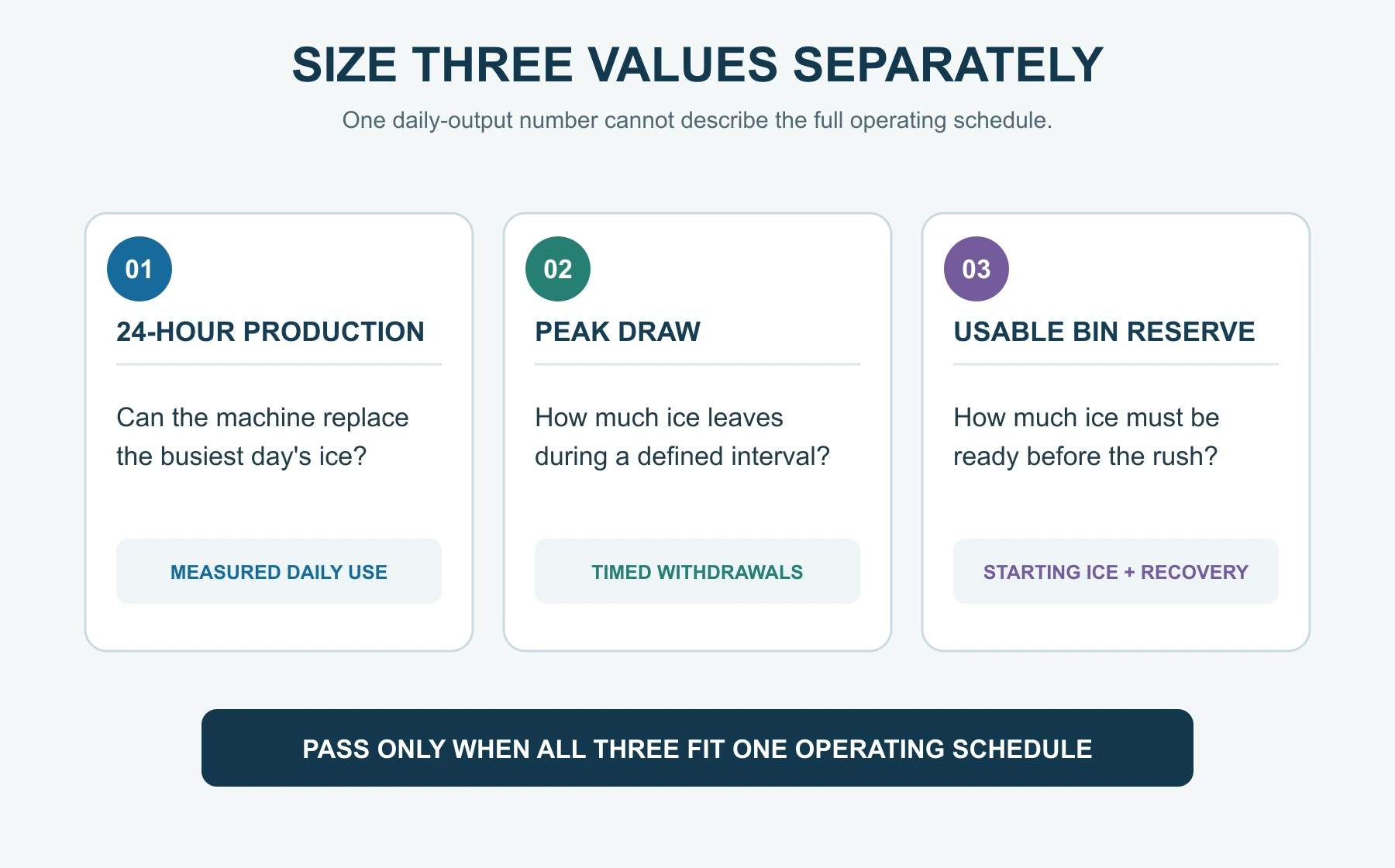
How to size a commercial ice machine begins with three separate checks: daily production, peak draw, and usable bin reserve. Add every use stream on the busiest realistic day, then map when staff will remove that ice. During each peak interval, starting ice plus production must cover withdrawals and still leave the operating minimum you choose. The machine must also rebuild the reserve before the next rush. Compare published output with the stated ambient air, inlet water, voltage and frequency, and condenser configuration. This method avoids two common errors: choosing by an average day and treating a large storage bin as a cure for inadequate production.
How to Size a Commercial Ice Machine with Three Checks
Use three capacity checks before comparing individual models or prices.
Separate the three decisions
Production, peak draw, and storage answer different questions, so a single kilograms-per-day figure cannot show whether ice remains available through a concentrated service window.
Keep them separate.
A model passes only when its documented output, interval balance, available reserve, and refill timing all meet the same operating schedule under the conditions expected at the site during its busiest day.
| Check | Question to answer | Required input | Pass condition |
|---|---|---|---|
| 24-hour production | Can the machine replace the busiest day's ice? | Measured daily use and model output at relevant conditions | Documented output covers the busiest-day total and planned net reserve increase |
| Peak draw | How quickly will staff remove ice? | Kilograms withdrawn during each defined interval | Starting reserve plus interval production minus withdrawals stays above the minimum |
| Usable bin reserve | How much ice must be ready before the rush? | Peak balance, operating minimum, and bin-control behavior | Reserve never falls below the chosen minimum and rebuilds in time |
The first check protects total supply. The second identifies the fastest depletion period. The third determines how much finished ice must be waiting when service begins, without assuming that every kilogram of nominal bin capacity is available on demand.
Review the commercial ice maker range only after these three values are written down. The supplier can then compare the brief with a built-in or modular configuration instead of recommending from a seat count alone.
Build the Busiest-Day Ice Schedule
Build a time-based demand record before selecting a production class.
Record every withdrawal by time
Over several representative operating days, weigh each withdrawal or count standardized containers used by beverage stations, food preparation, displays, delivery packing, guest floors, banquets, and other processes sharing the same supply.
Record the time.
Log each withdrawal in kilograms and at a stated time, because the same daily total could represent a gentle schedule or one demanding two-hour rush that drains storage quickly.
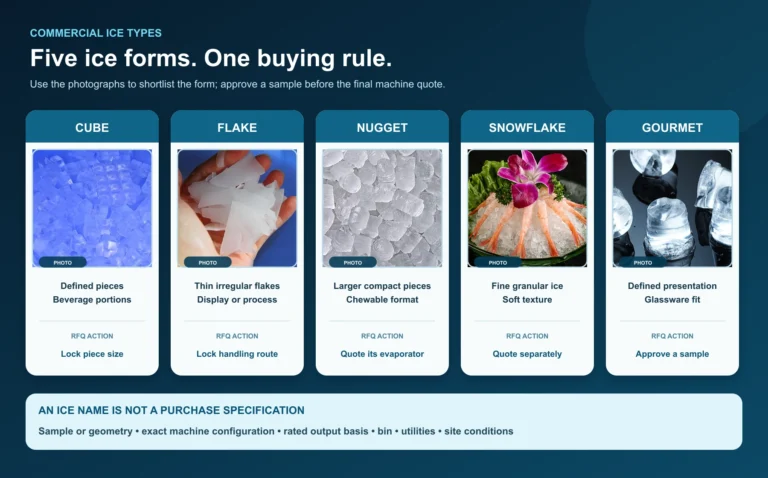
Do not combine different ice formats unless the proposed machine will actually serve them all. A bar may need cubes for drinks while a seafood display needs flake ice, and one total would hide two separate equipment decisions. Relevant application pages for restaurants, bars, hotels, and cafés help identify distinct service zones without supplying the buyer's measured demand.
| Time interval | Use point | Ice at start | Ice withdrawn | Ice produced | Ice at end | Note |
|---|---|---|---|---|---|---|
| Opening to breakfast | Record service point | Record kg | Record kg | Model data or measurement | Calculate kg | Occupancy and menu |
| Lunch peak | Record service point | Record kg | Record kg | Model data or measurement | Calculate kg | Duration and shared uses |
| Afternoon recovery | Record service point | Record kg | Record kg | Model data or measurement | Calculate kg | Door openings or cleaning |
| Dinner or event peak | Record service point | Record kg | Record kg | Model data or measurement | Calculate kg | Event size and stations |
Use the busiest realistic schedule, not an annual average or a single exceptional emergency. Note opening stock, each withdrawal, closing stock, and the hours available before the next concentrated draw so the final model can be checked against an operating sequence.
Calculate Required 24-Hour Production
Compare daily production only after recording the rating basis.
Compare output on stated conditions
AHRI Standard 810-2023 defines ice harvest rate as the gross weight harvested over 24 hours and uses standard rating conditions that include 32°C ambient air and 21°C inlet water.
Conditions can differ.
KAISON's current AP-220P and AP-300P product pages tell buyers to request the rated test conditions because actual output varies with ambient air, inlet-water temperature, and operating conditions at the site. Use the complete product range to build a shortlist, while requiring the quotation to identify voltage, frequency, condenser, ice setting, and output basis. The commercial ice maker buyer's guide shows why the comparison condition belongs beside the capacity figure.
Add all measured use streams for the busiest day. Then include only a reserve or recovery quantity your operation has defined, such as the required closing stock before a second service period. Do not apply an unexplained percentage buffer because a time-based requirement is easier to test and defend.
A simple daily check is `documented production at relevant conditions ≥ busiest-day use + planned net reserve increase`. If the bin begins and ends the day at the same level, the net reserve increase is zero, although the peak-balance test can still require substantial storage.
Calculate Peak Draw by Time Interval
Peak draw tests whether supply survives the busiest continuous interval.
Balance one peak interval
Use `ending reserve = starting usable ice + actual production during the interval − ice drawn during the interval`, then compare the result with the minimum reserve chosen by the operator.
Show every input.
Dividing a rated daily figure by 24 gives a planning average, not guaranteed hourly production, because harvest cycles, bin controls, ambient air, inlet water, condenser conditions, and cleaning state can change actual output.
| Illustrative input | Value |
|---|---|
| Starting usable ice | 42 kg |
| Ice drawn from 18:00 to 21:00 | 46 kg |
| Illustrative production during the interval | 15 kg |
| Ending reserve | 42 + 15 − 46 = 11 kg |
| Operator's chosen minimum reserve | 8 kg |
| Peak result | Passes by 3 kg if the selected model supports the 15 kg interval input at site conditions |
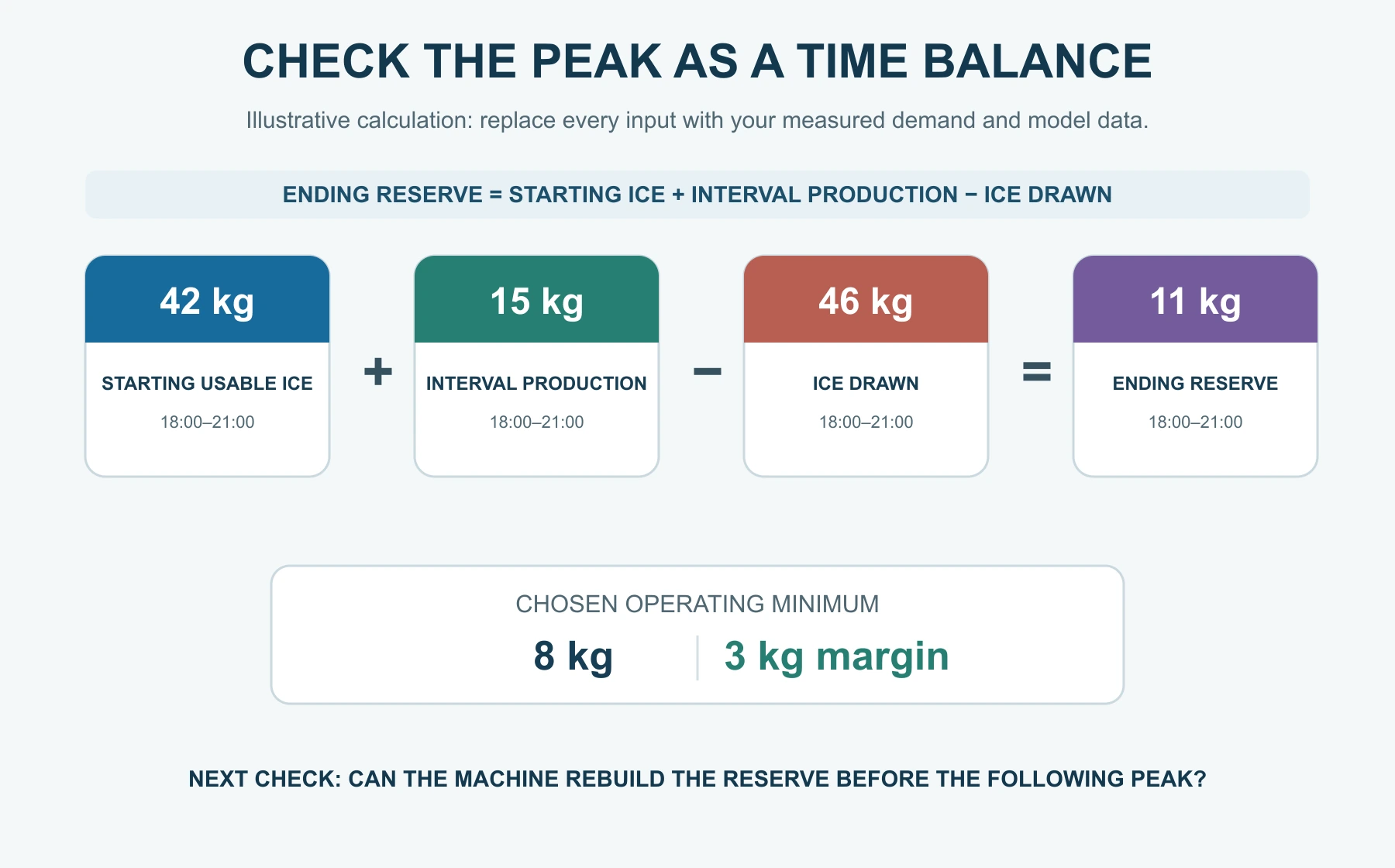
This dataset is a calculation example, not a customer case or industry average. Change the 15 kg production input to the selected model's documented performance near the proposed site conditions, or use a controlled field measurement from the same configuration.
Buyers comparing cube ice machines should also keep ice thickness and format consistent. A capacity result for one harvest setting cannot automatically represent another setting or a different ice family.
Size Bin Capacity from the Shortage Window
Size storage from the interval when withdrawals exceed concurrent production.
Find the required starting reserve
For each interval, calculate `ice drawn − confirmed interval production + chosen minimum reserve`; the largest positive result is the required starting usable reserve for that schedule.
Check recovery next.
The machine must rebuild the depleted reserve before the following peak, while accounting for any continuing withdrawals during that recovery period. A nominal bin figure is not automatically usable reserve because the ice level, control position, access pattern, melting, bridging, sanitation routine, and scoop clearance can affect day-to-day availability.
AHRI Standard 820-2023 separates internal volume and storage effectiveness concepts for non-refrigerated bins. Use the standard only to compare how bins are described, then request the matched-bin specification, control behavior, and any AHRI certification separately.
Published production is not ice on hand. When the bin reaches its full control state, production stops, so a larger bin helps only when the schedule allows it to fill and the next peak can use that stored reserve.
Compare Built-In and Separate-Bin Layouts
Choose the cabinet layout after the demand balance passes.
Match the cabinet to the calculation
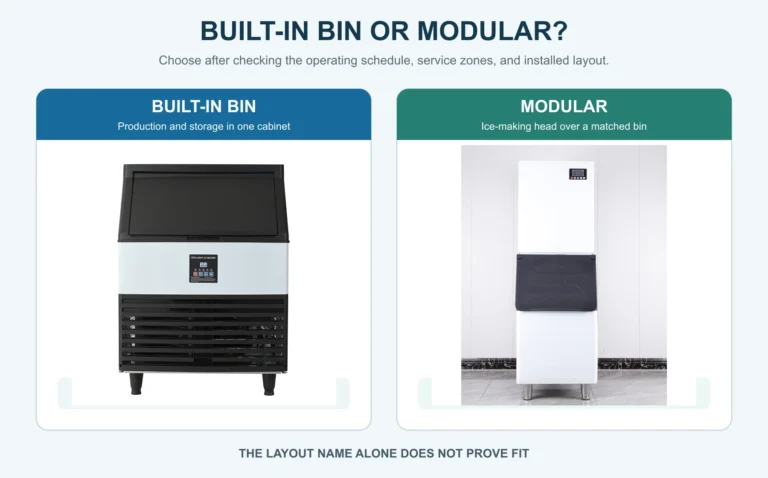
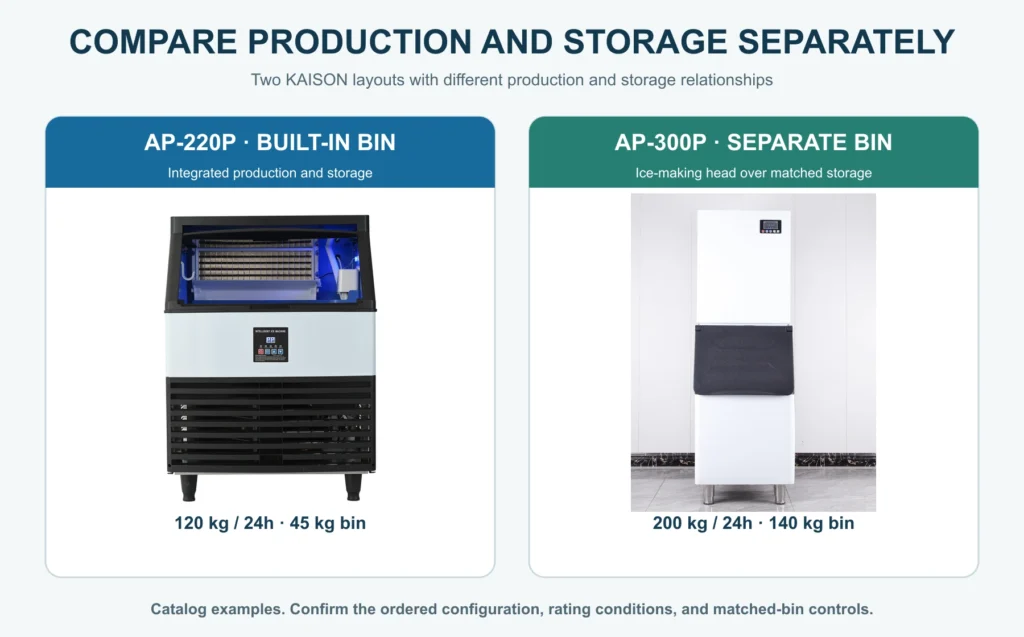
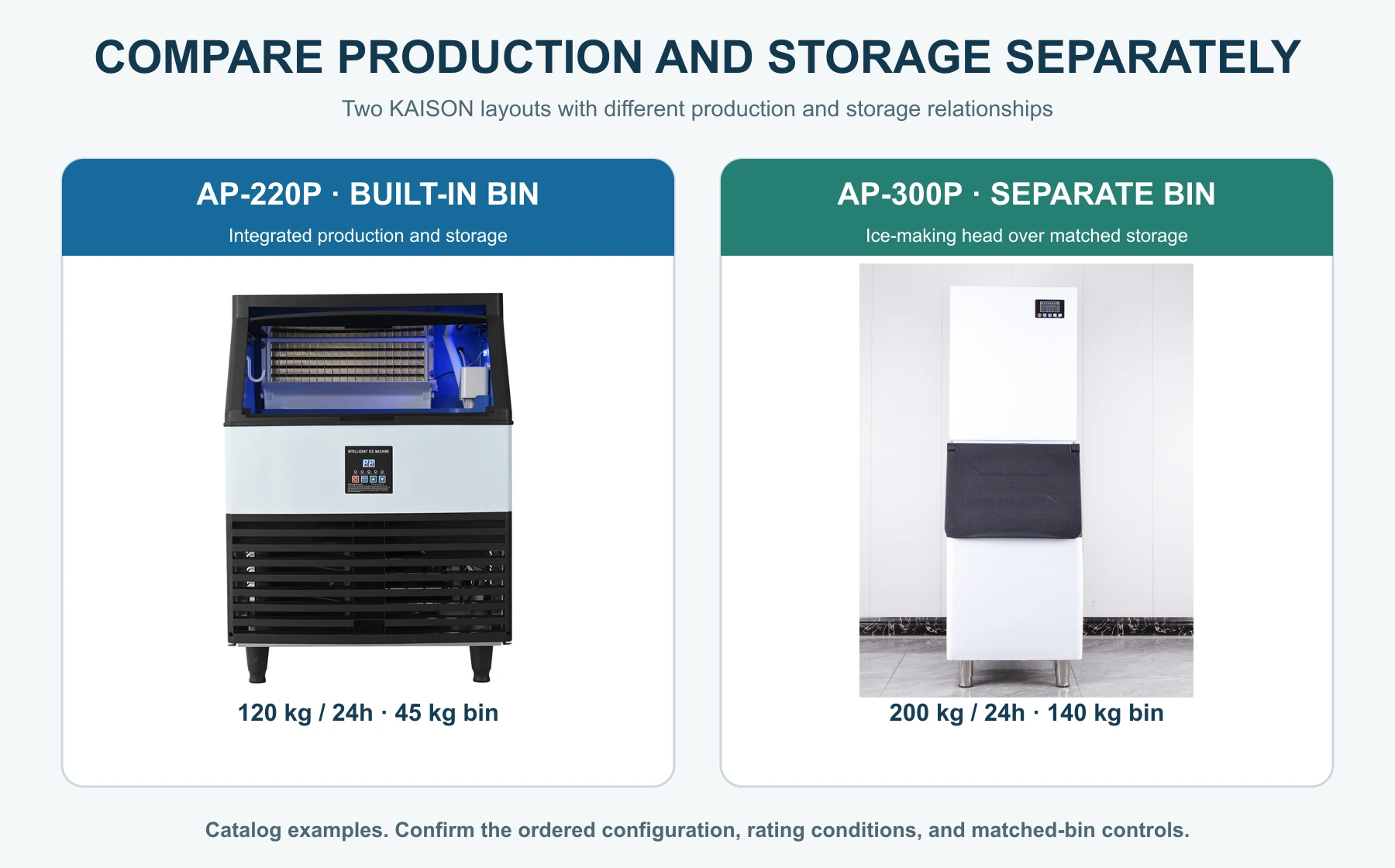
A built-in-bin ice machine combines production and storage in one cabinet, while a separate-bin ice machine gives the project more freedom to pair output with storage.
Space still matters.
KAISON lists the AP-220P at 120 kg per 24 hours with a 45 kg bin and the AP-300P at 200 kg per 24 hours with a 140 kg bin in its current catalog. These are catalog examples, not a claim that either model fits the illustrative peak above. Review the AP-220P product page and AP-300P product page only after calculating the required production and usable reserve.
| Decision | Built-in bin | Separate bin |
|---|---|---|
| Footprint and height | Integrated cabinet can simplify compact layouts | Head and bin dimensions must be checked together |
| Storage flexibility | Storage is fixed by the cabinet design | Compatible bin options may provide more flexibility |
| Delivery and service | Check doors, counters, panels, and drain access | Check total height, bin lid, head removal, floor load, and controls |
| Best sizing use | Demand and storage relationship fits the integrated unit | Production and peak reserve need a more flexible pairing |
Confirm whether the site needs an air-cooled ice machine or water-cooled ice machine. Cooling choice changes heat rejection, utilities, installation, and the conditions required for documented output.
Send a Complete Sizing Brief for Quotation
Send one complete operating brief with every model inquiry.
Standardize the supplier response
Include the busiest-day total, interval withdrawals, starting reserve, chosen minimum, recovery deadline, ice type, ambient and inlet-water temperatures, utilities, condenser preference, delivery route, clearances, drainage, and destination.
Make answers comparable.
Ask each supplier to state output at the relevant conditions, matched-bin capacity, bin-control behavior, voltage and frequency, condenser configuration, dimensions, installation limits, cleaning access, current datasheet, and the exact documents covering the offered build.
Use the contact page to send the worksheet and site photographs. The commercial ice machine installation requirements help organize utility and access checks. A model-specific recommendation should follow only after the production, peak-balance, storage, and installation inputs are complete, with any remaining assumption identified in the quotation.
- Size the system with three independent checks: 24-hour production, peak-interval draw, and usable bin reserve.
- AHRI Standard 810-2023 expresses harvest rate over 24 hours and defines standard rating conditions for comparable published data.
- AHRI Standard 820-2023 distinguishes storage-bin volume and storage-effectiveness concepts from machine production.
- Calculate every peak with starting reserve plus interval production minus interval withdrawals, then test the recovery window.
- A larger storage bin does not raise the machine's production rate and helps only when the schedule allows reserve to rebuild.
Frequently Asked Questions
Use these answers to check a sizing brief before requesting quotes.
Keep the worksheet nearby.
An answer is complete only when the buyer can trace its 24-hour demand, peak interval, starting reserve, minimum reserve, operating conditions, and recovery deadline to measured or documented inputs.
What size commercial ice machine does my business need?
Choose a machine only after three results pass: documented 24-hour production covers the busiest realistic day, starting ice plus production survives the largest timed draw, and the bin holds the required usable reserve. Measure withdrawals by service zone and interval instead of relying on seats or customers alone. Then compare output at the expected ambient air, inlet water, voltage, ice setting, and condenser configuration. The selected system must also rebuild the chosen reserve before the next busy period.
How do I calculate daily ice production capacity?
Add every measured ice use on the busiest representative day, including beverage service, preparation, displays, delivery packing, and other processes sharing the supply. Add a net reserve increase only when the operation intentionally needs more ice at the end of the day than at the start. Compare that total with the proposed model's documented 24-hour output at relevant conditions. Keep peak draw separate because an adequate daily total can still fail during a short rush.
Is bin capacity the same as daily production?
No. Production describes how much ice the machine makes over a stated period and under stated conditions. Bin capacity describes stored finished ice, while usable reserve is the portion available for the operating plan. A full-bin control can stop production before demand begins, and production restarts only after the control senses enough space. Check nominal capacity, usable level, matched controls, access, sanitation, and the time available to refill the bin before the next peak.
How do I calculate peak draw?
Define the busiest continuous interval, then record starting usable ice, ice produced during that interval, and every withdrawal. Calculate ending reserve as starting usable ice plus interval production minus ice drawn. The result must remain above the operator's chosen minimum. Repeat the equation for each service window because breakfast, lunch, dinner, banquets, and guest-floor collection can create different shortages. Use model-specific interval production or a controlled measurement, not an unsupported hourly assumption.
Can I divide rated daily output by 24?
You can divide a rated kilograms-per-day figure by 24 as a planning average, but do not treat the result as guaranteed hourly production. Commercial machines make ice in cycles, and the cycle result changes with ambient air, inlet water, condenser conditions, ice setting, bin control, and maintenance state. Request output or cycle data near the intended operating condition. If the supplier cannot provide it, label the hourly figure as an assumption and test a conservative scenario before ordering.
Does a larger storage bin increase ice production?
A larger bin does not increase the ice-making head's production rate. It can hold more ice before the full-bin control stops production, which helps only when the machine has enough low-demand time to build that reserve. Test the complete schedule: starting level, peak withdrawals, production during the peak, minimum reserve, and refill time. Confirm head-and-bin compatibility, control operation, overall height, floor load, lid clearance, drainage, cleaning access, and delivery route before selecting a larger bin.
How do hot kitchens and warm inlet water affect sizing?
Higher ambient air and warmer inlet water can increase the heat the system must remove and can change cycle time and output. Do not apply one universal loss percentage to every machine. Ask for the proposed model's performance at conditions close to the site, and record whether the condenser is air cooled or water cooled. Confirm ventilation, heat sources, clearances, water supply, drainage, and cleaning access because an installation that differs from the rating basis can change the available recovery margin.
What details should I send a commercial ice machine supplier?
Send the busiest-day total, a time-based withdrawal log, starting reserve, chosen minimum, required recovery time, ice type, ambient and inlet-water temperatures, operating hours, voltage, frequency, water, drainage, and condenser preference. Include room dimensions, clearances, floor loading, delivery route, service access, destination, and photographs. Request written output conditions, matched-bin data, bin-control behavior, dimensions, installation limits, current manuals, datasheet, warranty terms, and the exact configuration stated in the final quotation.