KAISON Team
Commercial Ice Machine Ice Problems: A Symptom-by-Symptom Guide
Commercial ice machine ice problems are easiest to isolate when you record the visible symptom, cycle stage, site conditions, and exact model before changing anything. Thin, hollow, wet, cloudy, clumped, or slow-to-release ice can point toward different water, airflow, setting, cleaning, or refrigeration checks. Appearance alone cannot identify a failed component, and clear-looking ice is not automatically safe to serve. Start with one complete operating cycle, compare it with the current model manual, and separate staff-safe observations from work that requires a qualified technician. This guide helps food-service operators build a useful case record and choose the next action without turning a symptom into a guessed diagnosis.
Diagnose Commercial Ice Machine Ice Problems by Symptom
Record the ice symptom before changing settings or replacing parts.
Capture one complete cycle
Photograph a fresh batch against a neutral background, then record ambient air, inlet-water temperature, complete cycle time, displayed setting, error code, water pattern, and whether the batch released completely. Start there.
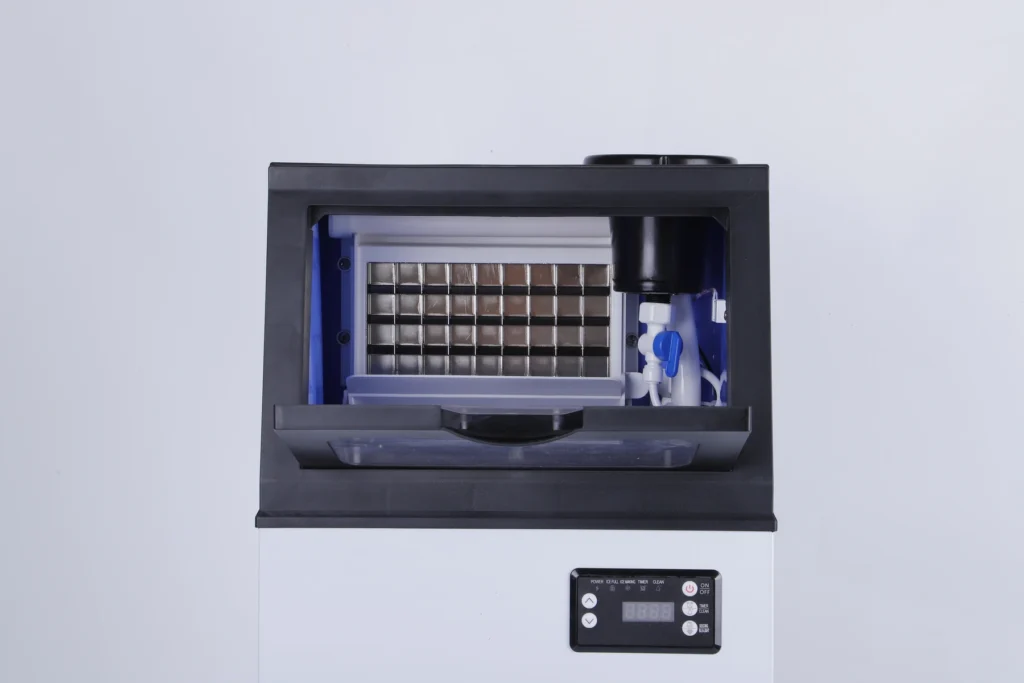
A short video should show the display, water distribution, water level, harvest stage, and finished cubes while all guarded electrical panels and refrigeration compartments remain closed. The ice-making cycle guide explains the stages, while the installation requirements help identify ventilation, water, drain, or clearance conditions that can distort the result.
Sort symptoms before causes
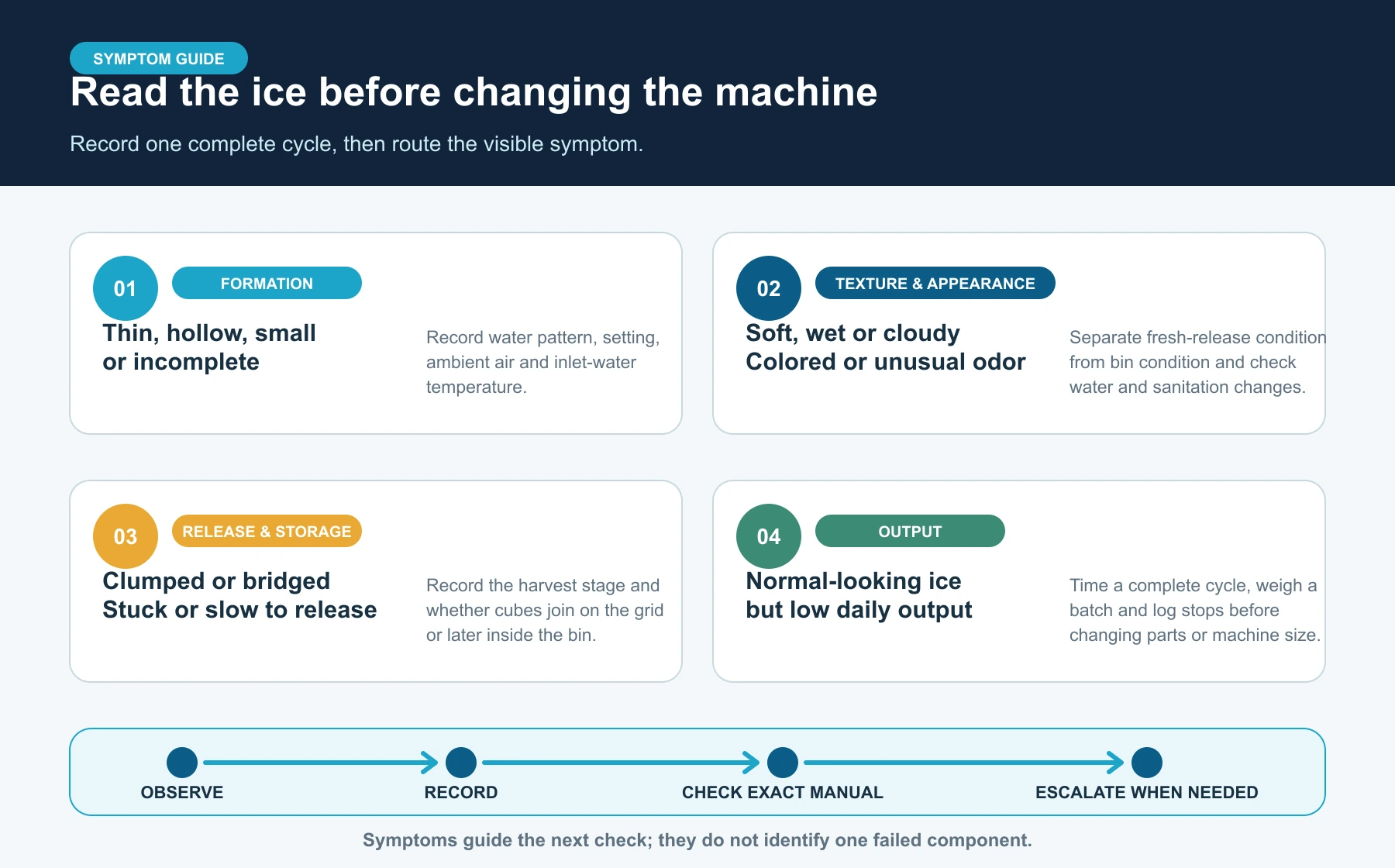
Use four practical groups: formation, texture or appearance, release or storage, and output. A cube can look incomplete because water coverage was uneven, because the freeze stage ended early, or because site heat changed the cycle, so one photograph cannot name a failed part.
| Observed symptom | Details to record | Possible check path | Escalate when |
|---|---|---|---|
| Thin, hollow, small, incomplete | Fresh batch photo, water pattern, setting, air and water temperatures | Flow, scale, setting, site heat | Repeats after approved cleaning and manual checks |
| Soft, wet, slushy, fast-melting | Harvest video, cube temperature context, bin condition | Freeze completion, harvest timing, storage heat | Ice repeatedly leaves the grid partly melted |
| Cloudy, colored, smelly, off-tasting | Source water sample, filter date, bin and food-zone inspection | Water, sanitation, corrosion, local advisory | Color, odor, contamination, or water safety is uncertain |
| Clumped, bridged, stuck, failed release | Slab pattern, door use, harvest stage, error code | Thickness, spray flow, bin heat, release system | Ice remains on the tray or tools would be needed |
| Normal ice, low output | Timed cycles, batch weight, stops, demand log | Site heat, airflow, water flow, bin control | Capacity remains below documented conditions |
Thin, Hollow, Small, or Incomplete Cubes
These shapes require water, setting, and site-condition details together.
Check distribution before refrigeration
Look for weak, missing, or uneven streams across the grid, then compare the water level and pressure with the current manual. A KAISON built-in-bin manual states 0.1–0.5 MPa supply pressure for its covered families and links uneven spray flow with scale in the pump or spray tube.
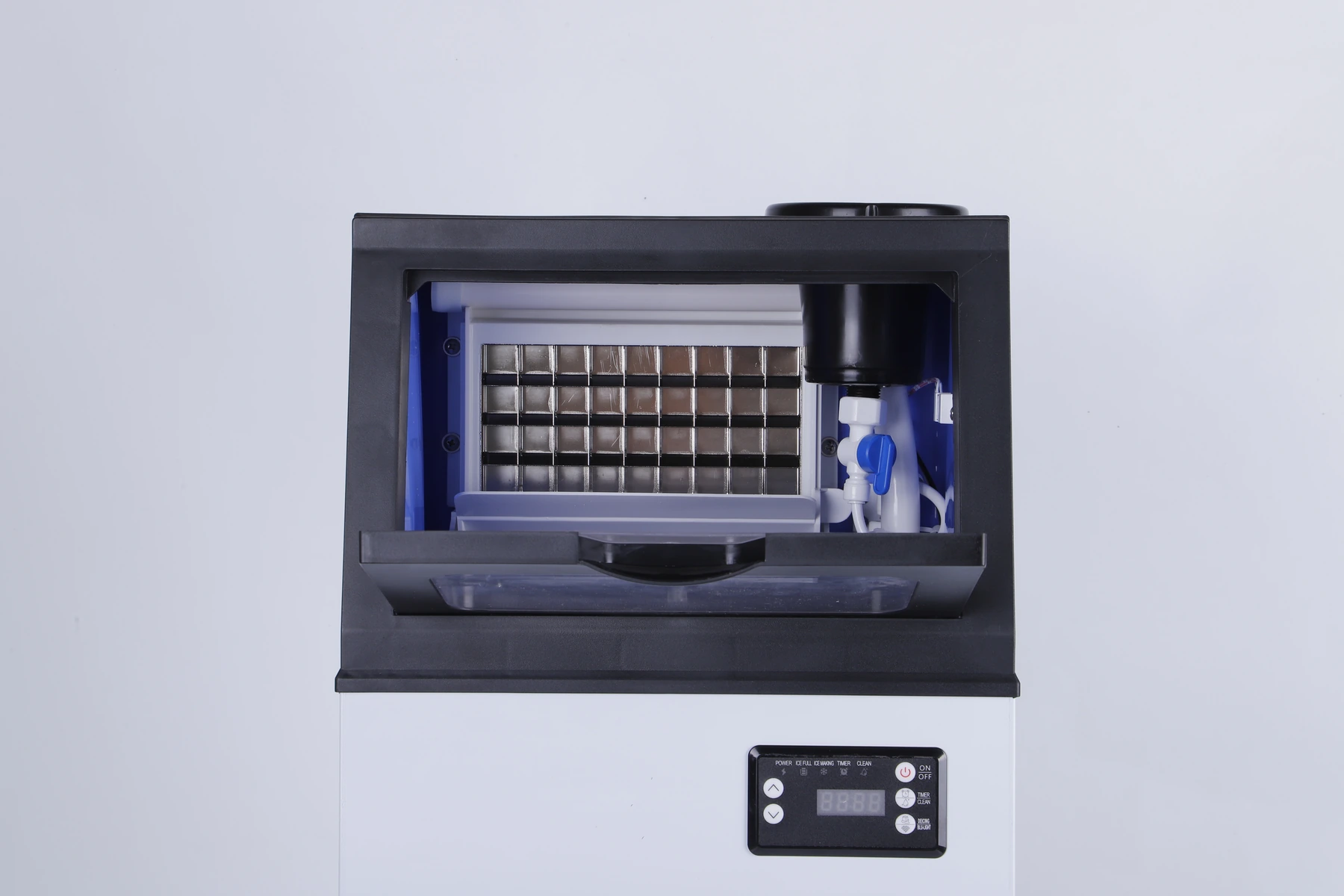
Do not transfer that pressure range to an unrelated model. Compare, do not guess.
If the pattern is uneven, follow the model’s approved commercial ice machine cleaning procedure and inspect the water system without substituting chemicals or concentrations. A repeated weak zone after cleaning may need pump, valve, or distribution diagnosis by service personnel.
Read the KT-36 results with their conditions
A September 18, 2023 KT-36 laboratory record followed one 4×9-grid sample with an FKA40ML compressor, 220 V/50 Hz supply, default setting, and 10°C inlet water at four conditions. Use those readings to compare operating conditions, not to set a fault threshold.
At 20°C ambient, the record shows a 15.25-minute complete cycle, 325-gram batch, 9.03-gram cube, and 30.69 kg/24h cycle-derived output. At 43°C, it shows 23.66 minutes, 265 grams, 7.36 grams, and 16.13 kg/24h.
| Ambient air | Inlet water | Complete cycle | Batch weight | Cube weight | Reported cycle-derived output |
|---|---|---|---|---|---|
| 20°C | 10°C | 15.25 min | 325 g | 9.03 g | 30.69 kg/24h |
| 32°C | 10°C | 18.75 min | 295 g | 8.19 g | 22.6 kg/24h |
| 38°C | 10°C | 20.5 min | 270 g | 7.5 g | 18.97 kg/24h |
| 43°C | 10°C | 23.66 min | 265 g | 7.36 g | 16.13 kg/24h |
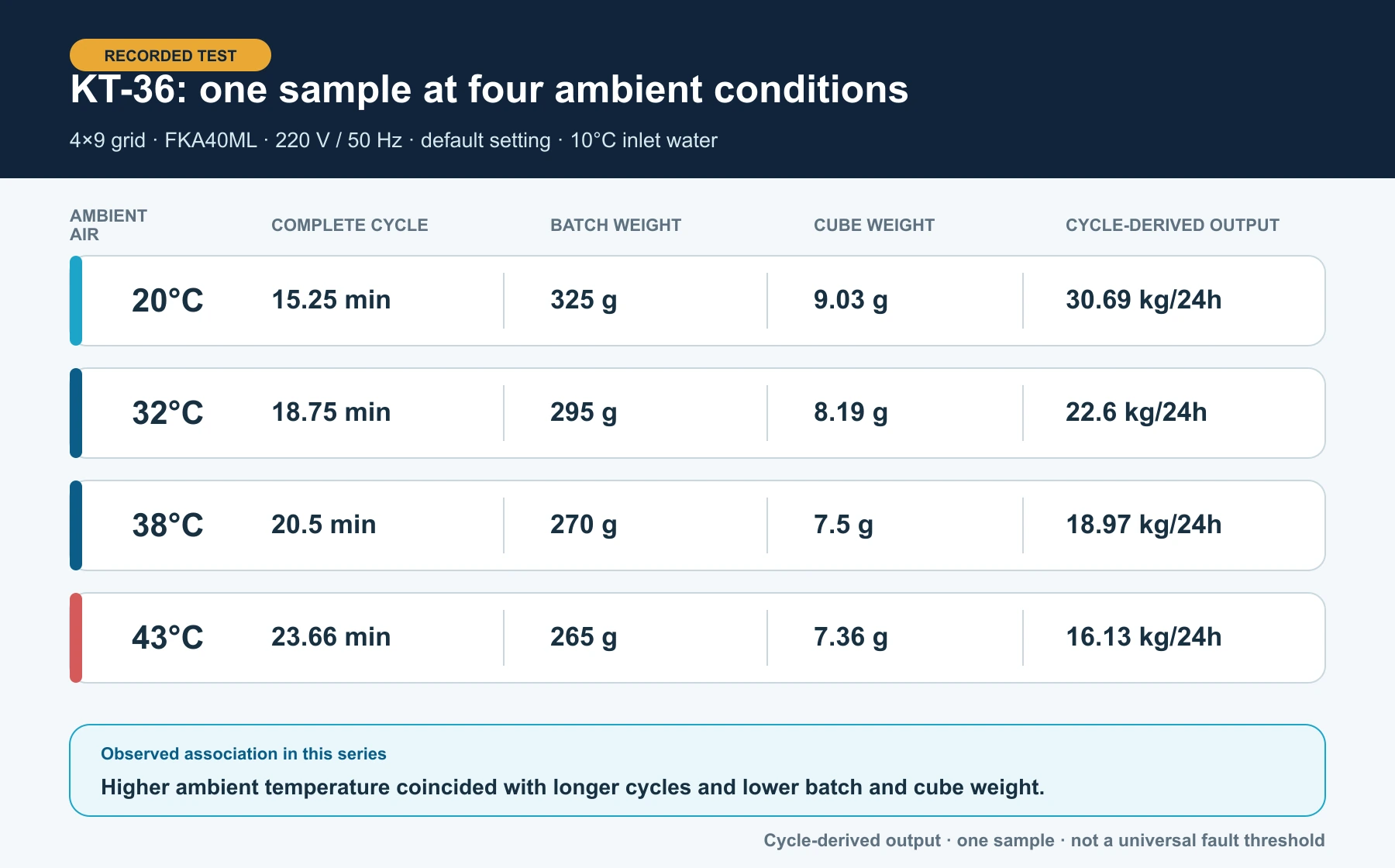
The commercial ice machine output and temperature guide explains the method, and the current KT-36 product page must be checked separately for the offered configuration. Use the four readings only for that documented sample and its stated conditions.
Soft, Wet, Slushy, or Fast-Melting Ice
Wet ice needs cycle-stage and storage observations before adjustment.
Distinguish production from storage
Observe whether cubes are already soft at release or become wet only after entering the bin. That distinction matters because incomplete freezing, extended harvest, warm storage, frequent door opening, poor drainage, and heavy demand can produce similar complaints through different paths.
Check the fresh batch first. Then inspect the bin.
Compare the current setting with the exact manual, but do not copy a number from another series. A thinner setting can shorten freezing on some controls, while another control family may encode thickness differently; technical support therefore needs the nameplate and displayed value before interpreting it correctly.
Confirm the intended ice type
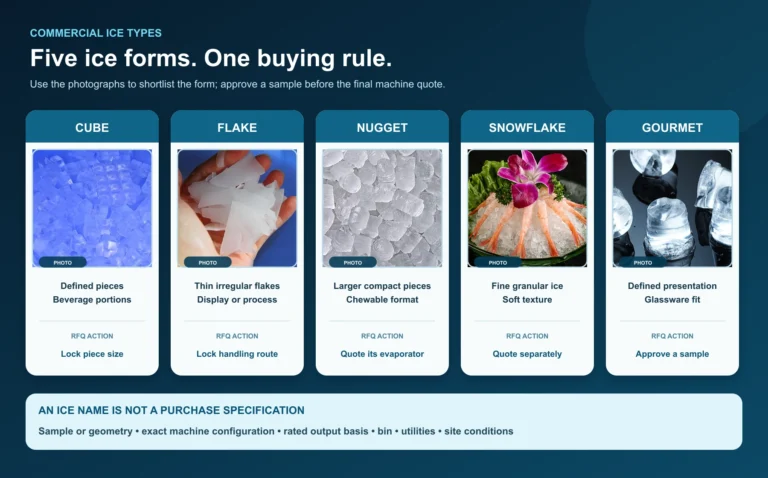
A commercial ice maker may produce cube, flake, snowflake, nugget, gourmet, or bullet ice, and those products should not share one texture standard. Buyers comparing a cube ice machine should use the approved cube shape, weight, and release behavior for the offered model, not expectations borrowed from flake or nugget equipment.
Cloudy, Discolored, Smelly, or Off-Tasting Ice
Appearance can guide inspection, but it cannot certify food safety.
Treat cloudiness as a clue
Air bubbles, particles, or dissolved material trapped during freezing can create a cloudy core, but keep the ice out of service when color, odor, taste, sanitation, or supply conditions change. Cloudiness alone does not mean the water is contaminated.

Compare ice with source water. Check the commercial ice machine water-quality guide for a structured review of source, treatment, filter, scale, and corrosion conditions.
Quarantine uncertain ice
Stop serving ice that has a new color, unusual odor, off-taste, visible soil, suspected chemical contact, or exposure to an unsafe water supply. Keep it out of drinks and food until the water source, machine food zone, storage bin, scoop practice, and local notices have been checked.
The FDA says ice used as food or a cooling medium should be made from drinking water. Covered components should be cleaned at the manufacturer’s frequency or often enough to prevent soil or mold under the FDA Food Code 2026. It is a model code, so operators must also follow local rules.
KAISON’s preventive-maintenance checklist can organize recurring inspections, but a checklist cannot identify a contaminant. Use the water utility, regulator, laboratory, or qualified service provider when safety remains uncertain.
Clumping, Bridging, Sticking, or Failed Release
Release symptoms must be separated from warm-bin clumping after harvest.
Observe where cubes join
A sheet leaving the grid with connected cubes points toward formation or thickness checks, while loose cubes bonding later in the bin point toward meltwater, heat, drainage, or door-use conditions. Record both moments.
The built-in-bin manual links clumped cubes or failed release with an unsuitable thickness setting, scaled spray passages, tank overflow, tray damage, or a harvest-valve fault. Only the first visible conditions belong to routine operator inspection; tray, valve, coating, electrical, and refrigeration work needs qualified service.
Never pry ice from the grid
Do not force a slab loose with hands, knives, screwdrivers, or other tools. This can damage the evaporator surface or coating and can expose the operator to sharp edges, moving components, hot surfaces, or energized areas.
Error codes are model-specific. For example, one built-in manual uses E04 for harvest timeout outside the 200P series and E06 for the 200P series after three cycles without release, while other manuals assign codes differently.
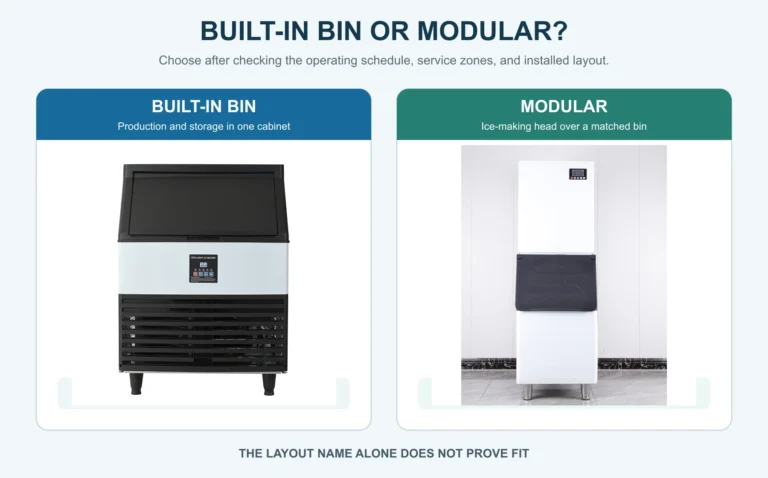
If the machine forms no usable ice, move to the dedicated commercial ice machine not making ice workflow. For integrated storage, compare the current built-in-bin range only after the fault is documented.
Normal-Looking Ice With Low Daily Output
Normal cubes can still arrive too slowly for operating demand.
Measure complete cycles and interruptions
Time at least one complete cycle, weigh the batch, record automatic stops, and note the busiest demand window. A clean cube does not reveal exhaust recirculation, condenser fouling, changing inlet water, restricted flow, premature bin-control stops, or long idle periods.
Measure before replacing equipment. Keep production and storage separate.
For an air-cooled ice machine, record temperature at the condenser intake and inspect its actual airflow path. A water-cooled ice machine shifts the condenser-side checks to the approved water circuit, flow, pressure, treatment, discharge, and local restrictions.
Compare equivalent conditions
The supplier should compare field logs with the offered model’s documented configuration, test condition, and measurement method, because a cycle-derived number is not a continuous 24-hour observation during stable operation on site. If demand exceeds verified production plus usable storage, the remedy may be sizing or reserve capacity, not repair.
Separate Staff Checks From Qualified Service
Operators should record facts without entering hazardous machine areas.
Staff-safe actions
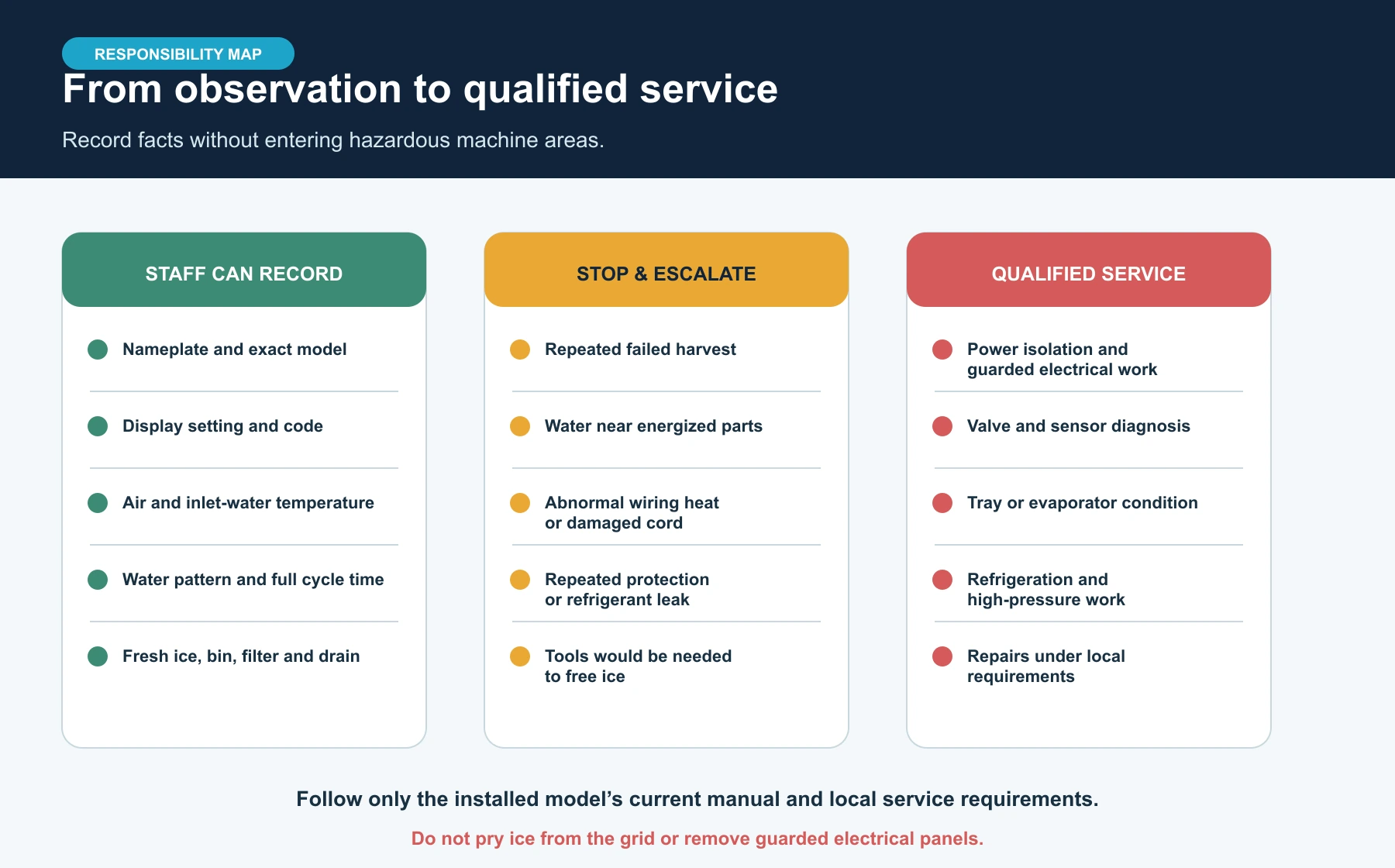
Staff can record the nameplate, displayed setting, code, air and water temperatures, water pattern, cycle time, fresh ice, bin condition, filter date, drain behavior, clearance, and door use before any panel is opened. They can perform only the cleaning and access steps authorized in the current manual.
Stop at the boundary. Do not remove guarded electrical panels.
Model pages such as the KX-55 cube machine and AP-300P modular cube machine help identify the product, but the supplied manual and ordered configuration control the procedure. Online similarity is not authorization.
Service-only conditions
Escalate refrigerant leaks, repeated high-pressure protection, abnormal wiring heat, damaged cords, water near energized parts, persistent harvest failure, deformed or corroded trays, failed valves, sensor faults, and refrigeration diagnosis. A qualified technician should isolate power and follow local requirements before service.
Send the Details Support Needs
A complete case record shortens diagnosis and improves replacement decisions.
Send one complete packet
KAISON support needs a video of the machine running, a clear model and nameplate photograph, purchase or order reference, current setting, error code, site temperatures, water details, cycle time, and photographs of fresh ice. Include what changed and when.
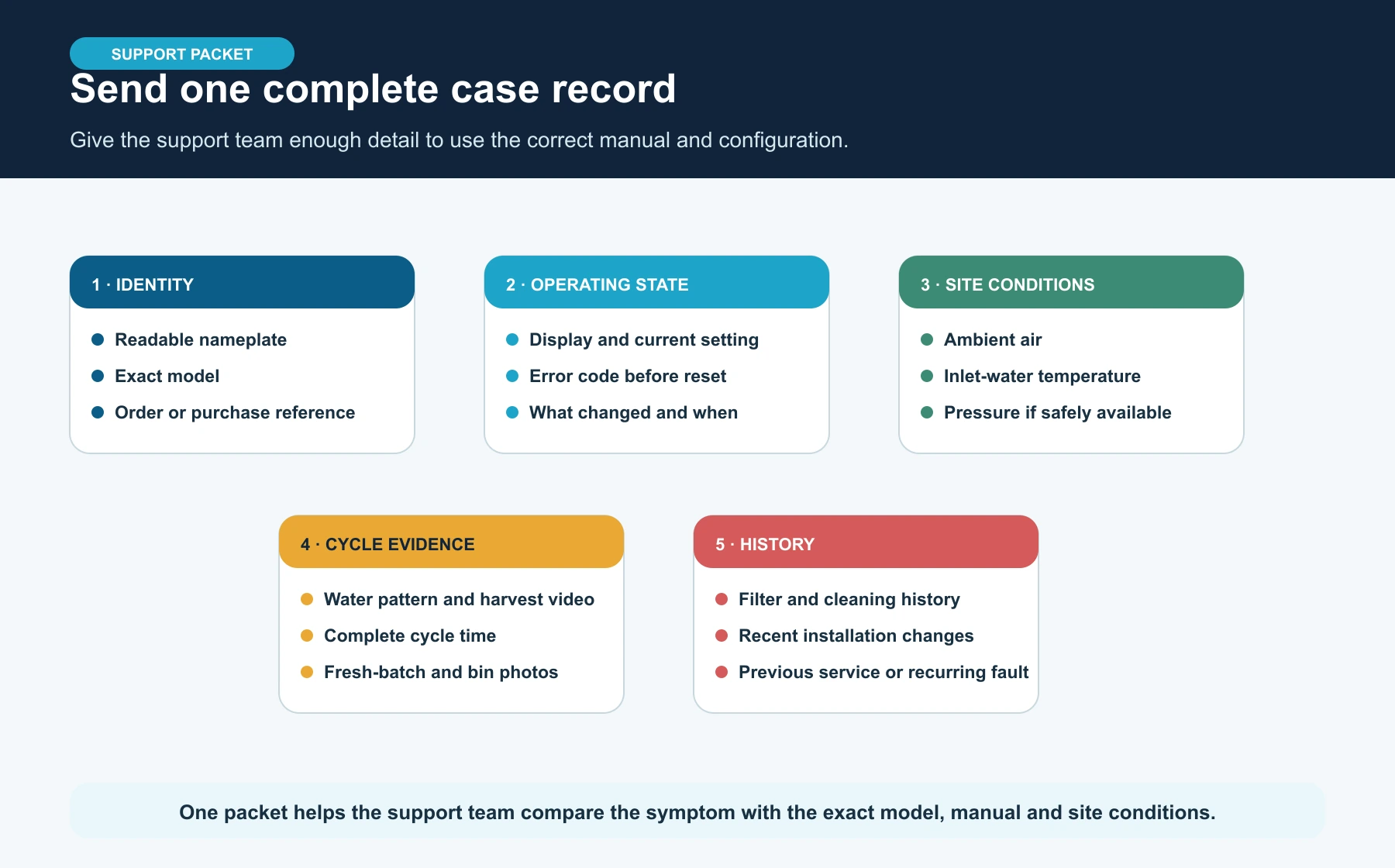
That packet lets the team compare the symptom with the manual, configuration, and available quality-control checks without treating a cube photograph as a parts diagnosis. Request applicable certification documents separately because compliance documents do not explain a field symptom.
Decide between correction and replacement
Correct installation, cleaning, water, setting, or maintenance issues when the approved procedure restores stable cycles. Consider replacement or resizing when verified demand, site conditions, service access, recurring repair cost, parts support, and documented capacity no longer fit the operation.
Review the commercial ice machine range before choosing a format, then send the complete case details through the technical inquiry page. Ask for a written model match and the test conditions behind its output claim.
- A 2023-09-18 KT-36 sample recorded 9.03 g per cube at 20°C ambient and 10°C inlet water.
- The same sample recorded 7.36 g per cube at 43°C ambient, with inlet water still held at 10°C.
- Its complete cycle increased from 15.25 to 23.66 minutes across those two conditions.
- One built-in-bin manual specifies 1–40°C ambient, 5–35°C inlet water, and 0.1–0.5 MPa supply pressure for its covered families.
- FDA Food Code 2026 treats drinking water and routine cleaning as core boundaries for ice used as food.
- E04 and E06 cannot be decoded safely without the exact model manual.
Frequently Asked Questions
These answers keep each action within the installed model’s limits.
Use them carefully.
No single symptom proves one failed component, so operators should combine a fresh-ice photograph with cycle timing, water pattern, displayed values, site temperatures, and the applicable manual before choosing corrective work.
Why is my commercial ice machine making thin or hollow cubes?
Thin or hollow cubes may follow uneven water coverage, restricted flow, scale in distribution parts, an unsuitable model-specific thickness setting, or site heat that changes the cycle. Record a fresh batch, the spray pattern, water level, ambient air, inlet-water temperature, complete cycle time, and displayed setting. Clean only by the current manual. If one area remains weak or the symptom repeats after approved checks, send the record to qualified service instead of increasing thickness blindly.
Is cloudy ice from a commercial ice machine unsafe?
Cloudiness alone cannot answer that question. Air bubbles, particles, or dissolved material trapped during freezing can make ice opaque, yet a clear cube can still be exposed to unsafe water or poor handling. Compare the ice with the source water and inspect the machine food zone and bin. Stop service when cloudiness appears with new color, odor, taste, visible soil, a water advisory, or an uncertain cleaning condition, then follow local food-safety requirements.
What should I do when ice smells or tastes unusual?
Remove the affected ice from service and prevent it from contacting drinks or food. Check whether the source water has the same change, confirm local water notices, review filter replacement, and inspect accessible food-contact areas and the bin under the approved procedure. Do not mask the problem with flavoring or assume a new filter solves contamination. If the source is unclear, request guidance from the water utility, regulator, laboratory, or qualified service provider.
Why do cubes clump into a slab or bridge?
Cubes may leave the grid connected because formation or thickness was abnormal, or they may bond later after partial melting in a warm, wet, or poorly drained bin. Capture the harvest and inspect the bin separately. KAISON service will also need the exact model, current setting, spray pattern, tank behavior, code, and fresh-ice image. Never break a stuck sheet from the evaporator with a tool; unresolved release faults require trained service.
Why does the machine form ice but not drop it?
A failed harvest can involve ice thickness, uneven water distribution, scale, tray condition, sensing, controls, a valve, or the refrigeration circuit. The code meaning and approved observations depend on the exact model. Record the display through the harvest stage and note whether any section releases. Do not pry the ice loose or reach behind guards. When release repeatedly fails, stop further experiments and provide the nameplate, video, settings, temperatures, and order reference to qualified support.
Why is output low even when the cubes look normal?
Daily availability depends on production rate, automatic stops, storage reserve, and demand timing. Normal appearance does not show condenser intake heat, exhaust recirculation, fouling, changing feed water, restricted flow, bin-control behavior, or downtime. Time a full cycle, weigh a batch, and log stops during the affected period. Compare those records with the same configuration and stated conditions, then decide whether the problem is maintenance, installation, service, or sizing.
Should staff reset the machine or change ice thickness first?
Not without the model-specific procedure. A reset can erase a useful code or operating state, and thickness controls do not use one universal scale across commercial ice machines. First photograph the code and setting, capture the symptom, and record one full cycle when operation is safe. Follow only the current manual’s authorized steps. If electrical damage, leakage, overheating, repeated protection, or failed harvest appears, stop and escalate instead of repeating resets or copying settings from another model.
What information should I send for technical support?
Send a readable nameplate photograph, order reference, video of the machine running, displayed setting, error code, ambient air, inlet-water temperature, water pressure when safely available, and complete cycle time. Add fresh-batch photographs, water-flow pattern, bin condition, filter history, and an installation view. State when the symptom began and what changed beforehand. A complete packet helps the support team match the correct manual and configuration, distinguish site conditions from service work, and recommend the next action.