KAISON Team
Built-In Bin vs Modular Ice Machines: Which Layout Fits Your Operation?
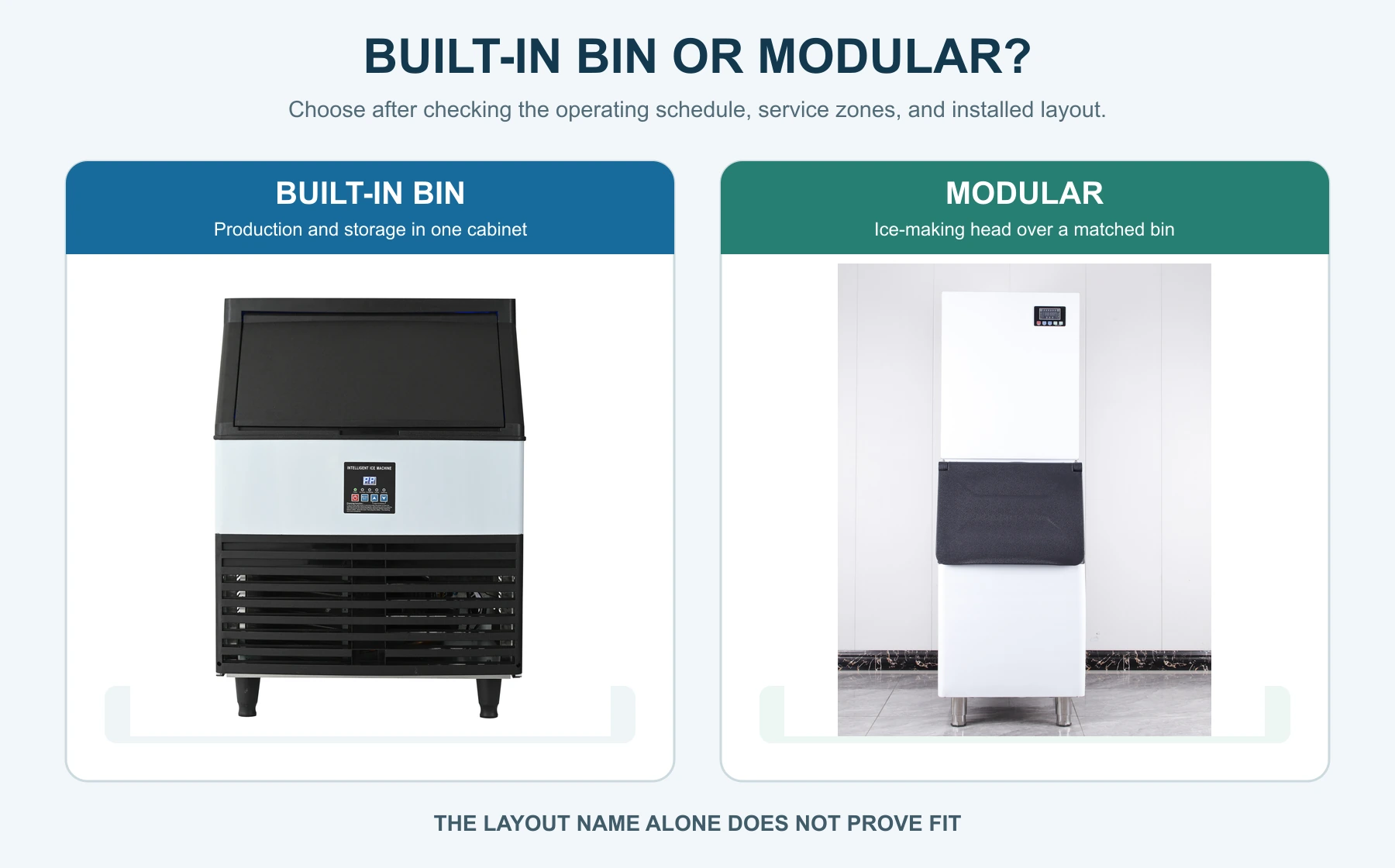
For buyers comparing built-in bin vs modular ice machines, layout drives the decision: choose an integrated cabinet when matched production and storage serve one location, and choose modular when they require separate selection. A central modular system may suit a large shared demand, while several point-of-use machines can shorten staff travel. Some operations need both. Before comparing models, record daily use, the busiest withdrawal period, opening reserve, refill time, service zones, utilities, and available access. Then compare the complete installed configuration, because a machine can meet the production target and still fail the site through incompatible components, excessive height, blocked bin access, or poor service clearance.
Built-In Bin vs Modular Ice Machines: Start With the Schedule
Start by recording how much ice moves through each service period.
Separate output, reserve, and distribution
Daily production replaces ice over time. Opening reserve covers withdrawals that arrive faster than the machine can produce, while distribution determines how staff move that stored ice to each service point.
Keep them separate.
A useful layout brief records the busiest realistic day, the heaviest continuous draw, the ice available before that draw, the minimum reserve, and the deadline for rebuilding stock before service repeats.
Use the commercial ice machine sizing guide to calculate those values before reviewing the commercial ice maker range. A daily kilograms figure alone cannot show whether one cabinet serves a three-hour rush or several separated workstations.
| Input | What to record | Why it changes the layout |
|---|---|---|
| Daily ice use | Measured kilograms for the busiest realistic day | Tests whether documented production can replace total use |
| Peak draw | Kilograms removed during the busiest continuous interval | Tests how much ready ice must be available before service |
| Opening reserve | Usable ice present when the peak begins | Shows the storage contribution to the peak balance |
| Recovery deadline | Time available to rebuild the chosen reserve | Tests whether the system can prepare for the next peak |
| Service zones | Every bar, kitchen, display, packing point, or floor supplied | Reveals whether ice should be made near use or distributed centrally |
| Ice type | The format required by each process | Prevents one layout from combining incompatible ice requirements |
How a Built-In Bin Ice Machine Fits Point-of-Use Service
An integrated cabinet works best when one location controls the demand.
Understand the fixed production-storage pairing
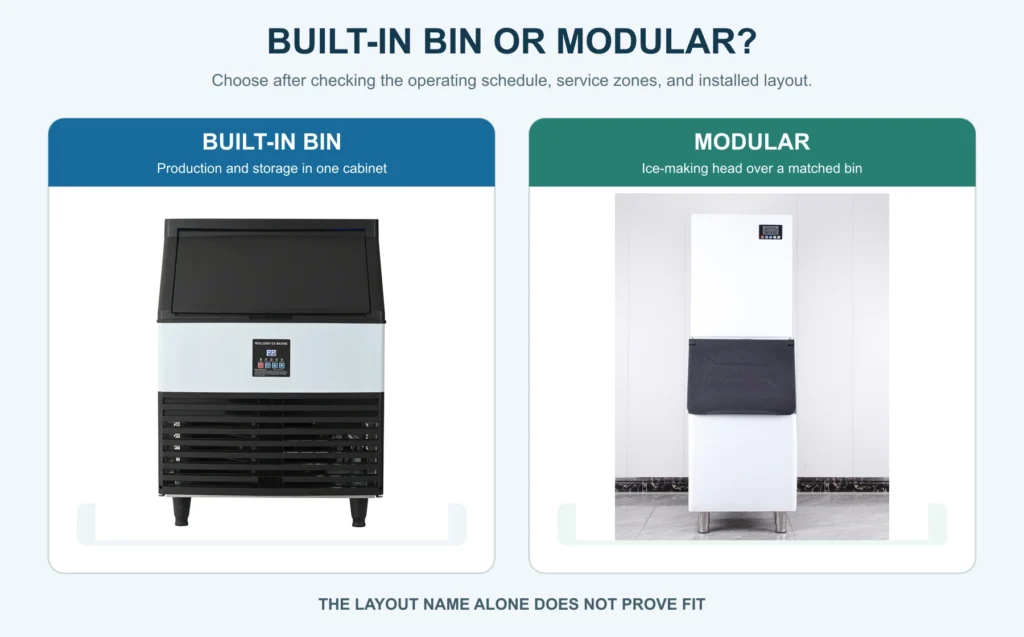
A built-in-bin ice machine places the ice-making system and insulated storage inside one factory-matched cabinet. The buyer compares one published production value, one bin capacity, and one complete set of dimensions.
That simplifies specification.
It does not prove capacity. The fixed bin must still hold the usable starting reserve, and the machine must replace withdrawals before the next operating period under the expected room and inlet-water conditions.
The current AP-260P cube ice machine illustrates this arrangement. Its published data lists 140 kg per 24 hours, a 45 kg bin, 500 W rated power, air cooling, and 660 × 680 × 915 mm dimensions.
Those specifications describe the offered configuration, not a recommendation for every site. A restaurant ice machine near one preparation area may follow a different withdrawal pattern from a bar ice machine beside several service wells.
Do not use `built-in bin` and `undercounter` as automatic synonyms. Some integrated cabinets fit below a counter, while taller freestanding machines require their own floor location and clear working space.
Choose this layout when the measured schedule fits its factory-matched production and storage, the cabinet belongs near the point of use, and staff can open, scoop, clean, drain, and service it safely.
When a Modular Head and Separate Bin Fit Better
A modular system separates ice production from the matched storage bin.
Select the head and bin as one system
This arrangement lets a project compare production and storage as distinct specifications. It can support a larger reserve, a central ice room, or a configuration whose bin is selected around a documented peak.
Flexibility adds checks.
The buyer must confirm head and bin compatibility, any required adapter, bin-control operation, total assembled dimensions, access to the bin, and enough room to remove or service the head.
A supplier response should state the head, bin, controls, adapter, cooling method, utilities, installed dimensions, rating basis, and access needs as one traceable configuration before the buyer compares price or signs the purchase order.
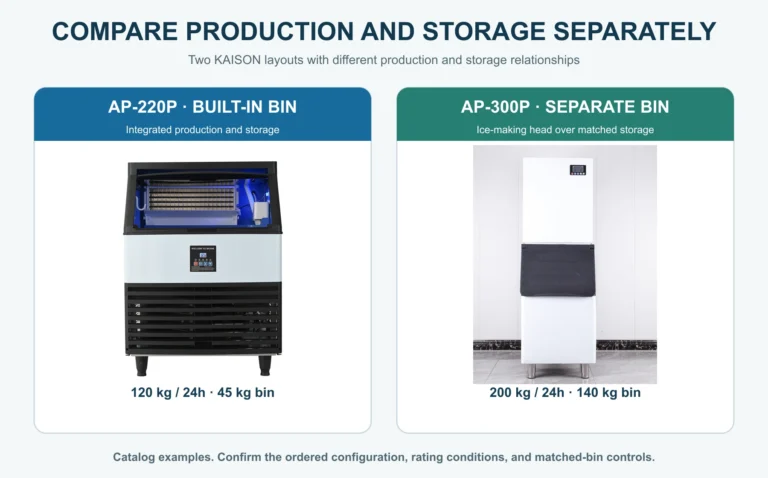
KAISON's modular ice machine category states that quotations include the ice maker and its matching storage bin. The current AP-300P cube ice machine is rated at 200 kg per 24 hours with a matched 140 kg bin.
Its published specification also lists 800 W, 560 × 830 × 1570 mm dimensions, and optional air-cooled or water-cooled configurations. Actual output can vary with room and inlet-water temperatures, so the quotation should identify the rating basis and selected build.
A modular layout is not automatically the better choice because it makes or stores more ice. It fits when the measured operating schedule benefits from separate production and storage selection, and the complete assembly passes the site review.
For a hotel ice machine, this may mean comparing a central supply with separate kitchen, banquet, and guest-floor demands. The transfer method and sanitation plan belong in that comparison.
Compare the Complete Installed Layout
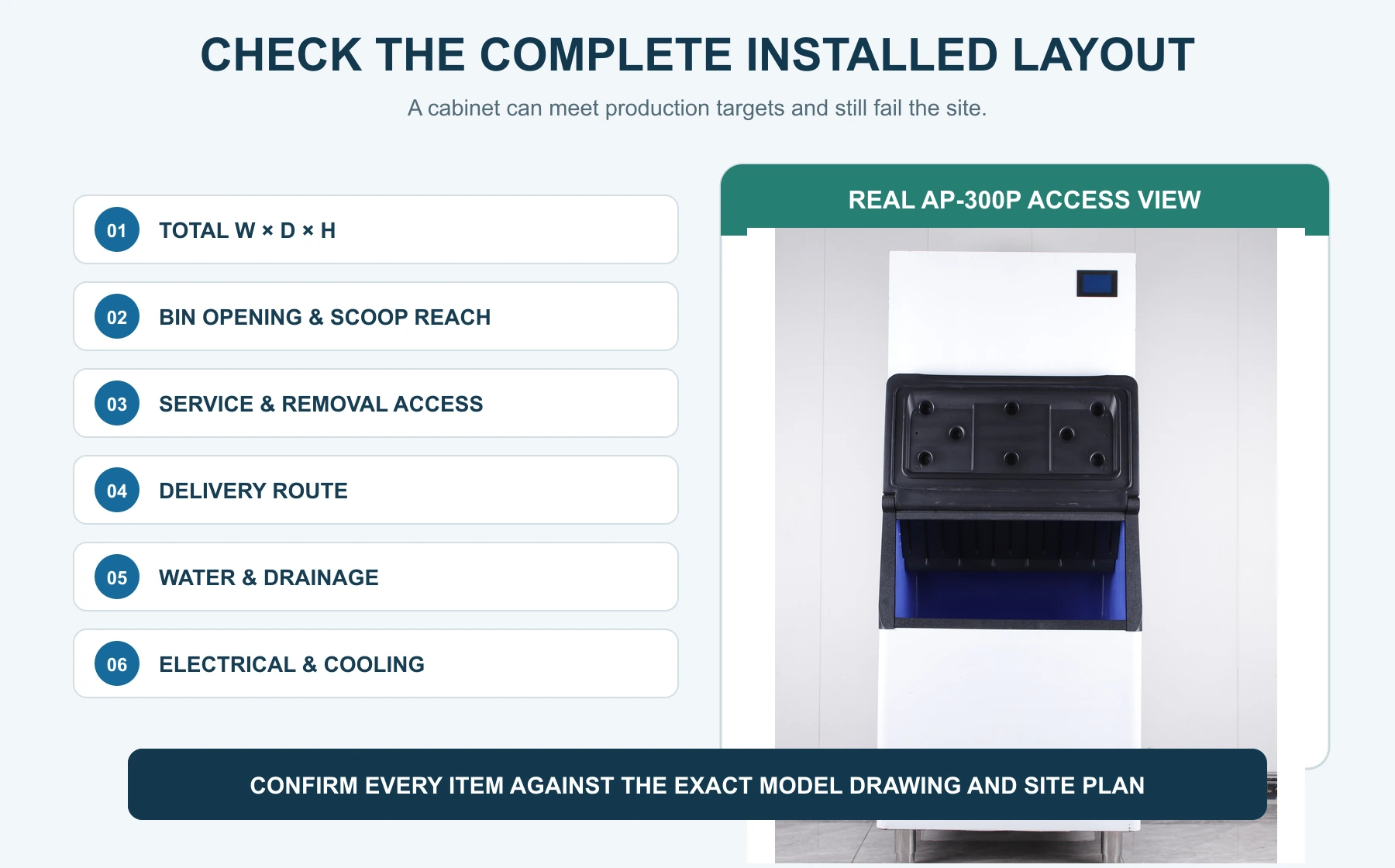
Measure the complete working envelope, not only the cabinet footprint.
Check movement, access, and utilities
Record the installed width, depth, and height. Add the space needed to open the bin, reach ice safely, remove panels, clean the interior, change filters, inspect utilities, and replace major components.
Trace the route.
The delivery drawing should include the narrowest doorway, lift, corridor turn, threshold, stairs, and final approach, because a cabinet that fits the room can still fail before reaching it.
A site passes only when the selected configuration reaches the room, connects to approved utilities, allows normal staff use, and remains accessible for documented cleaning and service work without obstruction.
Use the commercial ice machine installation requirements to organize the site review. Request the current model drawing for exact connections and clearances instead of applying a generic distance.
| Check | Built-in bin | Modular head and bin | Pass evidence |
|---|---|---|---|
| — | — | — | — |
| Complete dimensions | One cabinet width, depth, and height | Head, bin, any adapter, and total assembled height | Current model drawing and site plan agree |
| Ice access | Door or opening clears nearby equipment | Bin opening remains usable below the head | Staff can open, scoop, and close without obstruction |
| Service access | Panels, filter, utilities, and removable parts remain reachable | Head and bin can be serviced or removed in sequence | Service route is marked on the drawing |
| Delivery route | Cabinet clears every doorway and turn | Packed head and bin clear the route and can be assembled safely | Route measurements exceed the confirmed packed dimensions |
| Water and drainage | Connections match the exact model | Head, bin area, and condenser circuit are identified where applicable | Approved installation drawing shows each connection |
| Electrical supply | Voltage, frequency, phase, and circuit match the build | Complete system requirements match the available supply | Quotation and site electrical record agree |
| Heat rejection | Air path or cooling-water arrangement is documented | Selected condenser configuration has the required site provision | Cooling method and utility scope appear in the quote |
An air-cooled ice machine needs a suitable airflow and heat-rejection plan. A water-cooled ice machine adds condenser-water supply and discharge questions beyond the potable water used for ice.
Neither category link replaces the exact installation document. Local plumbing, electrical, food-service, ventilation, seismic, fire, accessibility, and building requirements remain project-specific responsibilities.
Choose Point-of-Use, Centralized, or Hybrid Ice Supply
Choose distribution around service zones, transfer steps, and recovery windows.
Map where ice is made and removed
One built-in-bin machine can serve a compact station when demand occurs nearby. A centralized modular system can combine production and storage where staff can distribute ice through a controlled back-of-house process.
Distance changes labor.
For every option, mark who collects ice, which container is used, how often staff travel, where spills can occur, and how the route stays separated from waste or contamination sources.
Multiple integrated machines may reduce travel but create more utility, cleaning, and service points. One central system can simplify production oversight, yet it may add transport work and a single supply dependency.
A hybrid layout uses each format for a different job. For example, central modular equipment may build the main reserve while a point-of-use unit supports a remote beverage station whose peak occurs at another time.
The hybrid decision needs measured demand for each zone. A café ice machine serving cold drinks should not inherit a hotel banquet schedule or a seafood display requirement without a separate record.
Compare the layouts with the application library. Include equipment, matched storage, installation, filtration, electrical work, ventilation or condenser water, labor, cleaning access, service visits, transfers, and backup planning.
Compare Two Current KAISON Configuration Examples
Current model data shows how the two configurations differ physically.
Treat the table as a shortlist
The two models below use published KAISON data checked against current category and product information. They illustrate configuration differences, but neither model is approved for a project until the operating and site records pass.
Context controls selection.
Read every value beside its model and conditions, because production, storage, power, cooling, and cabinet dimensions describe different parts of the operating and installation decision for a specific quoted build.
| Field | AP-260P built-in bin | AP-300P modular |
|---|---|---|
| — | — | — |
| Ice type | Cube | Cube |
| Published production | 140 kg per 24 hours | 200 kg per 24 hours |
| Published storage | 45 kg integrated bin | 140 kg matched separate bin |
| Rated power | 500 W | 800 W |
| Cooling configuration | Air-cooled | Air-cooled or water-cooled option |
| Published dimensions | 660 × 680 × 915 mm | 560 × 830 × 1570 mm |
| Layout implication | Production and storage are fixed in one cabinet | Head and bin form a taller matched assembly |
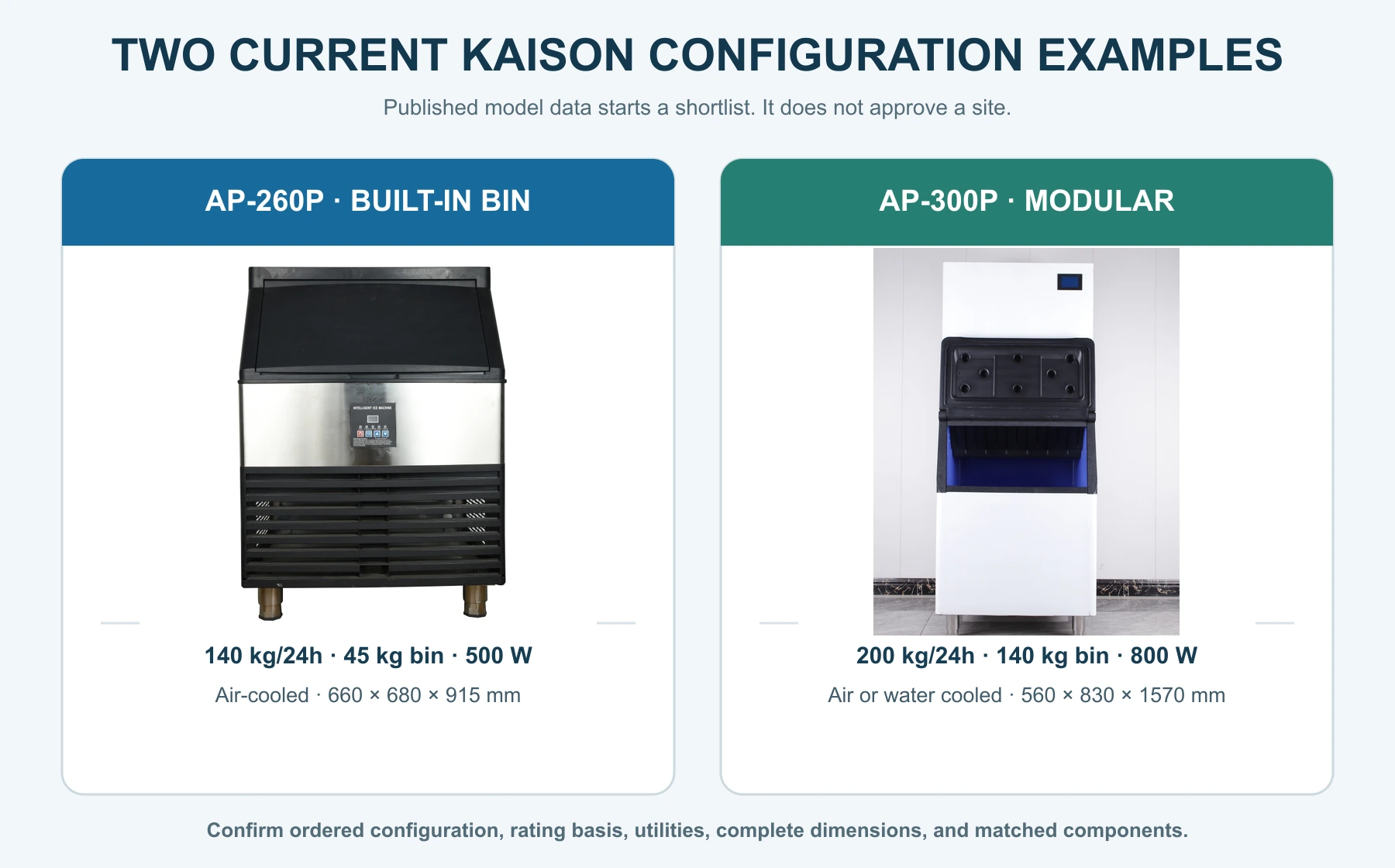
The AP-300P is narrower in the published comparison, but it is deeper and 655 mm taller. That contrast shows why width alone cannot decide fit.
The AP-260P stores less than its 24-hour production figure because production and storage describe different functions. The AP-300P's larger bin also does not raise its head's production rate.
Review the complete product range and cube ice machine category only after calculating demand and measuring the site. Keep the ice type, voltage, frequency, cooling method, rating basis, dimensions, and final head-bin pairing consistent across every supplier response.
Approve the Complete Configuration Before the Purchase Order
Make every supplier quote answer the same technical and commercial questions.
Standardize the response
Send the demand log, peak interval, opening reserve, refill deadline, ice type, operating hours, room and inlet-water conditions, destination, order quantity, site drawing, and photographs.
Name every component.
Ask the supplier to identify the exact ice-making head, storage bin, controls, adapter requirement, condenser configuration, electrical supply, rated output conditions, complete dimensions, utility connections, and documents covering the offered build.
| RFQ field | Required response |
|---|---|
| — | — |
| Operating schedule | Confirm how the proposed production and storage address daily use, peak draw, starting reserve, and recovery deadline |
| Complete configuration | State head model, bin model or integrated cabinet, ice type, cooling method, controls, and any adapter |
| Site fit | State installed and packed dimensions, weight, access needs, connection locations, and current installation drawing |
| Utilities | State voltage, frequency, phase, circuit requirement, water connections, drainage, filtration scope, and heat-rejection method |
| Performance basis | State the conditions supporting the published output and any limits relevant to the proposed site |
| Commercial scope | State quantity, price basis, included components, packaging, lead time, warranty, spare-parts scope, and exclusions |
| Documents | Identify the exact datasheet, manual, drawing, test information, and applicable compliance documents for the offered model |
The broader commercial ice machine buyer's guide can help compare suppliers. This layout article should remain the record for the physical arrangement, matched storage, service route, and distribution plan.
For this enquiry, keep the configuration request and the supplier response together so the proposed model, bin arrangement, utilities, dimensions, commercial scope, and supporting documents remain traceable through approval.
Do not approve a purchase order that names only a production class. The final line item should preserve the exact configuration and the documents reviewed, so receiving staff can compare delivered labels, components, and dimensions with the order.
- Choose an integrated cabinet when its fixed production and storage match one measured service location.
- Choose modular when production and storage need separate selection as a compatible, documented system.
- A 140 kg/24h machine with 45 kg storage illustrates why daily production and ready ice are different specifications.
- A 200 kg/24h head with a 140 kg bin still requires peak, recovery, access, utility, and compatibility checks.
- Compare complete installed height, bin access, service route, cooling, utilities, and quote scope before approving any layout.
Frequently Asked Questions
These answers turn common layout questions into verifiable purchase checks.
Resolve the decision before requesting prices
Use each answer to identify a missing measurement, drawing, specification, or operating input. A layout recommendation becomes useful only when the buyer can trace it to the same demand record and site plan.
Verify first.
A KAISON layout recommendation should point to the operating schedule, site drawing, quoted configuration, current model documents, and delivered equipment that the buyer can verify before final acceptance at the site.
What is the difference between a built-in-bin and modular ice machine?
A built-in-bin machine combines ice production and insulated storage in one factory-matched cabinet. A modular system places an ice-making head over a separate compatible bin, so production and storage can be specified as distinct parts of one system. The integrated format can simplify one point-of-use installation. Modular equipment can support a different storage relationship or central supply. Neither label determines capacity by itself. Compare the operating schedule, complete dimensions, utility requirements, access, rating basis, and exact quoted configuration.
Is a built-in-bin ice machine the same as an undercounter machine?
Not always. `Built-in bin` describes a cabinet that contains both the ice-making system and storage. `Undercounter` describes where a machine fits and usually imposes a counter-height limit. Some integrated units are designed for undercounter use, while other built-in-bin machines are taller freestanding cabinets. Confirm the published height, required ventilation, door movement, utility positions, and counter details. Do not rely on a search synonym or product photograph when the installation depends on a measured opening.
Does a modular ice machine always produce more ice?
No. Modular refers to the separate head-and-bin arrangement, not a guaranteed production level. Many modular ranges serve higher production classes, but the selected head's documented output and site conditions still control the comparison. An integrated model may suit a smaller measured schedule, while a modular model may suit a larger reserve or central supply. Review daily use, peak draw, refill time, room temperature, inlet-water temperature, cooling configuration, and the final rating basis before comparing capacities.
Can any ice-making head fit any storage bin?
No. A similar width does not prove mechanical, structural, control, sanitation, or warranty compatibility. The supplier should confirm the head and bin as a matched combination and identify any adapter, bin control, mounting hardware, complete height, access requirement, and documentation. If an existing component will remain, send its model, label photographs, dimensions, opening details, and condition. Do not order a replacement component until the responsible supplier confirms the exact pairing in writing.
How should I size storage for peak demand?
Begin with the busiest continuous interval. Record usable ice at the start, confirmed production during that period, total withdrawals, and the operator's chosen minimum reserve. The ending balance equals starting usable ice plus interval production minus withdrawals. Repeat the calculation for each peak, then test whether the machine rebuilds the planned reserve before the next one. Nominal bin capacity is not automatically usable ice. Access, control position, operating practice, cleaning, and the selected safety minimum affect the working result.
When does a hybrid ice-machine layout make sense?
A hybrid layout can fit an operation with service zones that differ in demand timing, ice type, travel distance, or backup needs. Central modular equipment might build the primary reserve while an integrated machine supports a remote point of use. Test each zone separately before combining the plan. Record transfers, containers, labor, utilities, cleaning ownership, downtime response, and the risk of one shared supply. A hybrid layout should solve a documented workflow problem, not add equipment without a measured purpose.
Which installation dimensions should I confirm?
Confirm the assembled width, depth, and height, plus the packed dimensions for delivery planning. Measure doorways, lifts, turns, thresholds, stairs, and the final approach. At the installed position, account for the bin door or lid, operator reach, nearby counters, service panels, filter replacement, utilities, drainage, ventilation, head removal, and future equipment removal. Request the current model drawing for exact connections and clearances. The published cabinet footprint alone does not describe the working envelope.
What should I send with a layout-specific quote request?
Send the busiest-day use, peak withdrawal interval, opening reserve, minimum reserve, recovery deadline, ice type, operating hours, room and inlet-water conditions, utilities, destination, and quantity. Add a dimensioned site drawing, route measurements, and photographs of the location and connections. Ask for the exact head and bin or integrated model, cooling method, electrical supply, dimensions, compatibility, adapters, output basis, installation documents, included components, warranty, lead time, and exclusions. This creates a comparable supplier response.
Send a Layout-Specific Ice Machine RFQ
Send the operating schedule and site record before requesting a model.
Make the recommendation traceable
Attach the demand worksheet, dimensioned layout, route measurements, utility details, site photographs, destination, required quantity, and preferred order timing. Identify every service zone and any existing equipment that must remain.
One package is enough.
Use the KAISON contact page to request a configuration that states the exact machine, storage arrangement, cooling method, electrical supply, dimensions, included components, output basis, documents, lead time, and exclusions.